 Written by
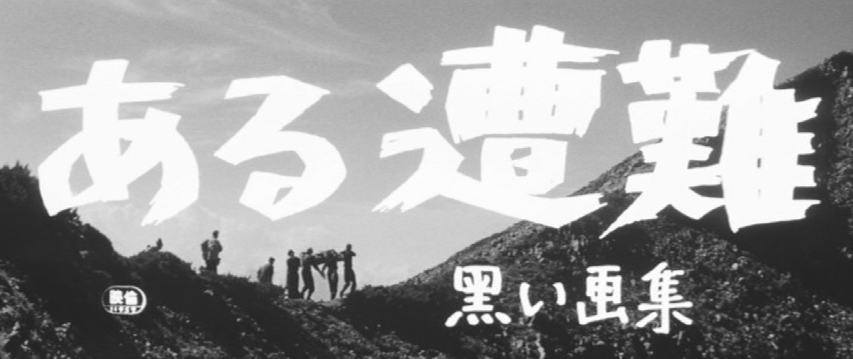
 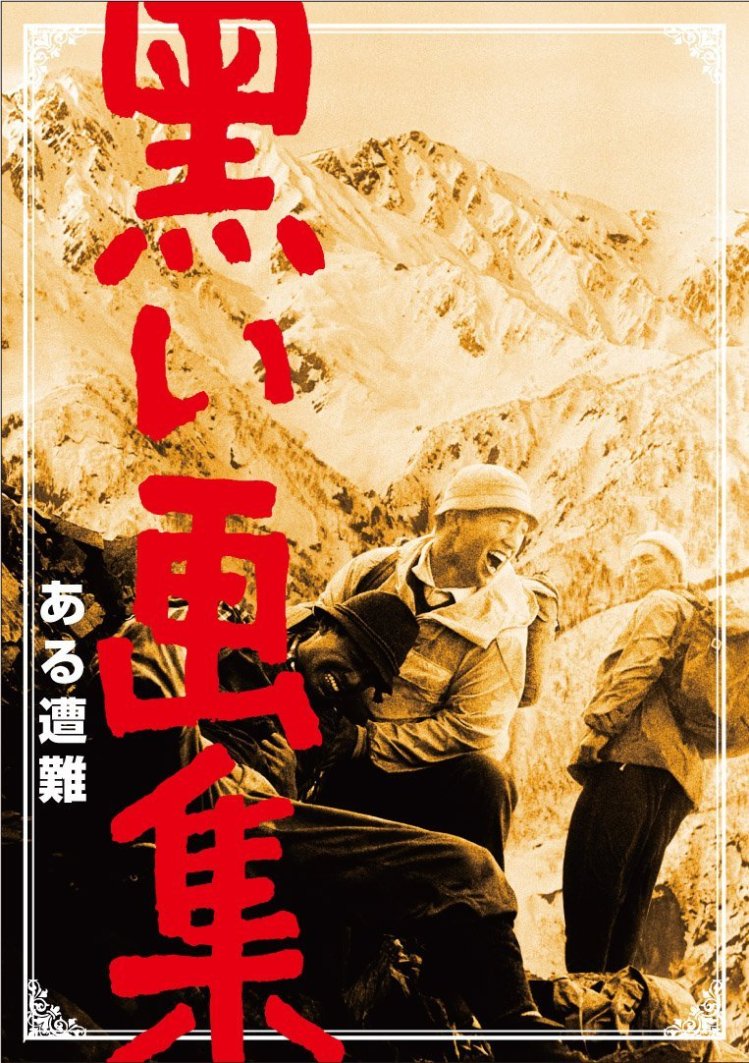 There can be few films with as accurate a title as Death on the Mountain (黒い画集 ある遭難, Kuroi Gashu: Aru Sonan) , but Toshio Sugie’s 1961 psychological melodrama certainly makes good on its promise. The Japanese title of the film is prefaced by “The Black Album” which is a title given to a series of novellas penned by one of Japan’s most prominent mystery writers, Seicho Matsumoto, whose work was frequently adapted for the screen including eight collaborations with director Yoshitaro Nomura of such well known mysteries as Zero Focus and Castle of Sand. Death on the Mountain was, like the others in the Black Album series, serialised in Shukan Asahi, in this case between 5th October and 14th December 1958 under the title “Sonan”. “Sonan” literally means “distress” or “disaster”, but it has another telling association – “Sonanshi”, meaning “accidental death” such as might occur while mountain climbing, sailing, or engaged in some other dangerous yet normalised activity. The death at the centre of Death on the Mountain is accidental in once sense, but very much not in another.
The film begins with a body being winched from a lower platform back up to a snowy ridge. Iwase (Kiyoshi Kodama), an experienced mountain climber, has perished in a freak accident. Packed inside his backpack, Iwase’s body is burned at the foot of his beloved mountains while his mother looks on sadly, his sister Masako (Kyoko Kagawa) angrily wondering how her brother, a true mountain man, could have died in such a bizarre way while a much less experienced climber, Urahashi (Takashi Wada), survived. The secret may lie with the leader of the expedition, Eda (Hisaya Ito), who has been looking sheepish ever since the incident but otherwise comports himself in a cool, detached manner.
Like many of Matsumoto’s mysteries, Death on the Mountain turns on a secret but Sugie’s adaptation never seriously considers that Eda is not in someway at fault or questions that Urahashi’s recollection of events, published in a popular mountaineering journal, is anything other than accurate. The facts, as laid out firstly by Urahashi’s article, state that Iwase had not been himself on the day of the climb. Eda had treated them all to first class sleeper cabins but Iwase spent the night drinking, chain-smoking and brooding, meaning he was tired before they even arrived at the mountain. He didn’t sleep at the inn either because of someone whispering all night long and needed to take frequent rests during the early part of the climb. Resting is, however, dangerous – as is excessive thirst, and Iwase spent a lot of time guzzling water and sitting down all of which made him even more exhausted. Coupled with a turn in the weather which left him cold and wet, Iwase’s exhaustion got the better of him and he finally lost his mind. At least, that’s the way Urahashi described it, and Eda seems not to dispute his version of events even if the failures – not bringing a map for both mountains they intended to climb but only one, pressing on despite the weather, and mistaking the trail back to the standard path, all rest squarely with him.
Japanese mysteries by and large are much more concerned with the how rather than the why, though in Death on the Mountain the how is a much greyer area than one might assume. As Masako’s cousin, an experienced mountaineer himself, points out, Iwase’s death was caused by a series of unfortunate circumstances but that doesn’t necessarily preclude that there was ill will or that someone didn’t help the “unfortunate circumstances” along in the hope that they would lead to the “accidental death” of the title. There was, therefore, not quite a murder but definitely a lot of ill will and gentle coaxing towards an act of guilty self destruction. As for the why, well that turns out to be far less interesting and suitably petty. Morally speaking, the act of “murder” becomes moot, though the “murderer” finally meets justice head on, only for the tale to end on a note of ambiguity as Masako, whose investigations have resulted only in further deaths, blames herself for daring to disturb the peace. If she’d only have let the “murder” of her brother lie, no one else would have died. Is Masako now an accidental “murderess” or a frustrated seeker of justice? Whatever the answer, all her efforts have been in vein.
Death on the Mountain was previously adapted as a TV drama shortly after the novel’s release, broadcast between 31st August and 7th September 1959, though presumably with lesser production values than Sugie’s admittedly minimal yet authentically detailed exploration of modern mountaineering. Shooting on location and making much of crunching snow, swirling fog, and pelting rain, Sugie runs high on atmosphere but fails to capitalise on the noirish sense of malevolence that lies at the centre of Matsumoto’s mystery, that evil can come dressed as kindness and the line between murder and accident is much thinner than might otherwise be presumed. Matsumoto seems to want to ask a few questions about causality and personal responsibility, the degree to which a man’s death is his own failing, how much the fault of “unfortunate circumstance”, and how much ill intentions from the world around him. Sugie, however, is content to let the suspense peter out with the solution offered in true detective style through a suppositional monologue delivered in front of the presumed murderer but for the audience’s benefit. Nevertheless, even if the mystery falls flat the mountain air rings true and Sugie has, at least, captured something of nature’s awesome power and terrifying beauty.
 Windows on Worlds
What were some of the other films in the “Black Album” series? I’ve been unable to trace this reference. I assume this series is specific to Toho, and isn’t the same as the “black” series from Daiei (e.g., “Black Test Car”, “Black Casebook”, “Black Weapon” and so on). I’d be very interested if you could point me in the right direction!
It’s not a film series, exactly. It’s the umbrella name for the series of short stories Seicho Matsumoto was publishing in Shukan Asahi. Two of the other stories were also adapted as films by Toho with the Black Album prefix:
Kuroi Gashu: Aru Salaryman no Shogen (黒い画集 あるサラリーマンの証言, lit. “Black Album: Testimony of a Salaryman”), Hiromichi Horikawa, 1960
Kuroi Gashu: Kanryu (黒い画集 寒流, lit. “Black Album: Cold Current”), Hideo Suzuki, 1961. Also known as Structure of Hate.
Ah, I see – thank you for the information! I’ve been watching as many of the Japanese film adaptations of Matsumoto’s work as I can find this year, and have managed to watch about a dozen. The quality seems uniformly respectable, and even the less successful films are extremely watchable.
I was able to find “Testimony of a Salaryman”, under the title “The Lost Alibi”, and enjoyed it a great deal. Unfortunately, “Structure of Hate” doesn’t seem to be available in the usual places online – but I’d love to get hold of it somewhere!
I rate Nomura’s Kichiku (“The Demon”) and Watanabe’s Kuro no honryu (“Cross-currents”, aka “Black Torrent”) very highly. The former was genuinely shocking and compelling, and the latter was a masterclass in building tension. I also loved that Kiri no hata (“Flag In The Mist”, aka “The Trap”) had the courage to end darkly.
Most disappointing for me was Suna no utsuwa (“The Castle of Sand”) which, despite its accolades and high ratings, I found ploddingly paced and poorly structured (and felt that Nomura also failed to capitalize on the talents of Tetsuro Tamba and Go Kato). However, in this case, the problem might be the source material – I read the English translation of the original novel years ago, and recall that it, too, was a bit of a slog.
(And an honorable mention to Seijun Suzuki’s Kanegaki koe (“Voice Without A Shadow”), which was sort of by-the-numbers, but had so many hints of his developing style that it was impossible not to enjoy it. Plus Nobuo Kaneko is one of my favorites.)
Thanks for taking the time to respond! If you have other opinions on Matsumoto adaptations, I would love to read them! (And will be searching the blog for them, too, so please don’t feel like you have to repeat yourself!) And: if you have any suggestions for really good Matsumoto adaptations, I’d love to hear those, too!