 Written by
The closure of a second-hand bookshop leaves a gaping hole at the centre of a community in Kota Nakamura’s warmhearted documentary, Polan (ポラン). Driven to close their physical shop because of the ongoing economic effects of the pandemic, an elderly couple contemplate changing times but still hope to save something of paper culture and the organic pleasures of offline browsing from unexpected discoveries to serendipitous friendship and the comfort to be found in having a familiar place you can be certain of returning to.
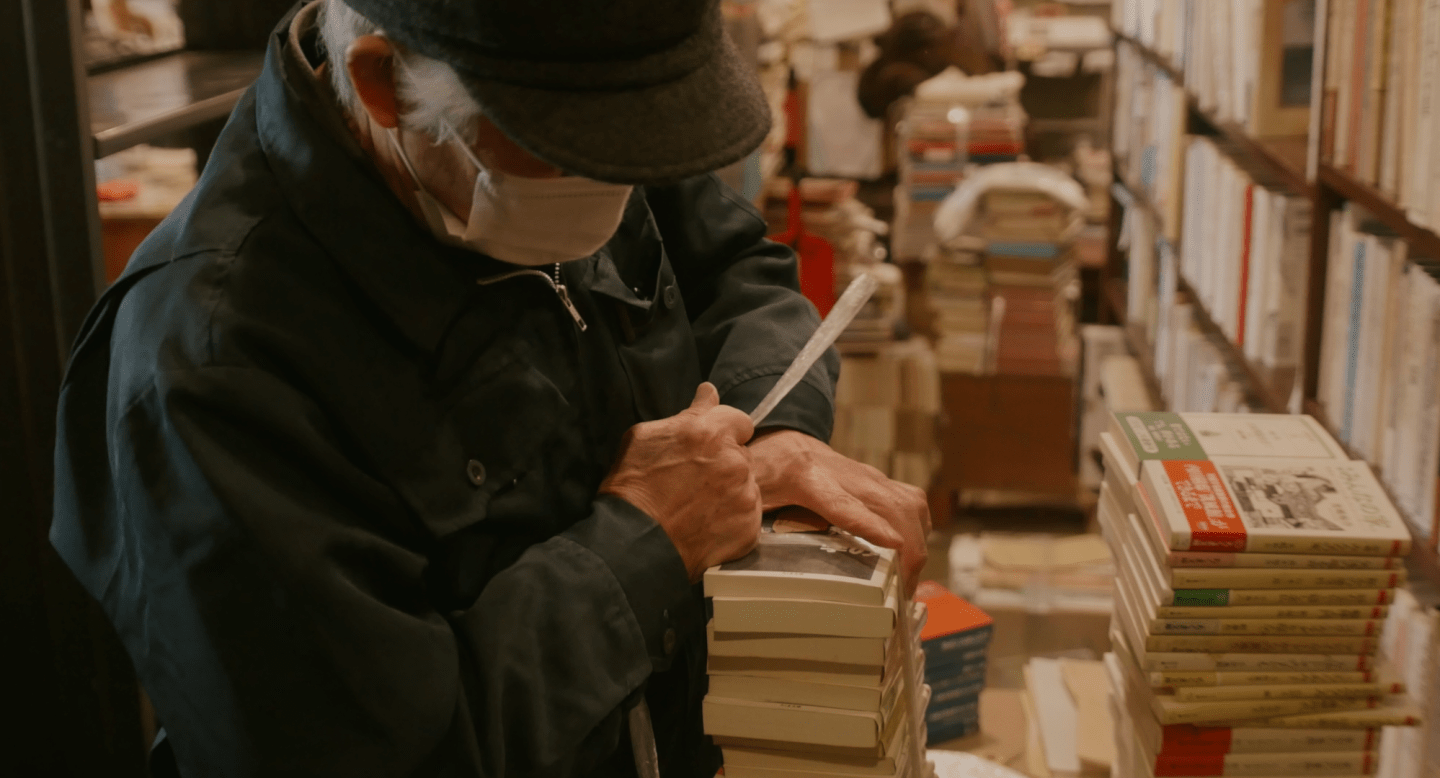
As he explains, Kyosuke Ishida found himself disillusioned when most of his fellow student protestors ended up getting regular salaryman jobs. He wanted to prove he was different, so he dropped out and started working as a tutor at cram schools before eventually deciding to open a small second-hand bookshop. The shop was so successful that they later moved to larger premises, but footfall began to fall during the pandemic while online sales remained constant. With his wife Chiseko who runs the bookshop with him already feeling the physical strain of their work and the landlord upping the cost of their lease, the pair eventually decide to close up though Kyosuke has mixed feelings and would have liked to continue a little longer.
More than the books, what the shop offers is a sense of community. Some customers tearfully remark that they’ve grown up with the store and feel themselves bereft while others share happy memories of browsing the shelves. The store itself is like a place out of time, decorated in a whimsical, antique style from the fretted front window to the antique clock on the wall and old-fashioned dolls sitting on the cases. As they’re fond of pointing out, everyone is welcome at the store and they pride themselves on providing a diverse selection of books rather than just the things they particularly like or know will sell well. Kyosuke devotes whole shelves to each genre and keeps them all well stocked rather than prioritise sure sellers ensuring that rare books are always available.
As he says, part of what he’s trying to save is paper culture. If you know what you’re looking for, then of course you can find it online right away and have it delivered quickly and cheaply. But perhaps something’s been lost in the drive towards convenience. Kyosuke remembers taking a lengthy train journey as a child during which they had to temporarily disembark in an unfamiliar place but that doesn’t happen with the Shinkansen where you can’t even open a widow or see much of the world around you as you rocket through it. As he sees it, you might have a happier life taking a more difficult path, much as he has opening a bookshop, discovering small things along the way rather than opting for easy convenience. He wants people to experience the thrill of the inconvenience of turning a page, along with “the joy of searching and pleasure of encountering” that can only be found with a physical experience in a real world bookshop.
Nevertheless as he admits times have changed and we’re entering a new and unknown post-pandemic world. He regrets that the bookshop can’t go too but consoles himself with the knowledge it’ll exist online. There is however continuity as their employee, Minami, decides to open a bookshop of her own taking some of the same sentiments with her in providing another community hub open to a diverse collection of book lovers in pleasant surroundings. Revisiting the location a year later, Nakamura discovers the shop space still vacant. Its bare industrial walls are somehow devoid of life. It’s difficult to believe the bookshop with its whimsical old world charm once existed there. It takes just 20 days to demolish it with the shelving and other furnishings taken by other store owners such as Minami and a distant relative in another town suggesting that the shop itself lives on, moving in a cycle much the books though some of those are unfortunately pulped as last resort. A gentle tribute to a disappeared local institution, the film ponders on what we’re losing in the post-pandemic world along with what our love of convenience may be costing us in a warmth and sensation otherwise unavailable in our rapidly digitising world.
Polan screened as part of this year’s Camera Japan.
Original trailer (no subtitles)
 Windows on Worlds