 Written by
When a snow leopard breaks into a herder’s pen and kills nine of his castrated rams, the herder traps it and effectively holds the animal hostage in the hope of gaining compensation in Pema Tseden’s mystical drama Snow Leopard (གསའ།). He is reminded that the snow leopard is a “first class protected animal” but understandably asks who’s going to protect him, why is the snow leopard’s life so much more important than his own?
Prone to angry rants, Jinpa (Jinpa) is more often than not portrayed as a snow leopard himself grunting and struggling to get free when the forestry police attempt to restrain him. He says that the herders and local wildlife used to live in harmony. If a snow leopard eats one or two sheep, then they just accept it but as climate change and other environmental forces have pushed them further down the mountain Jinpa feels the snow leopards in particular have become greedy and must be stopped. He wants to kill the snow leopard in revenge and refuses to let it go until the government agrees to compensate him for his financial loss. His rage is such that it’s economically irresponsible, calling in a local man with a digger to rescue the remaining sheep and telling him that it’s fine if one or two die while agreeing to pay the same price as the sheep is worth to have him try to rescue them.
Jinpa’s brother, a monk obsessed with photographing snow leopards, and father are each of the opinion that it’s spiritually irresponsible to keep the snow leopard bound up as it is the embodiment of the spirit of the mountains. It’s possible to read Jinpa’s animosity towards it as rage against the natural world and his fierce, almost mad diatribes against it as a kind of irrational hatred. Yet like him the snow leopard contains dualities. The one in the pen has a cub on the mountainside and seems to be capable of true tenderness though also violent carnality in its attack on the sheep. Jinpa more than anyone seems to be aware that the snow leopard is simply being what it is, but cannot forgive it for this very personal act of betrayal.
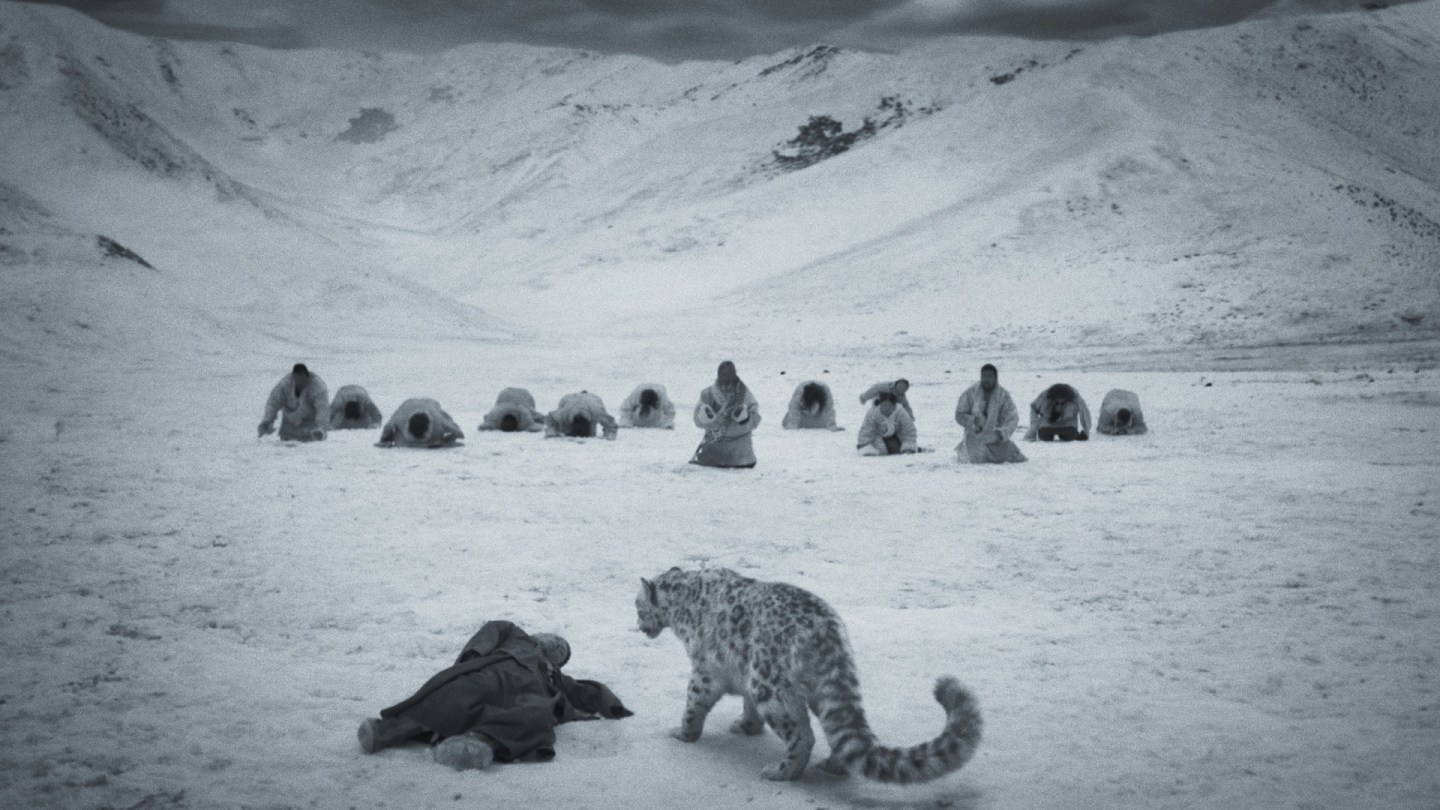
The monk, meanwhile, has a unique relationship with the captive snow leopard segueing into a surreal black and white sequence in which he eventually sets it free and is rewarded for his act of kindness. This seems to hint at the ways in which human life and animal could coexist but also at the essential spiritual quality of the snow leopard as a symbol of something elemental along with the roots of traditional Tibetan culture which are now on the brink of eclipse. A TV news crew tipped off by the monk with whom the reporter went to school turn up to capture these bizarre events but appear uncertain as to what they’re actually filming. The cameraman is frequently so awestruck that he forgets to film anything while the reporter is constantly fending off calls from his girlfriend.
A farcical stand off occurs when representatives from the government turn up, seemingly looking down on Jinpa and irritated by his demands for compensation while insisting that the snow leopard must be released. He refuses to give in even as they remind him that if anything happens to it, it’s him that will be held legally responsible. The forces of authority are also intruders, making an incursion from the world of modernity much as the snow leopard descends from the mountain and the ancient past. Men like Jinpa occupy a liminal space, caught between the old and the new while their way of life is increasingly threatened by the forces of modernity.
In a way, perhaps you could say the monk is trying to capture the snow leopard too even as he shares a special affiliation with it that connects him to the land and his culture along with something deeper and older that the modern world may lack. Yet what they need to do is set it free and restore an order that’s natural rather than manmade. Director Pema Tseden sadly passed away at the young age of 55 shortly after completing the film but offers a sense of the eternal in the snow-covered expanses of mountains and the cruel tenderness of those who live there.
Snow Leopard screened as part of this year’s London East Asia Film Festival.
International trailer (English subtitles)
 Windows on Worlds