
 Written by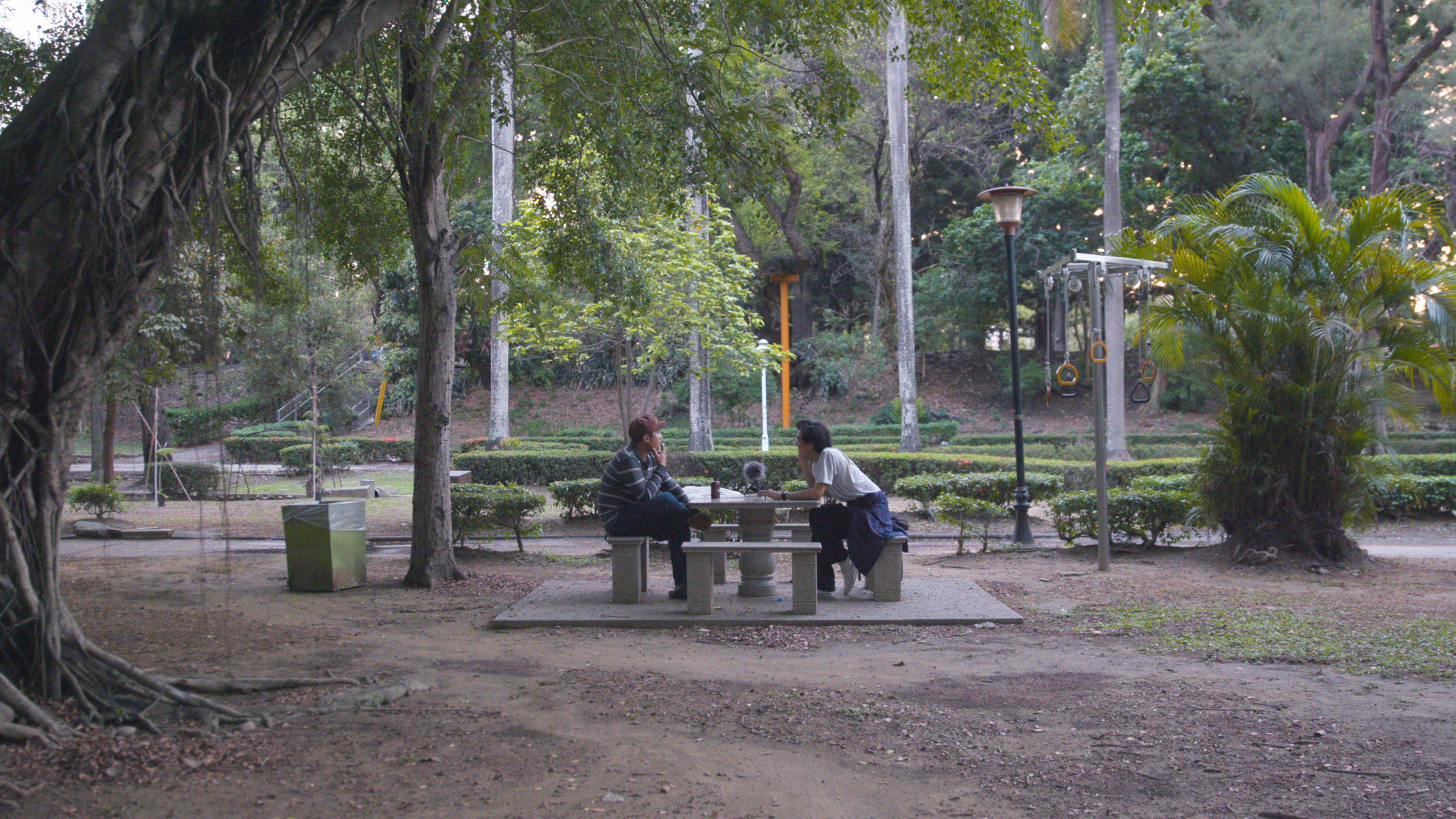
“Maybe they don’t want to make a film that conveys a message,” one of the men at the centre of So Yo-hen’s poetic documentary hybrid Park (Taman Taman) remarks, “they want the audience to find and seek the message themselves”. Admitting that he’s already quite tired of the process and wondering what the point of it is, Asri is likely right in his assumption that So’s film does not necessarily intend to convey a message but perhaps hopes that one will gradually emerge as the men make an elliptical journey through a park in Taiwan while each of them revealing that they likely can’t stay long enough to actually finish this film.
This in itself may reflect their liminal status as mature students from Indonesia who have recently concluded their studies and are thinking about the future. Asri intends to go back to Indonesia to become an academic, while Hanan has responsibilities to his family as the only boy. But both of them are mindful of the irony that they were given this opportunity to study because of a reciprocal agreement between Taiwan and Indonesia that allowed them to come as students in recompense for an exchange of labour. They are also migrants, but position themselves as slightly to the side of those who come to work while reflecting on the precarious position of their countrymen and more to the point countrywomen who are often expected to sacrifice their own lives to earn money abroad.
“This labour, this body, this mind, is no longer mine,” a “40-year-old woman from Jakarta” reveals in a poem titled “For the Sake of Money”. “They call me “a forge in exchange hero,” she explains with a note of bitterness as if her body and her labour had become a tool for the state or else converted into money to be “enjoyed” by others leaving little for herself. The body in this story seems to belong to no one, Hanan remarks to the woman who has now replaced Asri. A cue of other migrant workers extends behind her from the police box the men had co-opted for their imaginary radio show while Hanan contemplates the story of a woman named Listi who came to Taiwan to care for an elderly woman with dementia and doesn’t have many friends, spending her breaks in the park watching the woman on her phone screen.
Asri tells the story of another migrant worker whose shame father was picked up by an authoritarian regime and later came to Taiwan to care for a soldier’s mother leaving her own children behind. The woman has a degree of pride rather than just bitterness and is proud of the way she raised her children and the life she led in Taiwan after marrying the soldier. There are, however, lingering reminders of Taiwan’s own authoritarian regime including the guard post the men shelter under. They wonder at a speaker disguised as a stone which now broadcasts music into the night air. As the woman from Jakarta said, the night can be endless, and so is the odyssey of Asri and Hainan walking laps of the park in an endless cycle while reading poetry and reflecting on their lives.
Asri comes to the conclusion that the filmmakers are trying “to capture slow things in a fast-paced world,” which again seems to be fairly on point as the park slowly becomes a kind of mythical space that exists on this night only or perhaps one night is all nights in the park. It becomes a place of refuge and community as the migrant workers gather to talk and sing or exchange poetry. Asri and Hanan become like ghostly narrators, leaving their mark on this place though they are both shortly to depart as they wander around through the endless night. Though the night may indeed be endless, still the migrant workers must return to work even as their scooters light up the darkness and their song drifts through and around them. A slow thing in a fast-paced world, the park itself takes on an elegiac quality as a place of sadness and boredom but also a warmth and community as Asri reflects of the “depth of idealism” of the young filmmakers he once worked with on this strange and hypnotic project.
Park (Taman-taman) screens at Museum of the Moving Image 13th March as part of this year’s First Look
Trailer (Traditional Chinese & English subtites)
 Windows on Worlds