The Dawning Sky (明け行く空, Torajiro Saito, 1929)

A family broken by economic shock and destructive male pride is eventually mended through Christian faith in Torajiro Saito’s 1929 silent melodrama The Dawning Sky (明け行く空, Akeyuku Sora). Though most of his work is currently presumed lost, Saito became known as the “god of comedy” while working at Shochiku’s Kamata studios yet Dawning Sky while affecting a cheerful tone is marked by a sense of sadness and anxiety that perhaps reflects the precarities of the world of 1929.

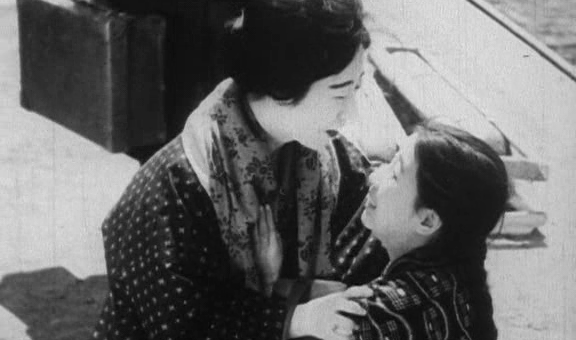
Recently widowed Kyoko (Yoshiko Kawada) has learned to bear her grief by doting on her newborn daughter Reiko, though her world is about to implode as the bank operated by her previously wealthy father-in-law Junzo (Reikichi Kawamura) has collapsed leaving the family in financial ruin. Kyoko’s parents approach Junzo offering to take her back, but the idea provokes only intense resentment in Junzo’s wounded pride as he takes it that they no longer feel his family is good enough for their daughter now that he is no longer rich. A traditionally minded woman Kyoko pleads with him to stay but he will have none of it, throwing her out but insisting on keeping Reiko with him. Out of old-fashioned ideas of loyalty, Kyoko decides that she will not return to her parents nor marry again but is at a loss for what to do sadly wandering about ominously near a bridge before catching sight of the cross on a Christian church and feeling herself saved. Some years later, Kyoko is sent to a small town as a female pastor where, by total coincidence, Junzo is also living with Reiko (Mitsuko Takao) and now working as a lowly coachman. 

The cause of Kyoko’s forced dislocation is located directly in the economic shock of the late 1920s which causes Junzo to lose his family bank and with it the social status which gives his life meaning, but it’s also implicitly the demands growing consumerist capitalism which have already undermined traditional familial bonds and responsibilities. Junzo is so consumed by resentment towards Kyoko’s family, who may have made the offer for pure-hearted reasons rather than snobbish disdain for Junzo’s ruined state, that he coldly separates a mother from her child and thinks nothing of the consequences seeing only red in his internalised shame in having failed in business. Yet true happiness is evidently not possible until he finally learns to abandon his lust for material success. “I’m poor, I know, but life is nice and carefree because I have my granddaughter” he explains to one of his passengers having reconsidered his priorities and come to realise it’s familial bonds which are most important after all. 

Nevertheless, he continues to hide the truth from Reiko having told her that both her parents are dead while she continues to pine for a mother she’s never known. Her little friend Koichi meanwhile is the only son of his widowed mother who is bedridden and unable to work. As the family is poor Koichi is responsible not only for her care, they’ve rigged up a kind of machine which automatically dispenses her medicine while he isn’t there to administer it, but for the cooking and cleaning too. The two children first bond when Reiko discovers a wounded pigeon shot by Koichi and scolds him that he has no right to kill living things though he only wanted to feed his sick mother, the pair of them deciding to bury the pigeon and give it a proper funeral. This brings her to the attention of the pastor, Kyoko, who is proving especially popular in the local community because of her innate kindness and compassion. But in suspecting that Reiko may be her daughter, Kyoko is at a loss as to how to move forward unwilling to disrupt her life with Junzo by telling her the truth while torn apart inside by her wounded maternity and new duties to her Christian faith. 

The film’s overt religious overtones are perhaps surprising for the world of 1929 as is the near universal approval with which the church is viewed in the local community with only the strange and bookish Hide refusing to attend on the grounds that he hates Christians while all of the other children begin hanging out inside largely because of Kyoko’s warmth and kindness. It is finally Christian virtues which allow the family to be repaired, Junzo overcoming his sense of wounded male pride when faced with Reiko’s constant pining as the pair eventually make a mad dash towards the station on learning that Kyoko has decided to leave town rather than risk causing Reiko further pain by disrupting her new life. “God’s grace brought them together” as the benshi intones, yet as much as Kyoko’s maternity is restored she remains a liminal figure returning not to Junzo’s house but only to the church as its pastor recommitting herself to her religious duties while looking out sadly as Reiko plays with the other children in the beautiful countryside suggesting that the ruptured bonds of the traditional family cannot ever be fully repaired. 

Saito’s elegant mise-en-scène has its moments of poignancy in the expressionist angles of Kyoko’s walk into darkness or frequent employment of superimposition, not to mention the intensity of its climactic storm scene intercut the with the spiritual ferocity of Kyoko’s desperate praying surrounded by candles in the dark and empty church, but the film is first and foremost a melancholy tale of familial reunion which, while in some senses incomplete, nevertheless suggests that true happiness exists only in simplicity, the family repairing itself through jettisoning contemporary ideas of capitalistic success and social hierarchy in order to embrace their natural affection for each other.
The Golden Bullet (黄金の弾丸, Hiroshi Innami, 1927)

Born in 1902*, Hiroshi Innami was something of an aberration in the early days of cinema in that he first joined the industry after graduating from university and directed his first film, The Golden Bullet (黄金の弾丸, Ogon no Dangan), at Toa Cinema at just 24 years old. His career, and life, were however short as he sadly passed away from tuberculosis at the young age of 36 in September 1938. Even so he managed to produce a prodigious number of films working both as a director and screenwriter though unfortunately little of his work has survived into the present day. 

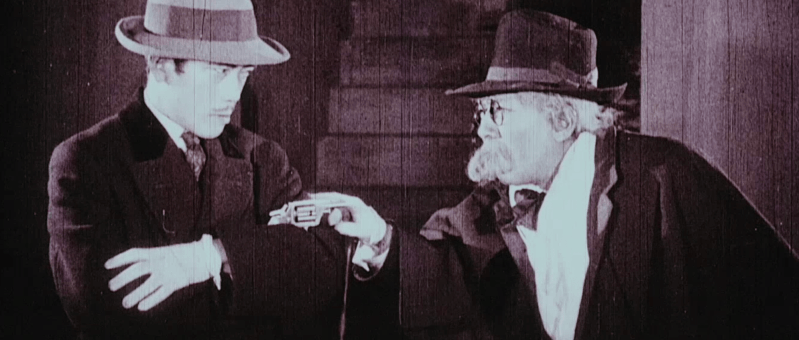
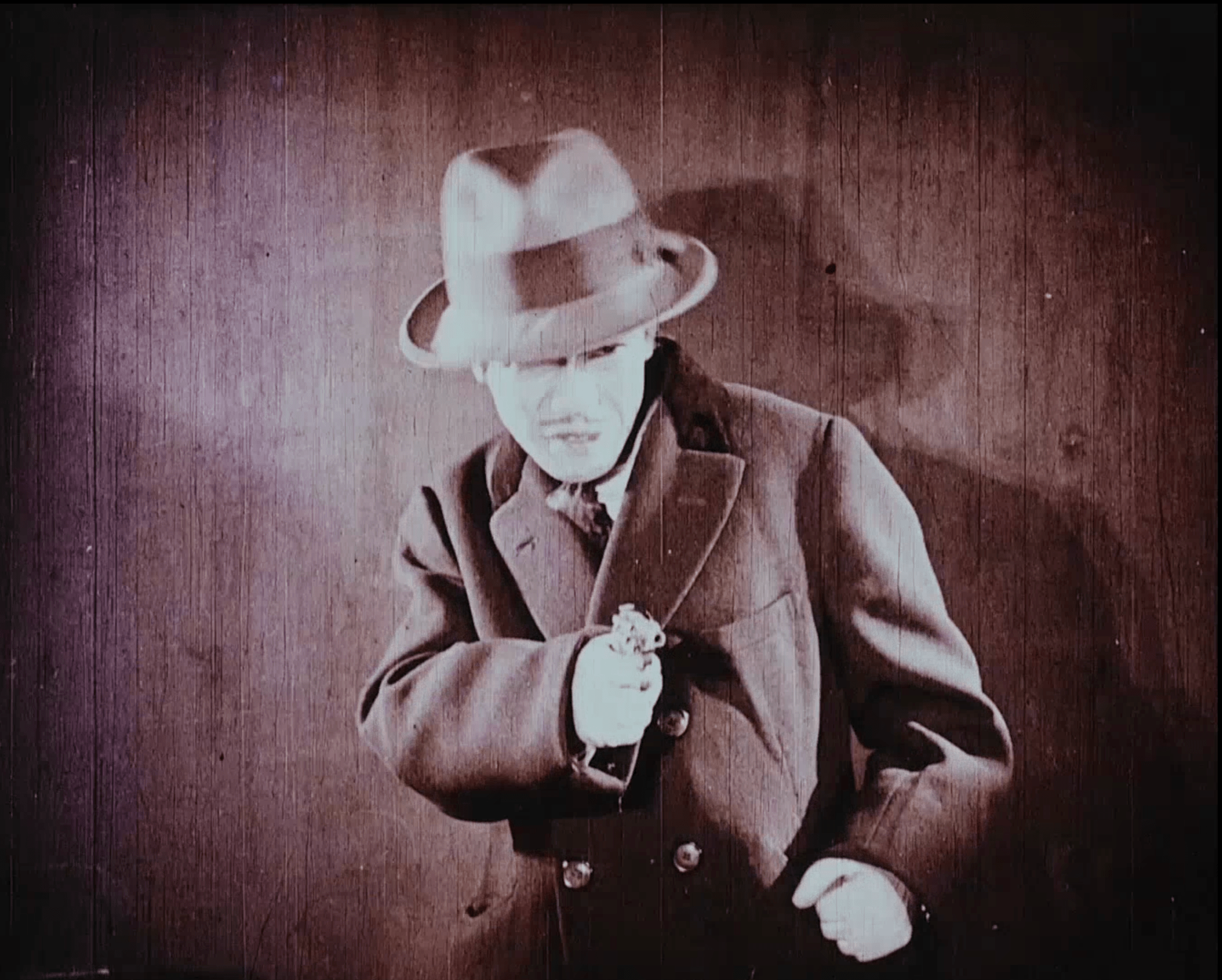
Adapted from a novel by Herman Landon, The Golden Bullet survives in incomplete form its fifth real presumed lost with the missing action conveyed through additional intertitles prepared for the restoration completed by the Kyoto Planet Film Archive. The source material is taken from a part of a series revolving around the “Benevolent Picaroon” who in the film at least is depicted as a kind of playful Robin Hood who daringly steals precious items from the homes of the wealthy and holds them to ransom promising to return what he’s stolen if only the victim donate 10% of its worth to charity. The Benevolent Picaroon is then known as a responsible criminal who prides himself on the fact he never resorts to violence in the course of his activities which is why Inspector Inomata is sure that he isn’t responsible for the murder of a mine owner found dead in his armchair having been shot with the very elitist weapon of golden bullets. Inomata also knows there was a woman at the scene, which raises his suspicion when he’s called to the home of a wealthy family who’ve received a ransom note from the Picaroon but have noticed nothing missing. With the daughter of the house acting suspiciously, Inomata calls in his “special friend” Kawanami to help who discovers the woman had been hiding something which is now missing in the false bottom of a decorative vase. 

In many ways, The Golden Bullet is surprising for the time in that it makes no real attempt to localise Landon’s mystery save for obvious changes in name presumably taken from the Japanese translation. The production design is heavily influenced by German expressionism and the buildings largely European, a plot point revolving around the Western-style fireplace and a painting that hangs next to it in the murdered man’s home. Only the home of the wealthy family appears comparable to those seen in other contemporary dramas, more a European-style country house than the angular townhouses inhabited by the victim and the old man next door who claims to have overheard the crime. The young mistress meanwhile dresses in kimono while at home and the latest flapper fashions when out, paying a visit to Kawanami assuming him to be the Picaroon in order to ask for the return of the missing item which is of course a golden bullet she picked up from the crime scene mistakenly believing her boyfriend, the nephew of the victim, had committed the murder after a heated argument with his uncle. 

Little motive is later given for the murder itself or its elaborate construction save for “gold” which perhaps hints at a discomfort with growing wealth inequality and changes in the social hierarchy as indeed does the very existence of the Picaroon who robs the rich to feed the poor while trying to force those with means to accept their communal responsibilities and give something back to the society to help the less fortunate. The Picaroon meanwhile is a chameleon Sherlock Holmes clone keen on disguises and with a strong sense of social justice, trying to help the young couple after figuring out what’s going by returning the bullet out of kindness partly for an act of compassion they once did him and partly in admiration for their love for each other because what says love better than trying to cover up murder? 

Nevertheless, the Picaroon soon finds himself on the run chased down by the dogged Inomata who at times seems either obvious or calculating almost as if he doesn’t really want to catch the Picaroon after all. Bold in style, Innami opens the film with a series of illustrated intertitle cards, even at one point playfully switching the colour tint to mimic a light turning on, and ends with a high octane chase sequence as the Picaroon makes his escape firstly on foot and then by hijacking a car while chased by horses and motorbikes passing through Kobe’s foreign concession out into the lush countryside before returning to take care of some unfinished business leading to an oddly homoerotic reunion between the detective and his “special friend”. The crime may have been solved but the key to the identity of the enigmatic Picaroon must remain a mystery if perhaps wilfully so. 


The Golden Bullet is available to stream worldwide courtesy of Kobe Planet Film Archive with either live music or benshi narration though English subtitles are provided for the intertitles only.

Trailer featuring benshi narration (no subtitles)

*There seems to be some confusion surrounding Innami’s birth year with some sources citing 1900 rather than 1902 (in which case he was 38 when he passed away).

Crossroads (十字路, Teinosuke Kinugasa, 1928)

Does it matter what path you take when none lead out of the darkness because all the world is dark? The heroine of Teinosuke Kinugasa’s Crossroads (十字路, Jujiro) eventually finds herself faced with this dilemma after a series of betrayals born of male failure place her into an impossible, infinitely ironic situation. Following his avant-garde masterpiece A Page Madness, Kinugasa heads in more straightforwardly melodramatic direction if maintaining the same expressionist aesthetic, but the world is still itself “mad” and inescapably so even as it prepares to swallow itself whole. 

Okiku (Akiko Chihaya), an earnest young woman, lives in a small room on the second floor of a squalid tenement building, captured in all of its grotty detail by Kinugasa’s manically wandering yet claustrophobic camera, with her brother Rikiya (Junosuke Bando). She supports the pair of them through seamstressing and doing other odd jobs, while Rikiya has become a devotee of the red light district and developed an infatuation with Oume (Yukiko Ogawa), the proprietress of an archery parlour. So enamoured of her is he that he declares his intention to fight for her love, literally, and is badly beaten by a samurai rival. He steals the ornate kimono his sister had been preparing for a client and hands it to Oume only to reencounter the samurai who tears it in two and hits him on the head, throwing ashes into his eyes causing him to believe that he is blind. Rikiya embarrasses himself by crying out for a sign of love from Oume while clinging to another woman. Humiliated and unable to see, he bumps back into his rival and slashes at him with a sword. Someone shouts “murderer” and Rikiya stumbles out of the tavern and back to his sister believing he has killed someone while the samurai is in fact perfectly fine, merely having another joke at his expense. 

The “joke” will have profound consequences, not only for Rikiya but for his devoted sister. Now entirely unsupported by her feckless brother and in fact burdened by him as he adjusts to his unsighted life, Okiku is determined to keep him safe from punishment for his legal transgression. This becomes another minor problem in their lives as a mysterious bogus policeman (Ippei Soma) with missing front teeth has begun hanging out in their front room for otherwise unexplained reasons, hinting that he knows all about Rikiya’s crime but offering to “protect” him from the authorities for the right price or a suitable alternative. Meanwhile, a doctor has also suggested that Rikiya’s eyes might be healed if he had money to heal them. An old hag having worn out a young woman she was exploiting for sex work is in search of a replacement and thinks Okiku fits the bill. She resists, but is at a loss as to how to find money both for the policeman and for her brother’s eyes. 

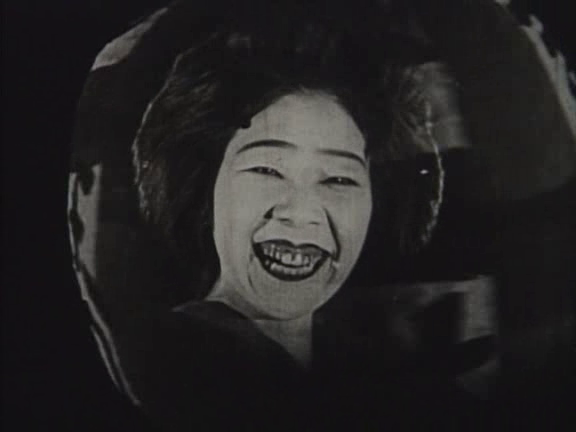
Old hag aside, all of Okiku’s problems are born of male failure. Her feckless brother has drawn her into his foolish romantic fancy, allowing himself to be swept away sold on the false promises of the Yoshiwara. Questioned by another patron, Oume reveals that she liked Rikiya but is turned off by “persistent” men. She enjoys the attention she gets, not to mention the gifts, but is not interested in the kind of relationship which limits her freedom. The archery parlour itself is a carnivalesque world of giddy madness, a permanent party town filled with maniacal laughter and the false jollity of those trying to escape despair through mindless hedonism. Rikiya is blind to his delusion and has no idea he has been trapped. Unlike Oume, Okiku is a pure soul and unable to manipulate male interest for her own ends. She finds herself caught between the old hag and the bogus policeman trying to protect the brother who made no attempt to protect her, even hiding in a cupboard when he suspected that his attacker had followed him home. 

Exploited from every possible angle, the siblings have nowhere left to turn but to each other. “If only I could live with you like this all my life” a chastened Rikiya exclaims, adding “I will take you, sister, wherever I escape” when the scene is ironically mirrored yet returning once again to Oume only to realise the degree to which he had been blinded by love even as he could see. Not even fraternal bonds are strong enough to survive the storm of human selfishness. Kinugasa conjures a world of spiralling madness in which cruelty and indifference are the only constants. It doesn’t matter which way you go, the destination is the same. 


Souls on the Road (路上の霊魂, Minoru Murata, 1921)

vlcsnap-2017-12-09-00h26m35s417Minoru Murata was one of the most important figures in early Japanese cinema but as the majority of his 36 films are lost and he sadly died at the young age of 43 in 1937, his work has largely been over looked outside of scholarly circles. Starting his career as an actor in the “shingeki” movement which aimed to bring modern, naturalist theatre to Japanese stages, Murata first performed in Norimasa Kaeriyama’s “Pure Films” in 1918 before joining Shochiku’s acting school on the recommendation of playwright Kaoru Osanai. The “Pure Film” movement, like the Shingeki movement in theatre, sought to create a new more modern Japanese cinema as opposed to the overly theatrical, kubuki influenced productions of the time. Souls on the Road (路上の霊魂, Rojo no Reikon), an early directorial effort for Murata in which he also stars, was made for Shochiku and is very much influenced by the Pure Film Movement as well as foreign cinema from Europe and America.

The narrative of Souls on the Road is adapted from two foreign literature sources – Gorky’s play The Lower Depths and the German novel Mutter Landstrasse, das Ende einer Jugend by Wilhelm August Schmidtbonn. Influenced by the work of D.W. Griffith, Murata cuts between the stories of four interconnected groups of people – a failed violinist who returns home to his family with a wife and daughter in tow, two escaped convicts hiding out in the woods, the local master and his servants including a young woodcutter played by the director, and a wealthy young girl.

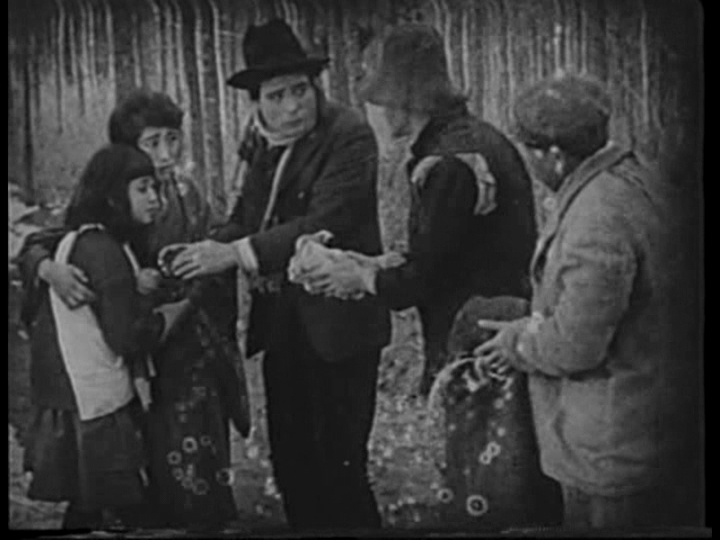
The central drama revolves around the musician who left home under a cloud to become a concert violinist in Tokyo but failed to make a success of himself. Despite having a fiancée at home, Koichiro (Denmei Suzuki) has married a Tokyo woman (Haruko Sawamura) and has a young daughter. Desperate and starving, the trio have made the snowbound journey back to Koichiro’s Hokkaido village largely on foot but Koichiro’s father (Kaoru Osanai) who is the master of a large estate refuses to help him. The former fiancée, Mitsuko (Ryuko Date), who is also Koichiro’s cousin, still lives with the master and is distressed by Koichiro’s return. Battling her own emotional pain, she wants to help Koichiro’s wife and daughter who are obviously in a bad way, but is also conditioned by the need to obey the master’s instructions even when they seem cruel and immoral.

Murata bookends the film with direct quotes – firstly from Gorky’s play and then from the Bible emphasising the need for human compassion. The master’s refusal to help his son is directly contrasted with the fate of the two convicts who cross Koichiro’s path in the forest. The two men originally try to rob Koichiro, but seeing that they too have nothing and the little girl is close to starving, the convicts give up their own food to help them. When they chance upon house they remain conflicted about trying to rob it – they don’t want to end up back in prison and they don’t want to steal but they are also starving and have no other options. The custodian of the house catches them in the act and enacts a sadistic punishment but later changes his mind and decides to help them.

Meanwhile, one of the master’s servants, a boy named Taro (played by director Minoru Murata), runs into the rebellious young mistress of a local estate (Yuriko Hanabusa) who dresses in a sailor suit and gleefully shoots her minder with an air gun to avoid having to go home. The young mistress strikes up a cross class friendship with Taro and invites him to the Christmas party she is organising at her mansion to which pretty much everyone is invited regardless of class origins or backgrounds. The young mistress’ “Christmas Party” might seem incongruous for a rural town in the Japan of 1921 and does indeed take on the trappings of Russian literature with the mummers and balalaika players replaced with traditional Yagibashi dancers, but the party itself seems to have no particular religious dimension as the young mistress dreams of being visited by Santa and a small shot of Mitsuko seeming to pray as Koichiro’s wife and daughter lie freezing in a barn is the only hint of a real presence of Christian thought outside of the overt references in the framing sequences and overall Christianising morality of the film as a whole.

Murata’s signature approach mixes an entrenched naturalism of location shooting and realistic performances with expressionistic techniques. Literally “souls” on the road, Murata introduces as series of ghosts using dissolves and superimpositions as the protagonists are haunted by alternate pasts and futures or even by themselves as Koichiro finds himself interrogated by the hopeful violinist who left with big dreams but has brought his wife and child to the brink of starvation and death from cold in a barn steps away from his childhood home. Somewhat heavy handed in its closing moments as Taro wonders what might have been if the master had been more forgiving and welcomed his son home instead of punishing him for leaving, and the young mistress wonders what might have happened to the convicts if the custodian had not taken pity on them, Souls on the Road is an early visionary masterpiece far ahead of its time which looks forward to a new kind of Japanese cinema.