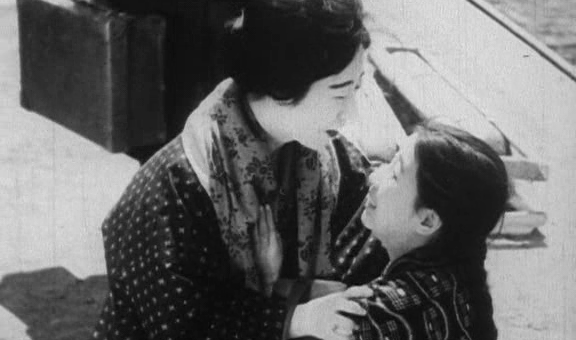
The Dawning Sky (明け行く空, Torajiro Saito, 1929)

A family broken by economic shock and destructive male pride is eventually mended through Christian faith in Torajiro Saito’s 1929 silent melodrama The Dawning Sky (明け行く空, Akeyuku Sora). Though most of his work is currently presumed lost, Saito became known as the “god of comedy” while working at Shochiku’s Kamata studios yet Dawning Sky while affecting a cheerful tone is marked by a sense of sadness and anxiety that perhaps reflects the precarities of the world of 1929.

Recently widowed Kyoko (Yoshiko Kawada) has learned to bear her grief by doting on her newborn daughter Reiko, though her world is about to implode as the bank operated by her previously wealthy father-in-law Junzo (Reikichi Kawamura) has collapsed leaving the family in financial ruin. Kyoko’s parents approach Junzo offering to take her back, but the idea provokes only intense resentment in Junzo’s wounded pride as he takes it that they no longer feel his family is good enough for their daughter now that he is no longer rich. A traditionally minded woman Kyoko pleads with him to stay but he will have none of it, throwing her out but insisting on keeping Reiko with him. Out of old-fashioned ideas of loyalty, Kyoko decides that she will not return to her parents nor marry again but is at a loss for what to do sadly wandering about ominously near a bridge before catching sight of the cross on a Christian church and feeling herself saved. Some years later, Kyoko is sent to a small town as a female pastor where, by total coincidence, Junzo is also living with Reiko (Mitsuko Takao) and now working as a lowly coachman. 

The cause of Kyoko’s forced dislocation is located directly in the economic shock of the late 1920s which causes Junzo to lose his family bank and with it the social status which gives his life meaning, but it’s also implicitly the demands growing consumerist capitalism which have already undermined traditional familial bonds and responsibilities. Junzo is so consumed by resentment towards Kyoko’s family, who may have made the offer for pure-hearted reasons rather than snobbish disdain for Junzo’s ruined state, that he coldly separates a mother from her child and thinks nothing of the consequences seeing only red in his internalised shame in having failed in business. Yet true happiness is evidently not possible until he finally learns to abandon his lust for material success. “I’m poor, I know, but life is nice and carefree because I have my granddaughter” he explains to one of his passengers having reconsidered his priorities and come to realise it’s familial bonds which are most important after all. 

Nevertheless, he continues to hide the truth from Reiko having told her that both her parents are dead while she continues to pine for a mother she’s never known. Her little friend Koichi meanwhile is the only son of his widowed mother who is bedridden and unable to work. As the family is poor Koichi is responsible not only for her care, they’ve rigged up a kind of machine which automatically dispenses her medicine while he isn’t there to administer it, but for the cooking and cleaning too. The two children first bond when Reiko discovers a wounded pigeon shot by Koichi and scolds him that he has no right to kill living things though he only wanted to feed his sick mother, the pair of them deciding to bury the pigeon and give it a proper funeral. This brings her to the attention of the pastor, Kyoko, who is proving especially popular in the local community because of her innate kindness and compassion. But in suspecting that Reiko may be her daughter, Kyoko is at a loss as to how to move forward unwilling to disrupt her life with Junzo by telling her the truth while torn apart inside by her wounded maternity and new duties to her Christian faith. 

The film’s overt religious overtones are perhaps surprising for the world of 1929 as is the near universal approval with which the church is viewed in the local community with only the strange and bookish Hide refusing to attend on the grounds that he hates Christians while all of the other children begin hanging out inside largely because of Kyoko’s warmth and kindness. It is finally Christian virtues which allow the family to be repaired, Junzo overcoming his sense of wounded male pride when faced with Reiko’s constant pining as the pair eventually make a mad dash towards the station on learning that Kyoko has decided to leave town rather than risk causing Reiko further pain by disrupting her new life. “God’s grace brought them together” as the benshi intones, yet as much as Kyoko’s maternity is restored she remains a liminal figure returning not to Junzo’s house but only to the church as its pastor recommitting herself to her religious duties while looking out sadly as Reiko plays with the other children in the beautiful countryside suggesting that the ruptured bonds of the traditional family cannot ever be fully repaired. 

Saito’s elegant mise-en-scène has its moments of poignancy in the expressionist angles of Kyoko’s walk into darkness or frequent employment of superimposition, not to mention the intensity of its climactic storm scene intercut the with the spiritual ferocity of Kyoko’s desperate praying surrounded by candles in the dark and empty church, but the film is first and foremost a melancholy tale of familial reunion which, while in some senses incomplete, nevertheless suggests that true happiness exists only in simplicity, the family repairing itself through jettisoning contemporary ideas of capitalistic success and social hierarchy in order to embrace their natural affection for each other.

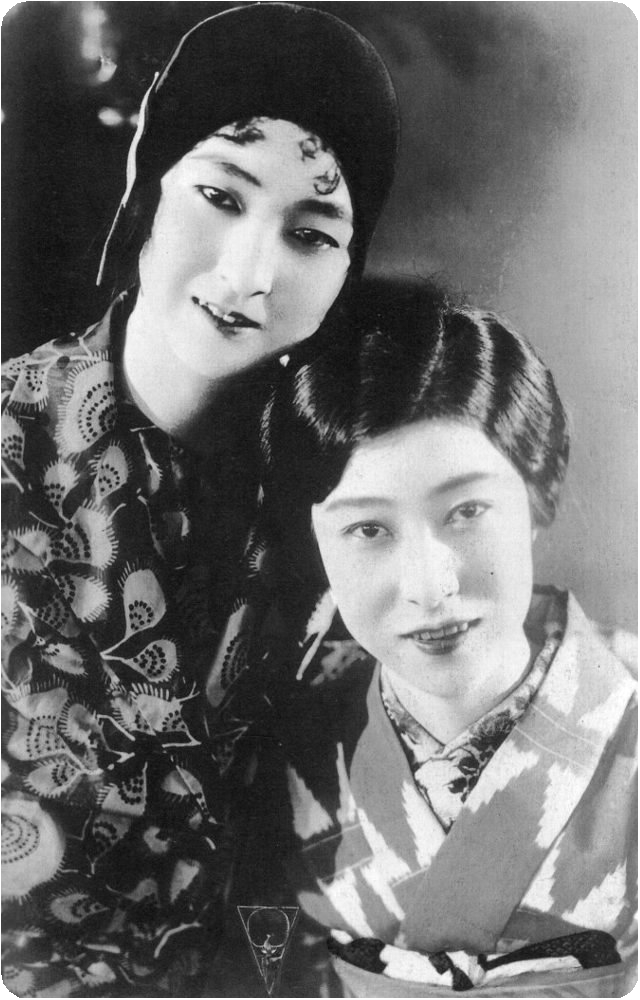
Eternal Heart (不壊の白珠, Hiroshi Shimizu, 1929)

Eternal Heart still 1

Hiroshi Shimizu is most often remembered for his sensitive depictions of childhood, but his career, which spanned more than 160 films many of which are presumed lost, was much more varied than might be assumed. His earliest completely extant feature, 1929’s Eternal Heart (不壊の白珠, Fue no Shiratama, AKA Undying Pearl), is a case in point. Set in the heady days of early Showa long before militarism took hold, Eternal Heart bears early witness to Shimizu’s distrust of romantic solutions as its wounded protagonists are forced to accept that they have lost out in the great game of love and there’s nothing they can do about it except learn to endure their sadness.

The heroine, Toshie (Emiko Yagumo), is an earnest young woman working as a typist. She has developed a crush on a nice young man, Shozo (Minoru Takada), who works at the same company but unfortunately for her, her “modern girl” sister Reiko (Michiko Oikawa) has taken a liking to him too. To Reiko, Shozo is just one of the guys she likes to string along, but to the seriously minded Toshie he’s the only man she’ll ever love. Plucking up the courage, Toshie writes a cryptic note asking to talk to Shozo about something important and has it sent to him in the interoffice mail to avoid the embarrassment of giving it to him directly. In a spectacular case of bad timing, however, she discovers that Shozo has proposed to Reiko. He thinks the letter is about the possible marriage and that perhaps Toshie is worried he’s not a suitable person to become her brother-in-law, never dreaming that Toshie herself meant to declare her love to him. Hugely embarrassed, Toshie does not handle the situation well but agrees to put a good word in with her mother, after all she does think that Shozo is the best of men and so could never speak ill of him.

The marriage is agreed and Toshie tries to make her peace with it, only to have some kind of episode at the wedding party that leaves Shozo feeling guilty, as if he might have somehow alienated his new sister-in-law. Meanwhile, Toshie also receives the solicitous attentions of the company’s boss, Katayama (Arai Atsushi), a middle-aged widower with three children who makes a clumsy pass at her in the coach home but later apologises and embarks on a more appropriate style of courtship.

The irony is that Shozo and Toshie are actually perfectly suited, only he never saw her because he was distracted by her sister’s modern sparkle. It would be easy enough to see the contrast between the two women as one between tradition and modernity, Toshie the perfect exemplification of traditional Japanese values and her sister the avarice of the flapper generation, but the distinction is more nuanced than it might at first seem. Despite her presentation as a “traditional” woman, Toshie is more progressive than her sister in that she has made a free choice to be a working woman and takes her job seriously, quickly becoming irritated by those who don’t, whereas Reiko is never in search of direct independence only of the freedom to move between one man of means and another. Toshie wants real love, but also her independence and perhaps does not feel that one must necessarily conflict with another.

While the relationship between Shozo and Reiko sours as she becomes bored with his niceness and lack of consumerist avarice, Toshie finds herself filled with hostility towards her former object of affection and consenting to date Katayama partly in romantic rebound. Though he eventually turns out to be a little nicer than that first unpleasant incident in the taxi might have suggested, Toshie cannot escape the sense of social inferiority which keeps her in a subordinate position to a man who ought, in her view it seems, to be her equal if they were married. On an abrupt visit to his family home, she finds herself waiting in the hallway where Katayama’s precocious son (Shoichi Kofujita) mistakes her for the new maid, while his daughters and nieces, dressed in the modern style, openly mock her for being a career woman, suggesting that “typist” is a synonym for “loose woman” while Katayama fails to help the situation by countering only that “some of them are decent”. In response, Toshie calmly and confidently reaffirms that she is proud of her job and ashamed of nothing, only for the kids to chime in with a show of banging a keyboard as if it were something that a baby could do for amusement and little more than noisemaking.

Toshie leaves humiliated, but seemingly continues seeing Katayama at least superficially. It’s at this point she re-ecounters Shozo, who now has something important he wants to discuss with her. Having married Reiko believing her to be playful and innocent, Shozo has awoken to her coquetry and figured out she’s been going on drives with the moustachioed man we saw her glare at on the train on her honeymoon. The implication is that Reiko is only dating the other guy, whom she knows to be married with children, because he has a fancy car – something Shozo showed no interest in getting even if he had the money because like Toshie what he wanted was love. Shozo is understandably hurt and angry but wants to reconcile. Toshie vows to help him, overcoming her timidity to head into one of the modern bars frequented by her sister to convince her to come home, which she does but only to collect her things. Reiko claims that it’s Shozo who is being “selfish” for asking about her life before their marriage. In that she might have had a point, but it’s not something Shozo particularly cared about and he is not in that sense jealous only confused and embarrassed. Reiko refuses to accept her role as a wife, but unlike Toshie she never means to be independent and decamps to the home of her married lover, presumably intending to live off him until something better comes along.

In that sense, Reiko’s “modernity” is not so much the problem as her innate selfishness which the modern world perhaps enables. Reiko, amoral, claims her individuality by reserving the right to do as she pleases ignoring both social convention and other people’s feelings. She married Shozo because he was kind of a catch only to grow bored with him and wonder if she might do better. Toshie, meanwhile, nurses her broken heart with as much grace as she can manage, desperately trying to save her sister’s failing marriage in order to preserve Shozo’s happiness more than to avoid the scandal of marital breakdown. Despite his disillusionment with Reiko’s Westernised “modernity” Shozo finds himself considering emigrating to America in order to escape his heartbreak, resolving that a separation would be “socially unacceptable” and hoping that Reiko will continue to live as “Mrs. Narita” at least superficially even in his absence. Toshie loses Shozo twice. Having married her sister there was no longer any way for her be with him other than as a relative, but now she must watch the pearl her sister cast aside sail away from her never to be seen again. United only in heartbreak they part, Toshie selflessly reflecting on Shozo’s sadness rather than her own, but in even in the midst of her disappointment she stands stoically alone, independent and self-possessed like truly “modern” woman.