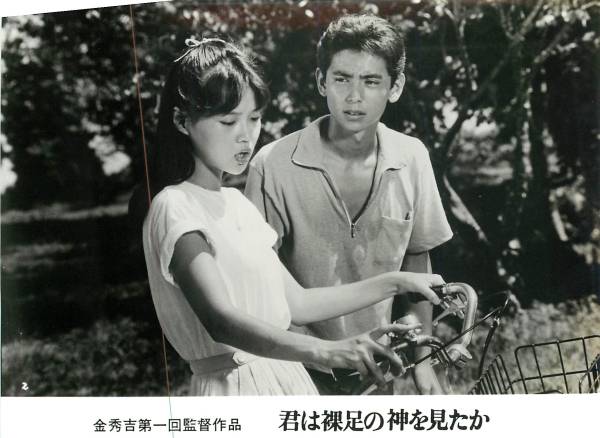
 A very late entry into Art Theatre Guild’s catalogue of Japanese art movies, Did you See the Barefoot God? (君は裸足の神を見たか, Kimi wa Hadashi no Kami wo Mitaka) marked the feature length debut of Korean-Japanese director Kim Soo-gil who, though he remains active in many fields up to the present day, sadly did not go on to build up an extensive filmography after the film’s release. Like many ATG films, Did You See the Barefoot God? is a “seishun eiga” or youth film with a contemporary setting which looks at the internal difficulties of adolescence running the gamut from romantic problems to familial responsibilities and the decision of whether to give up the dreams of youth in favour of the calm and ordered adulthood that the wider world demands.
Shinji and Shigeru are two best friends currently approaching the end of high school in a small rural backwater. Both boys currently have a crush on, thankfully, different girls but each is too shy to do anything. Shigeru is a painter and has restricted himself to painting the object of his affection as a special project that he intends to enter in a national competition. Shinji is also an artist, a poet in fact, but is much quieter about it. He’s got a crush on a girl who goes to the local girls’ Christian school and goes to great lengths to stalk her though he hasn’t spoken to her since they both attended the same middle school. As it turns out, Shigeru remembers Shinji’s girl, Hitomi, quite well as they shared a (strange) bonding experience during their middle school years. Shigeru then decides to contact Hitomi and convince her to date Shinji to help his sensitive friend out. Little does he know this will set in motion a tragic series of events which will change all of their lives forever.
Anybody can see where this story is going – it’s the oldest story in history. Boys A and B are friends, boy B likes girl C who prefers boy A, A & C eventually get together behind B’s back but feel so bad about it that the hot acid venom of their betrayal burns straight through everything in sight. Yes, this film is no different though its somewhat overwrought and melodramatic subject matter manages to feel oddly realistic. Intense painter Shigeru takes the leading role with his “complicated” personality and tortured artist dreams, whereas the gentle and sensitive poet Shinji ends up just as much on the sidelines as he would be in real life. The girl who comes between them, Hitomi, is in truth a little under developed and is largely defined by her religiosity (which is never fully explored).
Shigeru wants to be an artist but his father wants him to take over the family construction business – even his school advisor recommends he consider architecture. Shinji lives alone with his mother who runs a small bicycle store that she doesn’t particularly want to pass on to him but eventually Shinji, in a surprisingly mature fashion, decides that a quiet life as the proprietor of a bicycle store who writes poetry on the side might suit him (and perhaps a wife?) better than that of a starving urban poet. Headstrong Shigeru doesn’t waver under the constant pressure to conform to a “normal” life though fear and resentment conspire to fuel his already fraught nerves to near breaking point. Shinji looks at the sort of life he might have and makes his decision accordingly. Hitomi, alas, has far less personal agency to decide her own fate and seems destined for a life as a missionary nurse in some far off land in need of relief. Each is caught in the difficult liminal space of adolescence where they’re still trying to decide which parts of their childhood selves they’re going to keep, and which discard.
That’s without the added romantic complications which, again, leave Hitomi stranded in the middle like some kind of damaged prize. Both boys look down on a poor, Saraghina-like figure who dances madly in the graveyard and makes untoward advances to young boys – even the more understanding Shinji is reluctant to sympathise because she’s “prostituted” herself. Hitomi, as the nice kind of religious person, pities the woman and explains that it’s only because she’s been betrayed by so many men over the years that she’s ended up like this – if Shinji won’t sympathise he’d better take his place on the guilty side with the rest of the menfolk. Ultimately, Hitomi fears ending up this way herself, betrayed by faithless men and slighted by her own faith as a “fallen woman”. The boys can mourn their pride, throw a few punches and forget about it but for Hitomi, it’s not so easy.
Well, this being a seishun eiga it doesn’t end particularly well for the boys either. Everything’s ruined, dreams are shattered, hearts are broken and lives are ruptured beyond repair. In the end, it may be Hitomi who’s best placed to pick up and move on as a running subplot regarding the changing economic environment offers her another opportunity, but for Shigeru he’s left with nothing but the pain of realising how many lives he’s ruined with his self centred lack of consideration. Typical seishun eiga stuff, but well done. Director Kim Soo-gil handles the epic scope of the material with assurance and a good deal of directorial flair, it’s a shame he didn’t continue directing feature films to a greater extent. Not without its flaws, Did You See the Barefoot God? is nevertheless another interesting effort from the later ATG catalogue.
Original trailer (no subtitles)

 Windows on Worlds