Lost Land (Harà Watan, Akio Fujimoto, 2025)

The world’s largest group of stateless people, the Rohingya have been persecuted under several authoritarian regimes in Myanmar and forced continually on the move throughout the region. Having previously explored the lives of Burmese migrants in Japan, and those of Vietnamese workers caught in exploitative training contracts, in Lost Land (Harà Watan), Fujimoto follows a community of Rohingya refugees as they embark on a perilous journey across South East Asia to reach Malaysia.

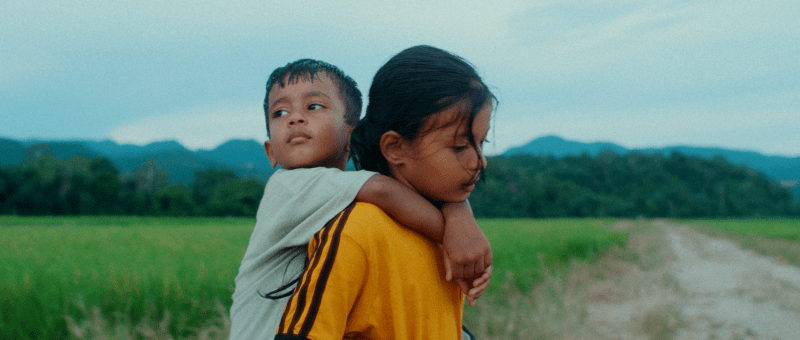
Somira and her brother Shafi don’t know much about this. They’ve been told that they have an uncle living there, but they don’t know his name or his phone number. Shafi keeps asking when they’re going “home”, but in reality they don’t quite have one. Their mother tells them stories about her childhood in Myanmar and a large mango tree that to her seems to embody the idea, but it’s an abstract concept that occupies a space of fairytale or mythical origin story. Later, Shafi will tell a kind young man looking after him that his uncle lives near a big mango tree, mixing up the stories he’s been told in his internal search for a home. He wanders off and finds a tall tree for himself in the middle of the city, looking up at it plaintively and playing hide and seek on his own knowing that no one’s coming to look for him. 

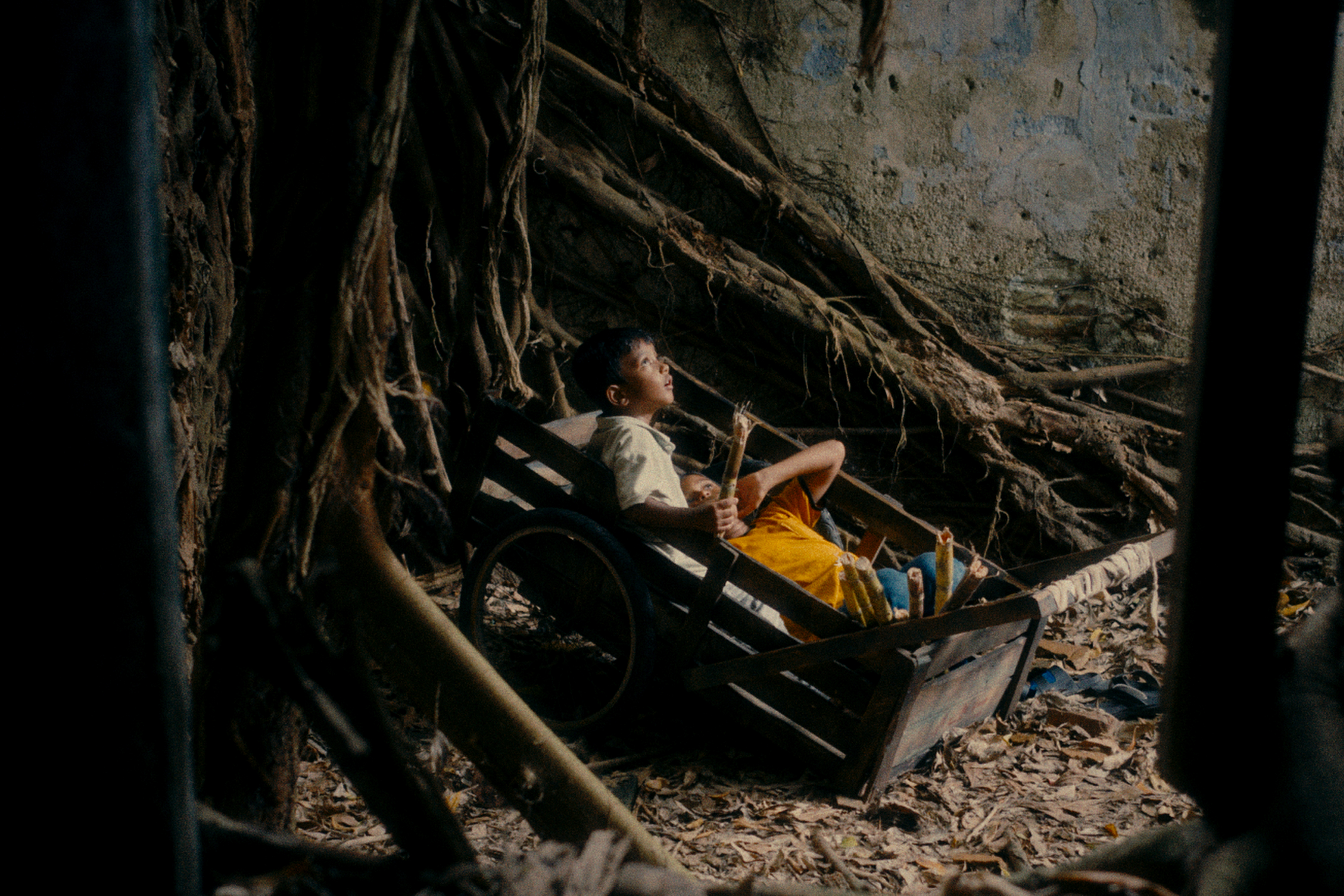
The siblings continue to play like children, but their games take on a darker quality when they become separated from their community and must try to look after themselves. They steal sugarcane to suck on, and beg local women for water, while planning to walk to Malaysia on their own despite not knowing the way. Eventually, they’re taken in by another fleeing Rohingya community who find themselves conflicted about what they should do with them. Though they may want to help these lone children for humanitarian reasons, they also know that they make their own passage more difficult and that the brokers will demand extra money they don’t have when they get to the next check point. 

By this time, it’s already been a couple of weeks since the children left their previous “home”. Their journey began by walking through the night to a dinghy that took them to a small ship where they encountered a storm, blew off course, and began to run out of food. One of their community died in the liminal space of the boat and was buried at sea. They frequently have to leave people behind because they couldn’t keep up or the authorities got them. This community too walk in the through the night clipping metal fences and then are forced to run for their lives. A horrifying moment finality demonstrates what it costs to look back or to try to help others while bullets fly indiscriminately in the darkness. 

Then again, there are moments of joy as a mother is reunited with her son after ten years even if he tells her that his workplace was raided and many of his friends were arrested. He was spared because he wasn’t working that day but ended up losing his job and will now struggle to find a new one while making sure to not blow his cover or be caught by the authorities. His mother’s faith remains strong as she insists that God wouldn’t let him suffer and is sure to find him a new job, despite all the fear and horror she’s been through on her journey towards him. She and her son are good people who look after Shafi even though they don’t have to because it’s the right thing to do. Though the siblings encounter good people like the Thai man who wanted to help them because he saw once Rohingya being taken away but couldn’t do anything about it, the world is otherwise heartless traffickers who’ll kill those who talk back to them or aren’t able to pay the extra money they’re sure to ask for. Wherever they go, the children aren’t welcome but are pushed on somewhere else, forced on more perilous journeys towards a distant homeland in an endless game of hide-and-seek. The first film ever produced in the Rohingya language, Fujimoto’s hard-hitting drama is a quiet plea for a little more compassion for those who are only in search of a home.


Los Land had its World Premiere at the 2025 Venice International Film Festival in the Orrizonti Section.

Along the Sea (海辺の彼女たち, Akio Fujimoto, 2020)

Japan has famously tough immigration law and surprisingly robust labour protections though enforcing them often proves difficult. The plight of undocumented migrant workers can however be stark as Akio Fujimoto’s Along the Sea (海辺の彼女たち, Umibe no Kanojotachi) makes plain. The three women at the film’s centre, originally from Vietnam, came to Japan legally as part of the government-backed Technical Intern Training Program set up in the early ‘90s supposedly to provide temporary training opportunities for workers from developing economies. Perhaps inevitably, the scheme has often come in for criticism that it amounts to little more than legalised people trafficking allowing employers to maintain exploitative working practices while hiring cheap foreign labour and placing the so-called interns into positions which offer no real technical training. 

This is very much the experience of Phuong (Hoang Phuong), Nhu (Quynh Nhu), and An (Huynh Tuyet Anh), three women in their early 20s who decide to leave their placement because of untenable exploitative conditions requiring them to work 15-hour days with little provision for meals or rest and no payment of overtime. Little different from traffickers, the employers have also held onto the women’s documentation in an attempt to prevent them leaving. The result of this, however, is that they will be living in Japan essentially illegally and without any kind of paperwork at all making it extremely difficult to return to Vietnam. 

Fujimoto opens with the women’s nighttime escape, a perilous journey carrying heavy bags through the night until reaching a train station and then on to buses and ferries to the frozen north of Japan where they are met by a man in a van who takes them to their new place of employment, a fish packing warehouse in Aomori. Though the work is physically strenuous, the payment is much higher than they were previously receiving and paid on time, and the conditions are much more like a regular job with more reasonable hours including weekends off. They are not watched and have a much greater degree of freedom but are obviously nervous of discovery and prevented from participating in certain activities owing to having no ID. This becomes a particular problem for one of the women, Phuong, who has begun feeling ill but is unable to get medical treatment without some kind of documentation to show hospital staff. 

What Phuong hasn’t shared with the other two women is that she suspects she may be pregnant by her hometown boyfriend. During their escape there had existed between them a fierce solidarity and now in a sense they have only each other to rely on, otherwise entirely alone in a foreign land. Phuong’s pregnancy revelation however drives a wedge between the women with Nhu in particular quickly losing sympathy and heavily pressurising her towards an abortion less out of concern and practicality than fear that she may give them all away. The later conclusion can only be that one or both of the women has betrayed Phuong by telling the broker about her pregnancy further piling on the pressure and almost certainly destroying the only support network the women had through an irreparable breach of trust. 

Turned away by the hospital Phuong resolves to buy fake documentation only to be exploited once again by a fixer who suddenly demands more money forcing her to trek through the frozen countryside after losing her train fare home. Like the broker, who is actually nice, polite, and considerate (to a point) in his treatment of the women, the fixer is also Vietnamese a reminder that the women are in a sense being exploited by their fellow countrymen. One of the broker’s chief concerns is obviously that he’s taking 10% of the women’s pay on top of his original commission on finding the work and therefore he loses out if Phuong is unable to work during her pregnancy while childcare is also incompatible with her current lifestyle. Compounding the problem is the fact that each of the women is working to provide not for themselves but for their families meaning that Phuong is in no way free to simply decide to go home and raise her child. Cheerfully discussing what they’d like to do if they had more money, Nhu and An want to pay off their parents’ debts and provide for their siblings’ education. Phuong’s predicament affects more than just the lives of the three women and it seems they are not above forcing her hand in order to protect the better life they’re suffering to provide for their families.

A melancholy character study, Fujimoto’s unflinching drama follows Phuong with documentary precision towards an almost inevitable conclusion as she finds herself hemmed in by the demands of others entirely unable to act on her own desires while denied basic rights and freedoms by virtue of her lack of documentation. Shining a light on the all too hidden lives of migrant workers, Along the Sea paints a bleak picture of the contemporary society in which even solidarity can be broken by the cruel desperation of those who have nothing else on which to depend.


Along the Sea screened as part of the 2021 Osaka Asian Film Festival.

Original trailer (English subtitles)