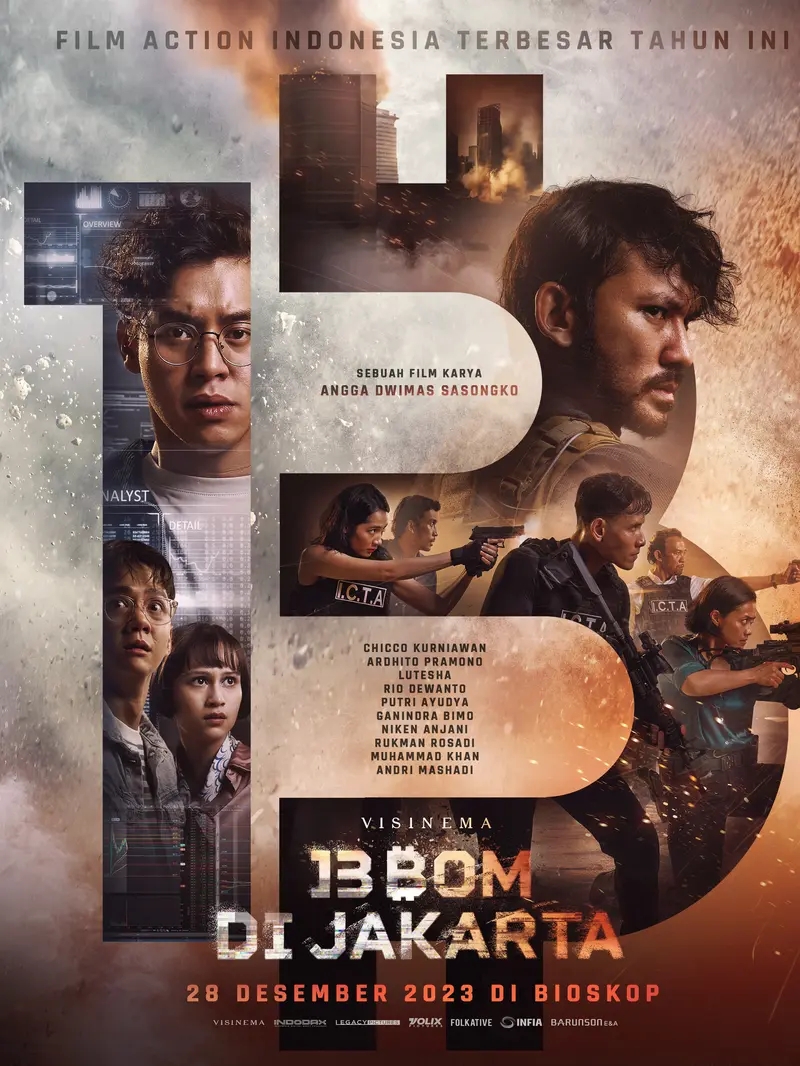
13 Bombs (13 Bom di Jakarta, Angga Dwimas Sasongko, 2023)

There’s an interesting juxtaposition in opening scenes of Angga Dwimas Sasongko’s action thriller 13 Bombs (13 Bom di Jakarta). A security guard in a cash van listens with exasperation to a radio broadcast voicing the nation’s economic decline before remarking that his mortgage keeps going up but his pay stays the same. Meanwhile, across town, two youngsters celebrate after receiving a huge payout from the cryptocurrency exchange app startup they’ve been running, drinking and partying oblivious to the poverty that surrounds them. Yet it’s the two youngsters that have unwittingly spurred a desperate man towards revolution, giving him the false idea of a utopia uncorrupted by money.

The interesting thing about the terrorists is that after attacking the cash van they blow the doors open and then leave without the money, allowing the people to pick it up instead. The explosion was apparently one of several more to come as the gang have placed 13 bombs around the city which they are holding to ransom, demanding to be paid in bitcoin solely through the boys’ exchange. The level of the crypto kids’ complicity is hard to discern, but it soon becomes clear they weren’t up for loss of life even if there’s a large payout at the end of it though they don’t really trust the police either. 

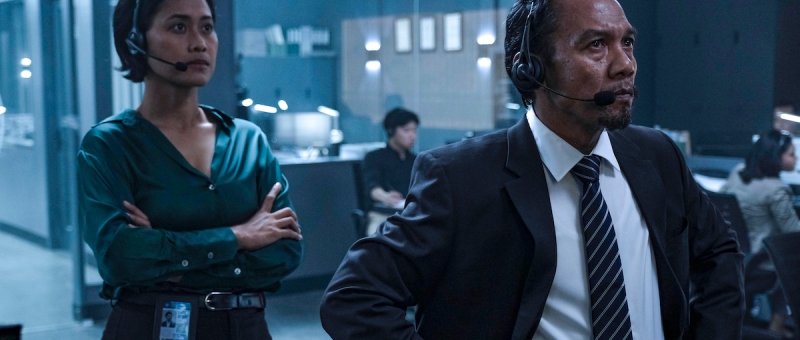
The police, or more precisely, the Counter Terrorism team, don’t come out of this very well. They’re originally quite reluctant to view the incidents as “terrorism” because that will make everything very “complicated” and also worsen the already precarious financial situation. They also seem to be fairly blindsided, arguing amongst themselves about the proper course of action with the sensible and reliable Karin (Putri Ayudya) often shouted down for relying too much on gut instinct as in her decision to trust bitcoin boys William (Ardhito Pramono) and Oscar (Chicco Kurniawan) only for them to immediately run away hoping to find the gang’s hideout for themselves after being disturbed by a strange message from the gang branding them as their allies.

Bitcoin seems like a strange thing for the revolutionaries to pin their hopes on, though it later seems they hope to do away “money” in its entirety, though it’s true enough that all of them have suffered because of the evils of contemporary capitalism. Many were victims of the same pyramid scheme, one man losing everything after his mother invested the family fortune and died soon after, and another scarred by the suicide of his wife and later death of his child. You can’t say that they don’t have a point when the press the authorities on their failure to protect the poor along with their uncomfortable cosiness with wealth and power. As their leader says, people starve to death every day because of poverty or die earlier than they would have because of a lack of access to healthcare yet the authorities don’t seem to be doing much at all to combat those sorts of “crimes”.

Nevertheless, there’s tension in the group with some opposing leader Arok’s (Rio Dewanto) increasingly cavalier attitude to human life and worrying tendency to suddenly change their well designed plans. The battle is essentially on two fronts, the police stalking them with traditional firepower and Arok fighting back with technology, harnessing the power of the internet to disguise his location while hacking police systems and public broadcasting alike to propagate his message of resistance against corrupt capitalism and oppressive poverty. Counter Terrorism does not appear to be very well equipped to deal with his new threat, but can seemingly call on vast reserves of armed troops even if in the end it’s mostly down to maverick officer Karin to raid the villains’ base largely on her own trying to rescue the boys after realising they are trying to help her after all.

These action sequences are dynamic and extremely well choreographed even if some of the narrative progressions lean towards the predictable and the final gambit somewhat far fetched in its implications. Then again, it’s also surprising that Counter Terrorism doesn’t seem to have much security and should perhaps have considered paying a little more for bulletproof glass in the control room. The subversive irony of the seeing the words “New Hope” and “deactivated” on the final screens cannot be overstated even as a kind of order is eventually restored in an otherwise unjust city.


13 Bombs screened as part of this year’s Osaka Asian Film Festival.

Original trailer (English subtitles)
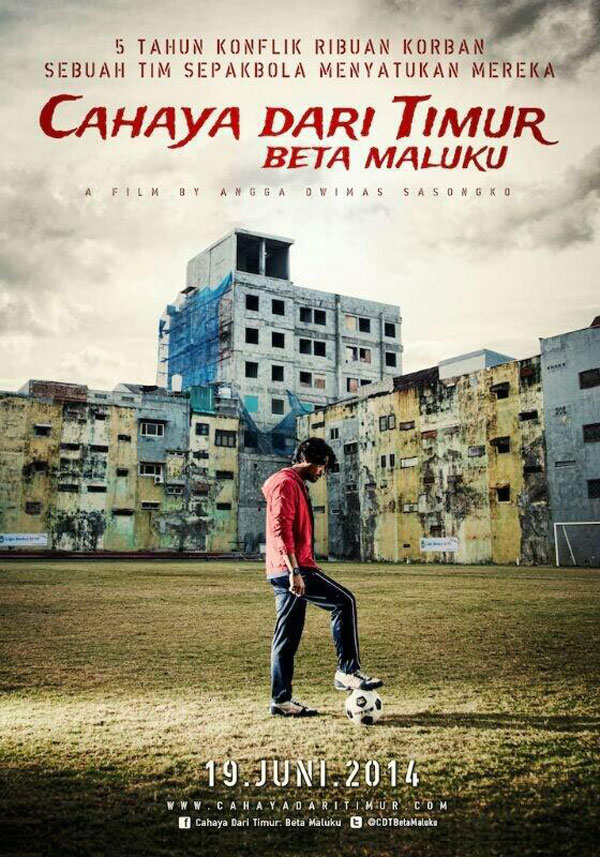
We Are Moluccans (Cahaya Dari Timur: Beta Maluku, Angga Dwimas Sasongko, 2014)

A motorbike courier finds himself torn between conflicting priorities when his community is threatened by internal strife in Angga Dwimas Sasongko’s inspirational sporting drama We Are Moluccans (Cahaya Dari Timur: Beta Maluku). As the title suggests, team sports provide a means of communal healing fostering both hope and unity among the young but even so the traumatic memories of the recent past prove hard to overcome while the older generation struggle in the wake of their own broken dreams and contradictory responsibilities. 

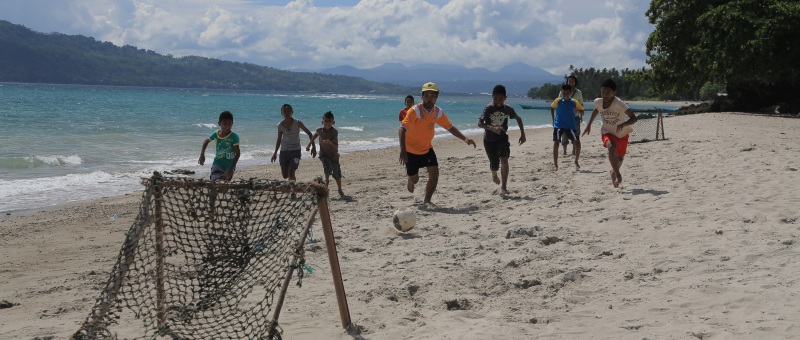
At the turn of the century, a violent conflict breaks out between Muslim and Christian communities who had until that point lived together in relative peace. With his motorcycle courier business disrupted by the ongoing chaos, former youth footballer Sani (Chicco Jerikho) begins coaching a collection of local boys mostly as a means of keeping them away from the immediate violence of the riots. As the situation begins to stabilise, his new responsibility to the children places a strain on his relationship with his wife, Haspa (Shafira Umm), who complains that he spends too much time giving back to the community while the family is struggling economically to the extent that she can no longer extend their tab at the grocery store. His old football friend Rafi (Frans Nendissa) is also struggling with his fishing business having lost most of his crew who fled the area’s violence and so the two of them begin to make the football club more formal but it soon becomes clear that they each have differing goals and responsibilities that endanger their partnership and the commitment they’ve made to the boys.  

At several points Rafi, not to mention Haspa, criticise Sani for what they see as irresponsibility while some of the other village men also accuse him of unmanliness for choosing to look after the children rather than fight with them to protect the village. His problem is that he’s too kind hearted but is entirely unable to order his priorities torn by the necessity of providing for his family and following through on the commitment he’s made to the neighbourhood boys. He often gives his hard won money away to those in need, angering his wife who cannot understand why he continues to help others rather protect his own family even giving away money he’d saved for their youngest daughter’s vaccinations and abruptly selling their goats without discussing it with her when she’d earmarked them as an emergency fund to pay the enrolment fees when the oldest daughter starts school. 

Because of the ongoing violence, many of the boys are in single parent families and live in relative poverty often needed to help out with their parent’s businesses. To begin with many are fine with them playing football so long as it keeps them safe but as they begin to grow older attitudes harden, many believing that it’s a “pointless” waste of time and too much of a distraction when the children should either be earning money or studying. Sani becomes a kind of surrogate father teaching the boys diligence and responsibility even if struggling with the same in his personal life but obviously cannot overcome the social and economic difficulties of small town life all on his own. His original goal was only to keep the children safe and ensure they had happy childhood memories that weren’t about hate, violence, and fear, whereas Rafi is much more ambitious floating the idea of opening an official football school while eventually deciding to run for public office further adding to Sani’s sense of personal inadequacy. 

“Nothing can destroy us as long as we have will to live a better life” Sani later tells the children, mistaken it seems in his belief that they would find it easier to overcome the differences between them when acting as head coach for a team representing the entirety of the local area. Many of the original team resent the introduction of “outsiders” from the nearby Christian town, but the difficulties turn out less to be about religion or community than trauma, the source of the problem being that the father of two of the Christian boys is a policeman whom another of the players blames for his own father’s death. While such tensions exist within the group the team continues to fail, losing not because of a lack of ability but because they cannot overcome the legacy of trauma to work together. The problem is only solved through a reassertion of their commonality as “Moluccans” rather than Muslim or Christian ironically forged in opposition to their current other which happens to be a team from Jakarta, the urban pitted against the rural. 

In any case, Angga Dwimas Sasongko’s inspirational drama eventually makes the case for mutual forgiveness as path toward putting the past to rest in order to move forward into a kinder and more prosperous era. The emotional closing scenes provide both a personal sense of acceptance in as Rafi begins to put his pride aside to support the local team while Muslims and Christians come together to listen to the nail-biting penalty shootout through their respective contacts in the auditorium after the TV broadcast cuts out before extra time. Demonstrating the power of sports to overcome cultural barriers, We Are Moluccans finally advocates for the right to dream as the youngsters begin to develop self-confidence and a sense of possibility while working together towards a clearly defined goal. 


We Are Moluccans streams in Poland until Nov. 29 as part of the 15th Five Flavours Film Festival.

Trailer (English subtitles)