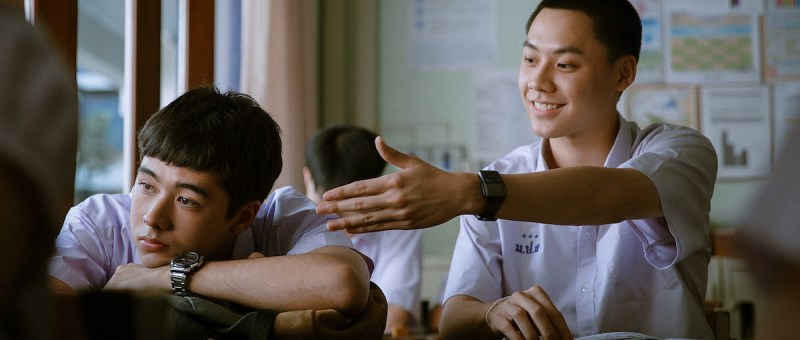
Not Friends (เพื่อน (ไม่) สนิท, Atta Hemwadee, 2023)

There’s a gentle sense of loss that runs through Atta Hemwadee’s quirky Thai dramedy Not Friends (เพื่อน (ไม่) สนิท), not only for those who are now absent and exist only in our memories but for missed opportunities and things left unsaid. Then again, its hero, Pae (Anthony Buisseret), takes a while to warm up to the benefits of friendship, like many teenage boys resentful and alienated, unable to accept the hand extended to him by his infinitely cheerful new deskmate, Joe (Pisitpol Ekaphongpisit), who walks around with a beatific smile permanently plastered across his face. 

Before he can make amends, however, Joe is hit by a car after returning from a school trip sending the school into a period of shocked mourning that for some reason includes a talent contest. After hearing of a competition that offers entrance to film school as a prize, Pae decides to enter and to make his late “best friend” Joe the focus of the film only to immediately be caught out in his duplicity by Joe’s former best friend Bokeh (Thitiya Jirapornsilp) who resents his intention to exploit Joe’s death for his own ends. 

It has to be said, that Pae does not come out of this well though his predicament does highlight a social stigma towards working class boys in his intense desire to escape having to take over his dad’s flour mill having been teased by his former classmates about his “stinky shirt” because he has to air dry his clothes in an area adjacent to the factory. A similar sense of lonely alienation is found in a short story Joe had submitted to a story contest which is about a boy who feels hopelessly ordinary and looks up to the stars thinking about all the other versions of himself on other planets who are “special”, top athletes or super spies or dim but loved by those around him. The boy wants his other selves to see him and know that he is special too, but seems not to feel it himself. 

Coming late to the idea, Pae slowly realises that Joe is special because “Joe is our friend” though he’d mostly ignored his attempts at friendship while he was alive. In any case, he doesn’t really notice the friendships he’s making with Bokeh or the others working on the film either but remains focussed on his own goal of winning the contest and escaping the flour mill. In the end the film he’s making ends up becoming less about Joe himself and more of an ode to absent friends, something echoed in Bokeh’s valedictory speech in which she bids goodbye to her “best not friends” and hopes that though they may not meet, they’ll miss each other every now and then. 

It comes down to a question of what friendship really is and whether Pae can be persuaded to abandon his sense of self interest to defend it. He realises that Joe had a lot of dreams too, ones he never got to fulfil and a couple that could be fulfilled for him if not in reality than in fantasy imagining how their lives might have turned out if Pae had been less self-involved and Joe had lived. Still, on finding out something unexpected he’s forced to confront the idea that perhaps you don’t really know anyone. Everyone knows a slightly different version of the same person but friendship is really about shared intimacy and a willingness to be open and vulnerable while simultaneously respecting the boundaries of others.

To that extent it really is about the friends we make along the way. Pae slowly comes to realise that he’s accidentally become friends with the crew on the film and lets go of some of his resentment becoming less self-centred and more willing to interact with others even warming to his father and family business he’d previously been ashamed of while also gaining the courage to pursue his dream of a career in film. Cineliterate, Atta Hemwadee breaks the action with a filmmaking rap and makes frequent references to popular film but invests the high school movie with a wistful sense of loss and nostalgia for the absent friends of youth whom we miss once in a while but are in another sense always with us. 


 Not Friends screened as part of this year’s Osaka Asian Film Festival.

Trailer (English subtitles)

You & Me & Me (เธอกับฉันกับฉัน, Weawwan Hongvivatana & Wanweaw Hongvivatana, 2023)

A pair of identical twins come to consider an inevitable separation on the eve of the Millennium in twin directors Wanweaw Hongvivatana and Weawwan Hongvivatana’s quirky Thai comedy You & Me & Me (เธอกับฉันกับฉัน). Set in 1999 and apparently autobiographically inspired, the film follows the two young women as they face the coming end of the world in Y2K anxiety, but for all that their world really is ending as they find themselves shipped off to the country with their mother as their parents embark on a trial separation with the looming threat of divorce. 

Amusingly named “You” and “Me”, the girls (both played by Thitiya Jirapornsilp) are all but inseparable and reflect that they are glad never to feel lonely and always to have someone to share things with. They rejoice in their sameness rather than resenting it and often use it to trick the world around them so they can get two dinners for the price of one or sneak each other into cinemas on a single ticket. They swap places all the time and occasionally sit exams for each other to maximise their individual strengths. But then, when Me sits a maths exam for You she ends up meeting fellow student Mark (Anthony Buisseret) who “shares” his pencil with her by breaking it in two. Mark then abruptly disappears, but the girls reencounter him once they go to stay with their grandmother in the country (Karuna Looktumthong) where he has also relocated following his parents’ divorce only he thinks the girl he gave his pencil to was You, not Me. 

Mark may be the first thing they can’t really “share” though in a way that’s what they end up doing. Me never tells her sister she likes Mark, and You doesn’t realise it was Me he liked at the maths exam, but gradually he starts to come between them if only in disrupting their dynamic as You starts to want more time away from her sister and Me feels as if she’s being abandoned. Half a melting ice lolly lying untouched in a glass seems to neatly sum up her views about the changing nature of their relationship as sisters. But then they’re also at the age in which their sameness might start to bother them. Me abruptly goes out and gets a different haircut, as if she wanted to play her sister at her own game and assert her individuality even if it ends their childish games of place swapping and trickery. 

The millennial apocalypse is also a symptom of their adolescent anxiety as they try to come to terms with impending adulthood and the changes that will inevitably take place in their lives meaning they too will need to split and necessarily head in different directions though it doesn’t mean they’ll be less close or connected, especially with the “Y2K safe” mobile phones their dad tragically thinks are his next big business opportunity. The film takes them from Bangkok to the country where their grandmother still speaks in dialect and in all honesty Y2K might not matter all that much even if the girls run up grandma’s tab in the local shop trying to prepare for the end of the world. The television news is full of tales of mass suicides and Nostradamus, but their problems are both bigger and smaller as they ponder fresh starts in a new century which is only really the entrance to the next stage of their lives. 

Millennial nostalgia and the laidback atmosphere of the Thai countryside lend the film a peaceful air of serenity as the girls begin shift towards acknowledging their individual identities over their bond as sisters, not exactly rejecting their sameness but adjusting it in considering the future paths of their lives. Playing both sisters, Thitiya Jirapornsilp captures a sense of what make Me Me and You You but also what they are together and the anxieties they each face as twins, something of which the directors have first hand knowledge in repeatedly insisting that in the end twins are just the same as everyone else even if the girls sometimes have trouble separating themselves from each other. Strangely poignant in its Millennial conclusion, the film nevertheless ends on a note of warmth and solidarity in which the two sisters prepare to step into the new century independently and together no longer so afraid of whatever it might bring. 


You & Me & Me screened as part of this year’s New York Asian Film Festival.

International trailer (English subtitles)

Images: ©2023 GDH 559 Co., Ltd.