East Palace, West Palace (Intro)

Text of an intro given at the Barbican Cinema, 29th June, 2023

East Palace, West Palace (东宫西宫, Dōng Gōng Xī Gōng) is often described as the first film to explicitly depict homosexuality in contemporary China though there had of course been films with strong queer subtext even as far back as Xie Jin’s Two Stage Sisters in 1964 which followed two female performers of Chinese opera who take very different paths leading up to the foundation of the People’s Republic in 1949. Chen Kaige’s 1993 landmark drama Farewell My Concubine was set partially in a similar time period and also takes advantage of the gender fluidity found in Peking Opera to depict the tragic love of a performer specialising in female roles for his male co-star. 

Despite its success on the international festival circuit, Farewell My Concubine was heavily censored on its domestic release and in fact temporarily removed from cinemas. East Palace, West Palace was smuggled out of China for editing in France after filming concluded in 1996 and was submitted to the 1997 Cannes Film Festival without receiving government clearance. A similar fate would befall China’s first explicitly lesbian film, Fish and Elephant, a print of which was lost en route to the Venice film festival in 2001 though it managed to screen at a few international festivals on videotape. 

Director Zhang Yuan was not able to travel to Cannes to support East Palace, West Palace because the authorities seized his passport on his return from a trip to Hong Kong while they had also pressured the producers of Zhang Yimou’s Keep Cool to boycott the festival if they insisted on screening the film. Cannes responded by empty chairing Zhang Yuan in order to make his absence highly present. Zhang had already been banned from filmmaking in a 1994 crackdown along with a series of other directors including Wang Xiaoshui (So Long, My Son) and Tian Zhuangzhuang (The Horse Thief, The Blue Kite) because of the transgressive nature of his work which often focused on marginalised communities and painted an unflattering portrait of contemporary China. 

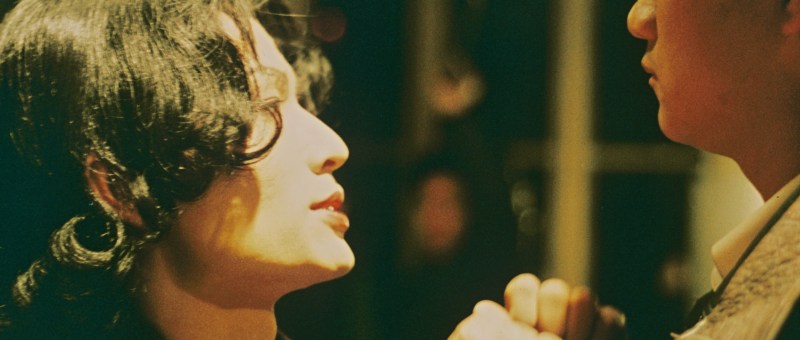
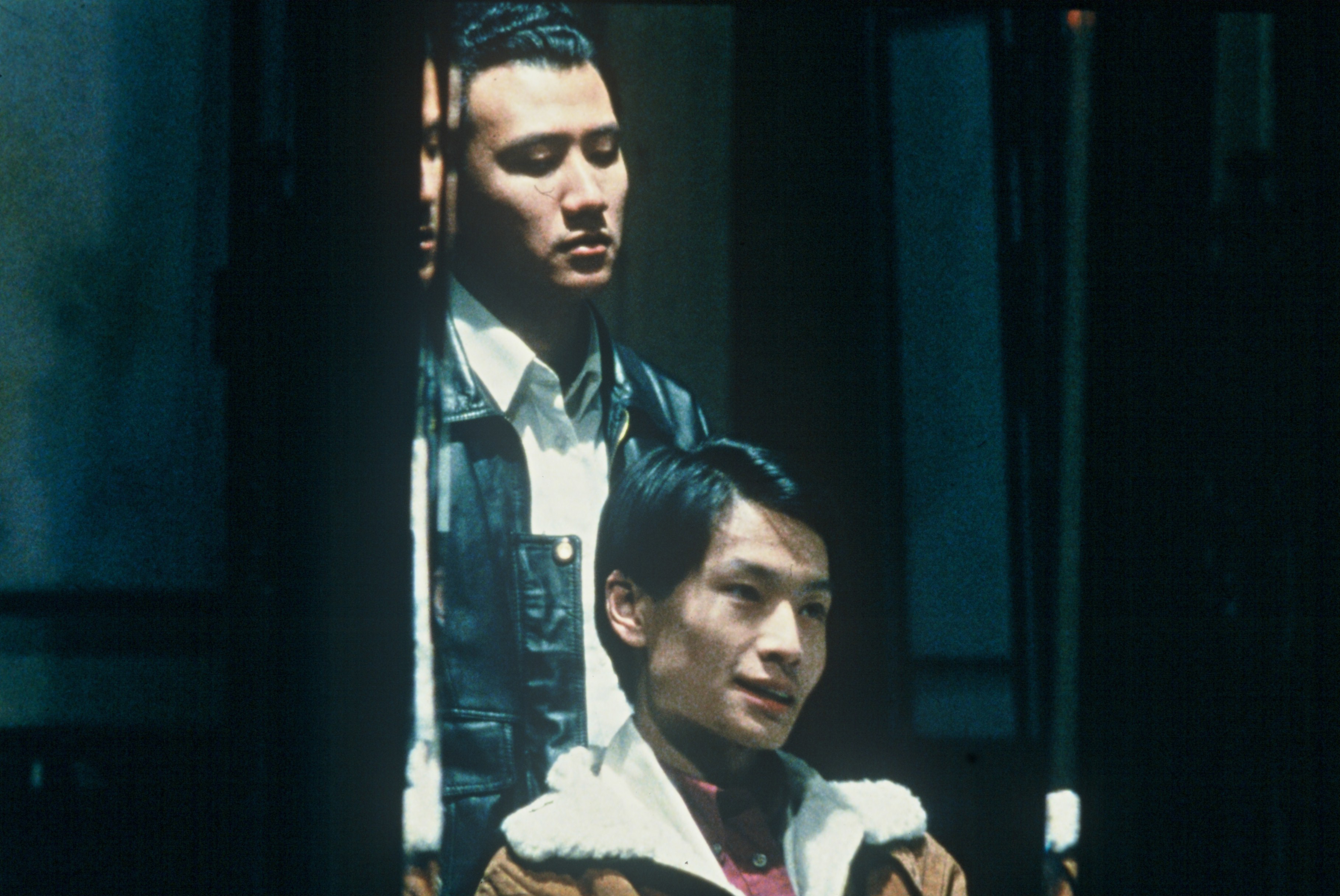
East Palace, West Palace which takes its title from a phrase referring to the mens’ public toilets in on either side of the Forbidden City widely known as gay cruising spots, is no different and depicts the lived reality of gay men in the conservative society of 90s China. Homosexuality was not against the law at the time but gay men were often harassed by the police and accused of the nebulous offence of “hooliganism” as you will see in the film when the park is raided and the men rounded up to be humiliated by the local police force who insult, threaten, and beat them though they have not done anything illegal. Led away by a policeman, Xiaohua, A-Lan, a young gay man, transgressively kisses him on the cheek and takes advantage of his shock and confusion to run away. Zhang’s implication is that A-Lan runs in order to be chased, and the relationship between himself and the guard is an allegory for that between the oppressed populace and the authoritarian regime in post-Tiananmen China which is essentially sadomasochistic in nature. 

Zhang’s previous films had largely been shot in a hyper naturalistic, documentarian style but co-scripted by Wang Xiaobo, East Palace, West Palace represents a radical departure in its overtly theatrical overtones in which the balance of power is constantly shifting and prisoner and guard become in a sense interchangeable. Like Two Stage Sisters and Farewell My Concubine, it plays with the aesthetics of Peking Opera in the allegory A-Lan offers while asked to explain himself by Xiaohua in what is really a complex dance of seduction in some ways reminiscent of Kiss of the Spider Woman in which Xiaohua is also forced to confront his own possibly latent homosexuality. 

It’s also worth noting that the actor who plays the policeman Xiaohua, Hu Jun, would go on to star in another Mainland queer classic as the closeted businessman at the centre of Stanley Kwan’s Lan Yu who falls in love with a young student amid the Tiananmen Square protests. Si Han, who plays A-Lan, was like the stars of Zhang’s earlier films a non-professional actor though he was not recruited from the Beijing gay scene but had been the makeup artist with Zhang’s film crew. Unfortunately given the high quality of his performance he has no further acting roles to date, though he does appear as himself in the film Looking for Tsai and resettled in Sweden after the film was completed where he is now an art curator. Those more familiar with Chinese cinema may also be surprised to spot a young Zhao Wei, also known as Vicky Zhao, as the middle school student in A-Lan’s flashbacks who went on to become for a time one of the highest paid actresses in China and made her own directorial debut with the film So Young in 2013. 

After the film’s release, Zhang Yuan shifted increasingly towards more mainstream filmmaking and picked up the Best Director Award in Venice for Seventeen Years which was ironically the first film to be given approval to shoot inside a Chinese prison. Nevertheless, he continued to address queer subjects in a short documentary focussing on transgender dancer Jin Xing who was the first person to publicly undergo gender affirming surgery after beginning her career in the military performance troupe and subsequently became a popular TV personality with her own talk show, and in the 2014 narrative short Boss, I Love You which is completely wordless and explores same sex attraction within the power dynamics of the contemporary society as a chauffeur falls for his callous boss. 

In the present day, the Mainland censorship regime still retains a strong bias against representations of queer people and relationships leaving LGBTQ+ cinema mainly in the underground and independent sectors where they are more likely to be picked up for international festivals as was the case with transgender drama The Rib from 2018 which focusses on a woman’s struggles to get her conservative father’s signature on a permission form she inexplicably needs for surgery despite being over 40 years old, or A Dog Barking at the Moon which won the Jury Prize Teddy Award in Berlin in 2019 and explores the destructive legacies of repression and marriages of convenience. In any case, East Palace, West Palace remains a defiant time capsule of queer life in post-Tiananmen China and a quietly beguiling romantic fable in the oscillating waltz between power and the powerless. I hope you will enjoy it.

20,000 Days on Earth

20000DAYS_QUAD4

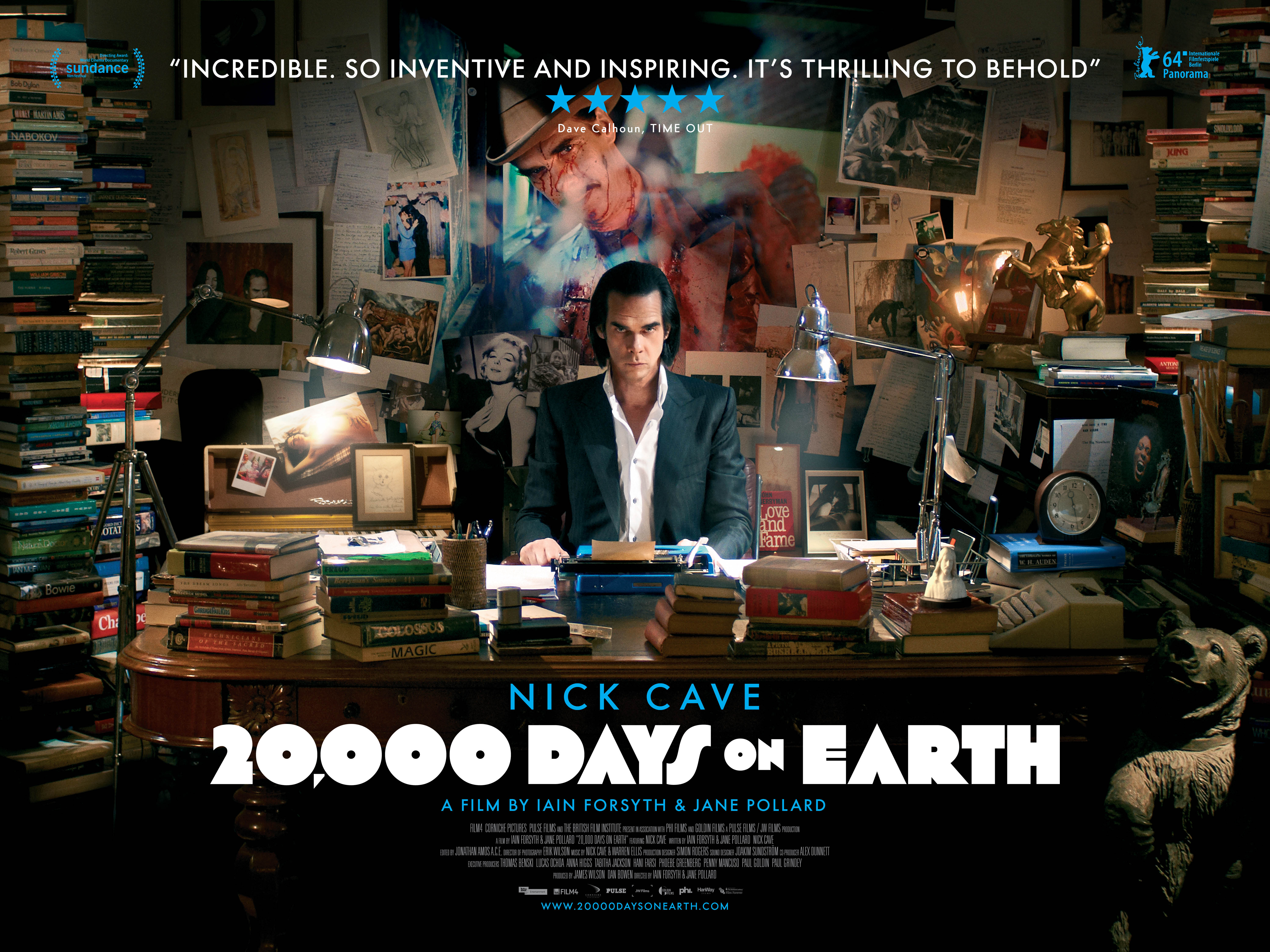
Nick Cave – post-punk, counter culture legend, novelist, screenwriter and occasional actor has certainly led a very full life and on the day we meet him is living his 20,000th day on the planet. It is, of course, a fairly arbitrary number and a fictional conceit taken from one of Cave’s old notebooks in which he realised he was exactly 20,000 days old when he began working on the album that would eventually be released last year – Push the Sky Away. 20,000 Days on Earth is not your usual rockumentary – part fictionalised, fairly light on personal histories and musical performances, the film seems to want to push deeper into the nature of art, and the artist, more than the man known as Cave.

The film begins with an explosive series of images ranging from the important pop-culture moments of the last fifty years to what could be the personal images of someone’s life alongside a clock counting up to the all important 20,000th day. Cave, awake at 6.59, gets up from his all white bed leaving a still sleeping dark haired woman with her face obscured by pillows (presumably his wife, Susie). He informs us that he ceased to be a human being at the end of the twentieth century – he eats, writes, watches TV, plays with his children and ‘terrorises’ his wife. This fictional 24 hours in the creation of an album sees Cave probing and re-evaluating his life as an artist, his creative process and ultimately his purpose in life. What it does not do, particularly, is attempt to tell the story of Cave’s life or reveal any great personal truths but this extraordinary and ramshackle testament to the nature of art is as beguiling as it is inspiring.

Cave narrates his story with the air of a pulpy noir detective sitting down at a typewriter, probably fatally wounded, to tell us how it all went wrong after ‘that dame’ walked into his office. Equal parts Walter Neff leaving a last confession on a tape recorder and a punkish William Burroughs offering poetic and philosophical musings on the nature of memory and the art of transformation, Cave imparts to us the secrets of his craft. It’s not all solo musings though as Cave is visited by three ‘ghosts’ of his past each accompanying him on a picturesque drive along Brighton’s seafront. With actor Ray Winstone, who starred in the Cave scripted The Proposition, Cave seems deferent but talks about his love of performing and rejection of conscious ‘re-invention’. A second meeting with ex-bandmember Blix Bargeld feels rawer as they discuss the reasons for his departure from the band but the third, with fellow Ozzie Kylie Minogue feels altogether warmer and more cheerful. Each disappear as mysteriously as they arrived and you can’t help but wonder if they were ever really there at all or just a re-conjured memory or an imagined conversation only existing inside Cave’s mind. That’s not to mention the frequent reminiscences with more recent collaborator Warren Ellis about shared memories and an artistic working relationship or the fake interview with a psychoanalyst who probes Cave on his earliest sexual experiences and relationship with his father.

Cave describes himself at one point as ‘a front row kind of guy’ and worries that his performances don’t stretch so far beyond that. He likes to pick an audience member and ‘terrify’ them, there’s something about the mix of awe and terror that fascinates him and indeed the scenes from an intimate concert at Camden’s Koko show him bringing one female audience member to a state of near fearful ecstasy – such is his stage presence. The film features scenes from the creation of an album but isn’t the usual chronicle of its completion nor an exploration of the album itself. The whole thing climaxes with a triumphant performance sequence taken from a high octane concert taking place at Sydney Opera House which bears testimony to his skill as a stage performer and the ultimate justification of everything that’s gone before. In a slice of cinema magic, Cave appears to step out of Sydney Opera house directly onto the pebble beach at Brighton where he offers another description likening the process of songwriting as being like a sighting of a sea monster – sometimes you only see the humps but it’s your job to lure Nessie to the surface.

20,000 Days on Earth sometimes feels like one of those late night pub corner conversations with a mysterious old man who’s decided he wants to tell you his story. You aren’t sure if any of this is true, and some of it certainly sounds improbable in the least, but something about his delivery or the look in his eyes makes you want to believe him. He’s telling you the story he wants you to hear which bears its own truth, even if it wasn’t the one you were expecting. Lyrical and strangely profound 20,000 Days on Earth is an inspiring journey inside the mind of an artistic genius.

Crossroads of Youth – Barbican centre 2nd August 2012

London was treated to something very special today as Korea’s oldest surviving silent film was screened at the barbican exactly the way its original 1934 audience would have seen it.

Young-bok has been adopted into Bong-Sun’s family as her intended husband. For seven long years he’s done everything that’s been asked of him, no matter how tedious or demanding, without complaint. Now 21, Bong-sun’s father is beginning to think the time for Young-bok’s marriage is near seeing as Bong-sun is now sixteen. However, tragedy strikes as Bong-sun is seduced by another man from the village. Heartbroken, Young-bok takes off for the city to make something of himself there, leaving his mother and sister behind in his home village.

Although Yong-bok is a good and kind young man, his heartbreak leads him to waste his life in drink. When working at the station one day he catches sight of the man who crushed all his young hopes in the village – little does he know of the havoc he is still to wreak on Young-bok’s city life.

Unbeknownst to Young-bok, his younger sister has come to the city to look for him following the death of their mother. Unable to find him she takes a job as hostess in a bar where she falls prey to the same man that ruined Bong-sun and an even worse friend of his. Young-bok also begins a tentative romance with a girl, Ge-soon, who pumps petrol but she has her own problems as her father’s ill health and rising debts have decreed she is to become the third wife of a money lender to satisfy them. Can these three young people find each other and happiness despite the poverty and hardship to which they’ve been subjected?

In contrast to the way silent films were usually seen in the west, in Korea rather than the intertitles we use to give crucial information of the story a live narrator (byeonsa) would interpret the action and/or act some of it out. As I understand it director Ahn’s original script is lost (though fortunately a brief synopsis had survived) and a new version had to be put together by closely watching the film and filling in the gaps.  Kim Tae-yong director of Late Autumn and Family Ties effectively re-directed the piece for for the stage along with Cho Hee-bong who fills the role of the narrator. The new script is obviously not afraid to embrace the melodrama of the film’s storyline in a self aware way, even throwing in a few knowing jokes at its own expense.

The performance began with a song by two young actors portraying Ge-soon and Young-bok, both of whom had absolutely wonderful voices and interpretation. Even though there were no subtitles for this first part it didn’t matter as the heartfelt intention of the song came across perfectly. Once this finished the film started playing with English subtitles for what the narrator was saying. Occasionally the subtitles didn’t cover the length of the narrator’s speech or perhaps missed some of the nuances of his humour but there was never a problem knowing what was going on. There was then another song about half way through covering a particularly intense scene between Ge-soon and Young-bok with the narrator adding occasional dialogue in the middle and a final song song functioning as an epilogue. The film was accompanied throughout by a band of four musicians playing an energetic and lively score which worked extremely well with the film and atmosphere.

All in all it was a fascinating and extremely enjoyable experience which deserves to be seen as widely as possible.