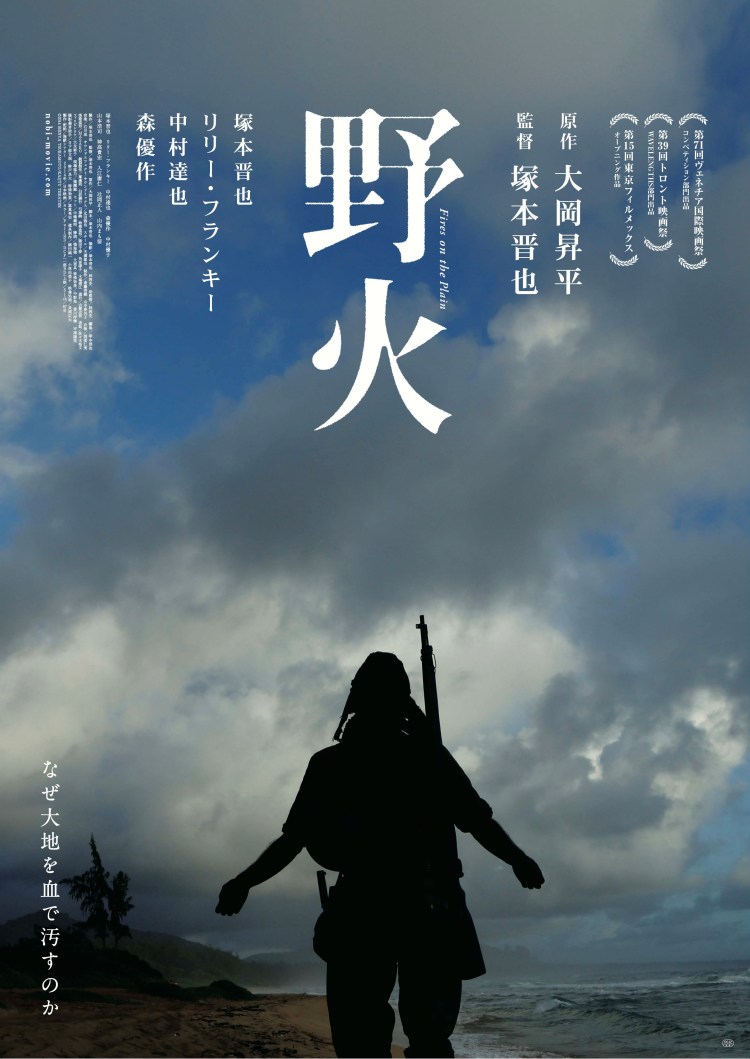
Fires on the Plain (野火, Shinya Tsukamoto, 2015)

fires on the plain 2015 posterShinya Tsukamoto is back with another characteristically visceral look at the dark sides of human nature in his latest feature length effort, Fires on the Plain (野火, Nobi). Another take on the classic, autobiographically inspired novel of the same name by Shohei Ooka (previously adapted by Kon Ichikawa in 1959), Fires on the Plain is a disturbing, surreal examination of the effects of war both on and off the battlefield.

Late in the war when it’s almost lost though no one wants to admit it, Corporal Tamura (Shinya Tsukamoto) finds himself suffering with TB on the Philippine island of Leyte where supplies, and tethers, are running short. Shortly after being punched in the face by his commanding officer, he’s given five days’ worth of supplies and ordered to march to the field hospital for treatment as no one wants a sick man weighing down the unit. Only, when he finally arrives at the field hospital, they have their hands full (literally) with the battlefield wounded. Marching back to his unit again, Tamura is ordered back to the field hospital and told to use his grenade to ease the burden on his fellow soldiers if refused. So begins Tamura’s fevered, mostly solitary odyssey across the beautiful landscape of the Philippine jungle suddenly scarred with corpses, the starving and the mad.

Tsukamoto’s adaptation sticks closer to the original novel than Ichikawa’s 1959 version, though both eschew Ooka’s Christianity. Tamura is a man at odds with his fellow soldiers. Formerly a writer he’s “an intellectual” as one puts it, and a little on the old side for a corporal. Coughing and wheezing, he shuffles his way through just trying to survive. Unlike Ooka’s original novel in which the protagonist’s Catholicism makes suicide an unavailable option, it’s the memory of Tamura’s wife which stays his hand on the pin of his grenade. Tamura wants to go home, to escape this hellish island full of the walking dead, hostile locals and hidden clusters of enemy troops.

To get home, to survive, what will it cost? There was barely any food left to start with. The original five days’ worth of rations Tamura was given amounted to a handful of yams. On his second trip to the military hospital he was given nothing at all. There’s no wildlife, even if you manage to find some plant roots they’ll need cooking. Of course, there is one abundant source of food, except that it doesn’t bear thinking about. Tsukamoto’s version takes a less ambiguous approach to the idea of cannibalism than Ichikawa’s which removed Tamura’s moral dilemma by having his teeth fall out through malnutrition and rendering him unable to indulge in “monkey meat” even if he might have succumbed. Death feeds on death and there’s no humanity to be found here anymore where men prey on men like animals.

There’s no glory in dying like this. Half starved, half mad and baking to death in the heat of a foreign jungle abandoned by your country which cared so little for its men that it never thought to conserve them. When you make it home, if you make it home, you aren’t the same you that left. The things you had to do to get there stay with you for the rest of your life, and not just with you – with all of those around you too. Wars don’t end when treaties are signed, they survive in the eyes of the men who fought them.

A timely and a visceral look at the literal horror of war, Tsukamoto’s Fires on the Plain is a refreshingly frank, if stylised, examination of the battlefield. Limbs fly, heads explode, organs are exposed and brain fragments leak out of ruined corpses. At any other time, Leyte would be a paradise of lush vegetation, colourful flowers and beautiful blue skies but it’s corrupted now by the fruits of human cruelty. This is what it means to go to war. There’s nothing noble in this – just death, decay and eternal grief. Though the film often suffers from its low budget and some may be put off by the stark, hyperreal cinematography, Fires on the Plain is another typically troubling effort from the master of discomfort and comes as a warning bell to those who still think it is sweet and fitting to die for one’s country.


Reviewed at Raindance 2015.

Original trailer (English subtitles)

First published by UK Anime Network.
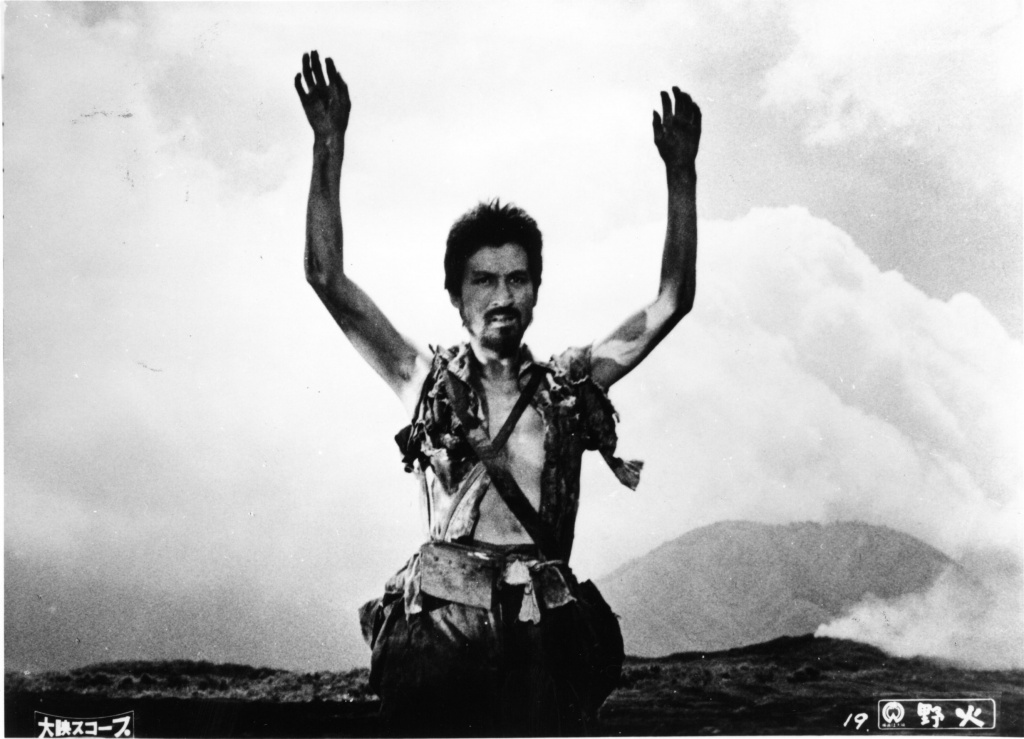
Nobi: Fires on the Plain (野火, Kon Ichikawa, 1959)

86485840228b9d174ae44b6a189f8c0bIt’s a fallacy to think Japan doesn’t make war films. Or perhaps, more that they didn’t make them until the recent swing to the right in Japanese politics seems to have made it OK to make Hollywood style war movies. Up until the sixties, Japanese cinema was willing and able to engage with the darkness of the recent past and several wonderful films such as Kobayashi’s The Human Condition (Ningen no Jouken 人間の条件) or Okamoto’s The Human Bullet (Nikudan 肉弾) not to mention Ichikawa’s own The Burmese Harp (Biruma no Tategotoビルマの竪琴) presented the still fresh sorrow and regret associated with Imperialist ’30s onwards. None of them, however, come close to the hellish world of Fires on the Plain (Nobi 野火).

Based on Shohei Ooka’s novel of the same name, Fires on the Plain begins with the beleaguered conscript Tamura (Funakoshi Eiji) being berated (at length) by his commanding officer for returning from the field hospital earlier than expected. Despite having been given five days food, Tamura has returned after just three days because the hospital refused to admit him. Sick with TB, Tamura is told the hospital feels its duty is to the battlefield wounded – not those who’ve been unlucky enough to catch a debilitating and often terminal condition. Of course, his CO doesn’t want him back either – with only so many resources left and staring defeat in the face, why waste food and effort on a man who can’t pull his weight and is probably going to die anyway. And so, Tamura is sent back to the field hospital with no additional food and instructed to wait there until they let him in or alternatively, there’s your grenade – isn’t there? Do the decent thing. Thus begins Tamura’s bleak odyssey into the depths of human depravity, trying desperately to survive in the unforgiving Philippine jungle.

Legend has it that Funakoshi was so dedicated to the part that in true method fashion he’d been living on a starvation diet prior to the film’s starting and in fact actually caused it to be halted almost immediately when he collapsed from severe malnutrition. That might in part explain his miraculous performance with vacant, staring eyes like someone whose soul has gone somewhere far away. His halting and confused speech, understanding and not understanding, desperate to survive but terrified of what he might become – Tamura has no choice but to keep on walking, trying to find something to cling on to. Everybody knows the war is lost, yet there’s nothing they can do but keep on fighting. Tamura even considers the unthinkable – surrender, but another soldier beats him to it and is promptly mown down by a machine gun wielded by a Filipina resistance fighter working with the Americans. The most pressing problem is the lack of food. There is very little to live on left on the island which has been well and truly wrecked by every side. You can steal food from the indigenous people (if you can find any) or there’s ‘monkey meat’. The great taboo – cannibalism. Ultimately Tamura decides sometimes the price for survival is just too high if you won’t be able to live with what you’ve done.

In the west, particularly in the US, the film was criticised for its ‘sympathetic’ portrayal of Japanese soldiers – that it was another instance of Japan ‘playing the victim’ which was a common American reaction to the more contemplative war films of Post War Japan. It is true, the films glosses over the immediate situation of the Japanese occupied Philippines though the film largely takes with the Japanese on the run from American troops and the Philippine resistance. The fact there have been atrocities is never directly addressed though it hangs in the background like a grim, guilty spectre. It might explain why Tamura’s early meeting with a pair of villagers who’ve made a stealthy visit to their abandoned home to retrieve a parcel of salt buried under the floor becomes so fraught. In the first instance, Tamura was foolish to enter the house and approach them – even his disordered mind he must have known it was very unlikely they’d react kindly to his presence. If he just wanted to know what was buried under the floorboards, he had only to fire a warning shot and scare them off before they could dig it up and then retrieve it himself. When he does show himself the male villager runs off but the female is so scared she can barely move and can’t stop screaming. Tamura shoots her and takes the salt for himself. Disgusted with his actions he throws his rifle into the nearest pond. That isn’t to say the film lets Tamura, or indeed the other men or the whole Japanese war machine, off the hook. Only that they’ve become this way because of what war reduces you to – less than animals, surviving by any means even if that means betraying your fellow men.

Fires on the Plain was adapted from Shohei Ooka’s novel of the same name by Ichikawa and his screen writing wife Wada Natto who, while keeping broadly to the tone and spirit of the book, made several changes. The most obvious being to the structure of the novel which has more of a framing sequence, an unreliable first person narrator and a complicated structure. In the novel Tamura, a fictionalised version of the author, is a Christian and the book is written with a Christian view of the world rather than the traditionally Japanese viewpoint common to the majority of soldiers. Therefore, Ichikawa decided to remove the Christian themes from the film in order to present Tamura as more of an everyman though the Tamura of the book is presented much more ambiguously. This also explains the changes to the film’s ending which is bleaker and less forgiving that than that of the novel.

One of the most horrifying depictions of war ever put on screen, Fires on the Plain lays bare the true horror of warfare. Trapped in a sort of purgatory, forced to wander the jungle waiting for the inevitable yet desperately clinging on to life, Tamura’s story can’t be described as anything less than hellish. Wading past corpses, mud, blood and those who’ve already gone mad – this is humanity at its lowest point. Even if you meet another soldier, they can’t be trusted – it’s every man for himself. Ichikawa’s world is bleak beyond belief with no hope in sight, the only possibility of salvation lying in the large fires that appear at distant points along plains. Everyone assumes them to be a signal of some kind but nobody knows what they mean or for whom they are intended. A descent into hell, Ichikawa’s Fires on the Plain is one of the most realistic and most powerful anti-war films in cinema history.

Fires on the Plain is unavailable in the UK but is available in the US from the Criterion Collection. Shohei Ooka’s book is likewise unpublished in the UK but is available in English in its original 1957 translation by Ivan Morris currently in print from Tuttle in the US though it should be noted that Morris’ translation is itself heavily edited.