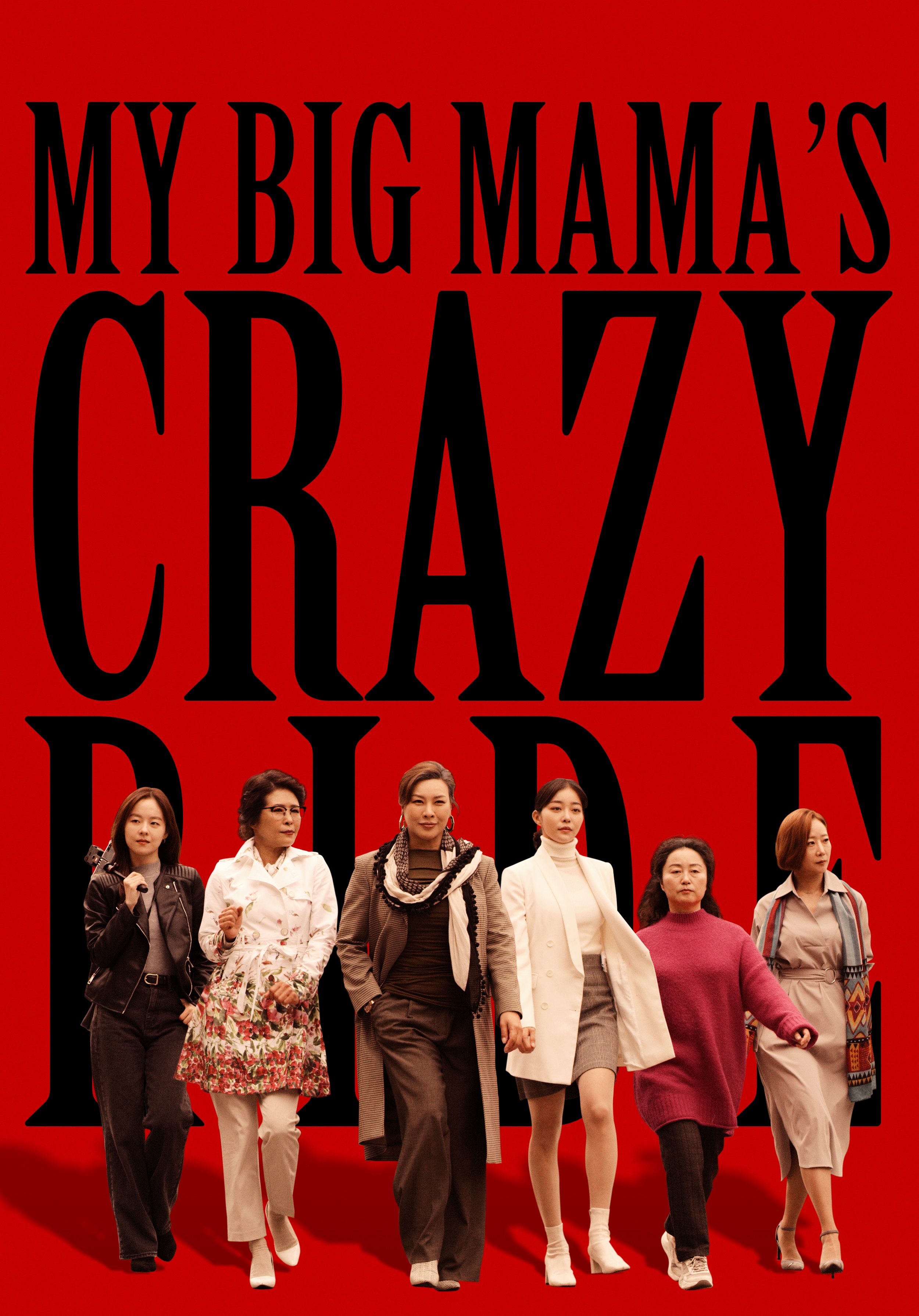
Iron Mask (만분의 일초, Kim Sung-hwan, 2023)

A young man seeking revenge sets his eyes on kendo glory in Kim Sung-hwan’s sporting drama Iron Mask (만분의 일초, Manbun-ui Ilcho). As his coach reminds him, a swordsman’s only opponent is himself though he continues to fixate on the man he blames for the destruction of his family still as an adult seeking reparation for the paternal influence he feels was stolen from him and the right to a legacy he feels to be rightfully his.

That might be one reason Jae-woo (Joo Jong-hyuk) is sometimes taken to task for his “entitlement” while some of the other students attending this training camp in the hope of making it onto the national team think he shouldn’t even be here seeing as he only came second in a regional competition when the others are veteran champions. But then as it turns out, Jae-woo has an ulterior motive for his participation. He is obsessed with number one challenger Tae-su (Moon Jin-seung) but for reasons outside of the sport, apparently hellbent on taking his revenge through kendo though it isn’t particularly clear what he hopes to achieve by it save personal vindication.

Kim pays particular attention to the peculiar rituals of the sport, a sense of rigorous order in the folding of the bandannas and tightening of the strings that fix the mask to the swordsman’s face while it’s clear that Jae-woo’s weakness is his emotional volatility. Though he manages to strike an impressive blow against Tae-su on the first day, his game then declines largely thanks to a hand tremor partly caused by a blow from Tae-su but also a manifestation of his jangling nerves.

He resents Tae-su on a personal level, irritated when he hears him talking on the phone to his wife about parenting their young daughter outraged that this man who he holds responsible for the implosion of his family has a family of his own while Jae-woo appears to have nothing other than his rage and resentment. He cannot forgive his estrangement from his kendo master father or that he chose to train another boy and not him, though perhaps that was simply his father’s way of coping with an impossible situation in the hope of making something good out of a personal tragedy. As another kendo master later tells him, as his father once did Jae-woo will have to find his own answers if he is to find success in kendo and indeed in life.

Still he struggles with fatherly relationships, first bonding with an older man who has two sons of his own and tries to impart paternal wisdom and comfort to the volatile Jae-woo but later accidentally injuring him during a sparring match when his temper gets the better of him. The only way he can free himself, is by moving past his image of his father to become his own man and also claim his own kendo rather than being resentful of that which was not bequeathed to him but to Tae-su for whom kendo is also a means of atonement and honouring of a paternal legacy.

Kim lends the battle a quasi-mythical quality, shooting a realm of eye-shaped mist as Jae-woo confronts Tae-su in his mind seeing only clashing swords and shadows while still unable to recognise that the man he is in competition with is only himself, his resentment and hurt in his abandonment, still a lonely little boy failing to become a man while Tae-su at least seemingly has been able to move on and make something of himself. Only by calming his nerves can he begin to perfect his art, taking the advice given to him by the team’s video replay expert seriously and apologising for his petulant behaviour. 

In essence, he has to escape from the “iron mask” of his repressed emotion and deal seriously with the traumatic past in order to progress to adulthood and also assume his rightful place on the kendo board. A psychological sports thriller, Kim lends a noirish touch to Jae-woo’s dark obsession even as it continues to consume him but finally implies the implosion of his rage through a dissolve transitioning to the falling snow as he now in white allows his resentment to melt away in favour of a more balanced hope for a peaceful future.


Iron Mask screened as part of this year’s London East Asia Film Festival.

Original trailer (Korean subtitles only)
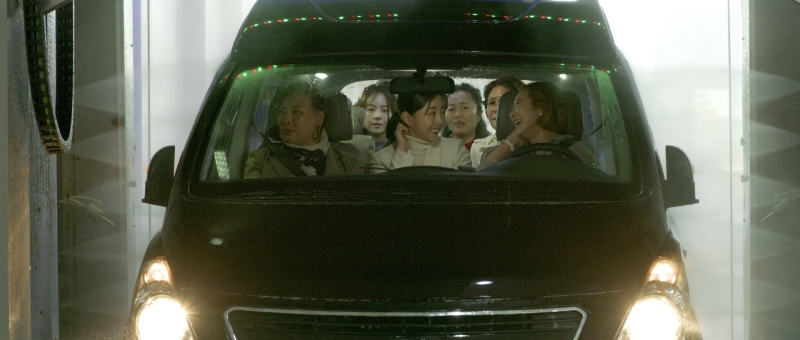
My Big Mama’s Crazy Ride (큰엄마의 미친봉고, Paek Seung-hwan, 2021)

A veteran matriarch suddenly decides she’s had enough in Paek Seung-hwan’s indie comedy, My Big Mama’s Crazy Ride (큰엄마의 미친봉고, Keuneommaui michinbonggo). Taking aim not only at the deeply ingrained and hopelessly outdated patriarchal social codes of contemporary society, Paek also asks a series of questions about the concept of family with the wives and daughters-in-law repeatedly finding themselves described as “outsiders” yet expected to sacrifice their hopes and aspirations in dedicating themselves entirely to the “family” which more often than not treats them as unremunerated housekeepers. 

It’s easy enough to see why “Big Mama” Yeong-hui (Jung Young-joo) is fed up as her husband Han-il (Yu Seong-ju) barks orders from upstairs while she tries to sort out the food for the ancestral rites knowing the men are up there lounging around drinking just expecting everything to be done for them without needing to lift a finger to help. This year she’s choosing chaos, rounding up all of the other women in the family including Eun-seo (Kim Ga-eun) her nephew’s fiancée meeting the family for the first time and packing them into her minivan leaving the men to fend for themselves.  

This is a problem for them for several reasons the biggest being that it soon becomes clear they have no idea how to do anything for themselves, drill sergeant Han-il ordering his brother and sons to finish all the food prep within the hour while they search for YouTube videos to teach them basic cooking. They can barely even figure out how to make themselves some instant noodles while they wait, becoming progressively drunker to avoid facing the reality of their situation or accept that perhaps their treatment of their wives has been unfair or that they’ve taken all of their labour for granted. Old-fashioned authoritarian Han-il even approves of Yeong-hui’s flight in the beginning in the belief that she’s taken the other women out to teach them some discipline despite her having brought up the subject of divorce because of his own treatment of her. He doesn’t see his behaviour as essentially abusive because of the patriarchal social codes in which he operates believing this is simply the way that husbands are supposed to boss their wives. His brother and sons are little different though subordinate to him as head of the family, oldest song Hwang-sang (Song Dong-hwan) eventually kicking back but only after realising his mother may really leave profoundly shaking his foundations even as a grown man with a son of his own. 

Then again, aside from a potential divorce Yeong-hui is otherwise described as an “outsider” having married into the family most particularly when it comes to light that Han-il has sold some ancestral land and intended to keep the money for himself rather than share it amongst the other family members. When he sends the proceeds to Yeong-hui in a last ditch effort to get her to come home, it causes division on both sides with his brother Han-san (Yoo Byung-hoon) in particular objecting to the money leaving the family as Yeong-hui is technically a Lee and not a Yu while the women also think she should share the money with them rather than keep it for herself little knowing she was already planning to do so. Having serious doubts about marrying into this crazy family, Eun-seo, who is in any case Christian, isn’t sure why she was attending their ancestral rites anyway but if none of these women are actually “family” why is it they’re the ones expected to prepare the rites for the Yu ancestors? Yeong-hui sees the money in part as compensation for the unpaid labour she’s performed over the last 40 years while being shouted at and ordered around by her overbearing authoritarian husband. 

Thanks to YouTuber niece Hyo-jeong (Ha Jung-min) and sleazy tabloid journalist nephew Jae-sang (Cho Dal-hwan) the women’s flight ends up going viral and even making the evening news where they find mass support from other women in similar situations along with unexpected male solidarity though a big thumbs up from a series of male policemen seems a little unlikely given the threat they present to the entrenched social order in rebelling against the same kind of patriarchal male authority the police force itself represents. In any case, it becomes clear that Yeong-hui has simply chosen to celebrate her own ancestral rights in paying tribute to another woman whose name she only belatedly found out, the other women also revealing that they don’t even quite know each other’s given names because they’re so used to addressing each other only as daughter/sister-in-law or else as X’s mum to the extent that they’ve been robbed of an individual identity. Nevertheless through their transgressive road trip the women rediscover a sense of female solidarity while the men are forced to reckon with the way they treat their wives realising that if they want to keep their family together they’ll have to move with the times. 


My Big Mama’s Crazy Ride streamed as part of the 14th season of Asian Pop-Up Cinema.

Original trailer (English subtitles)

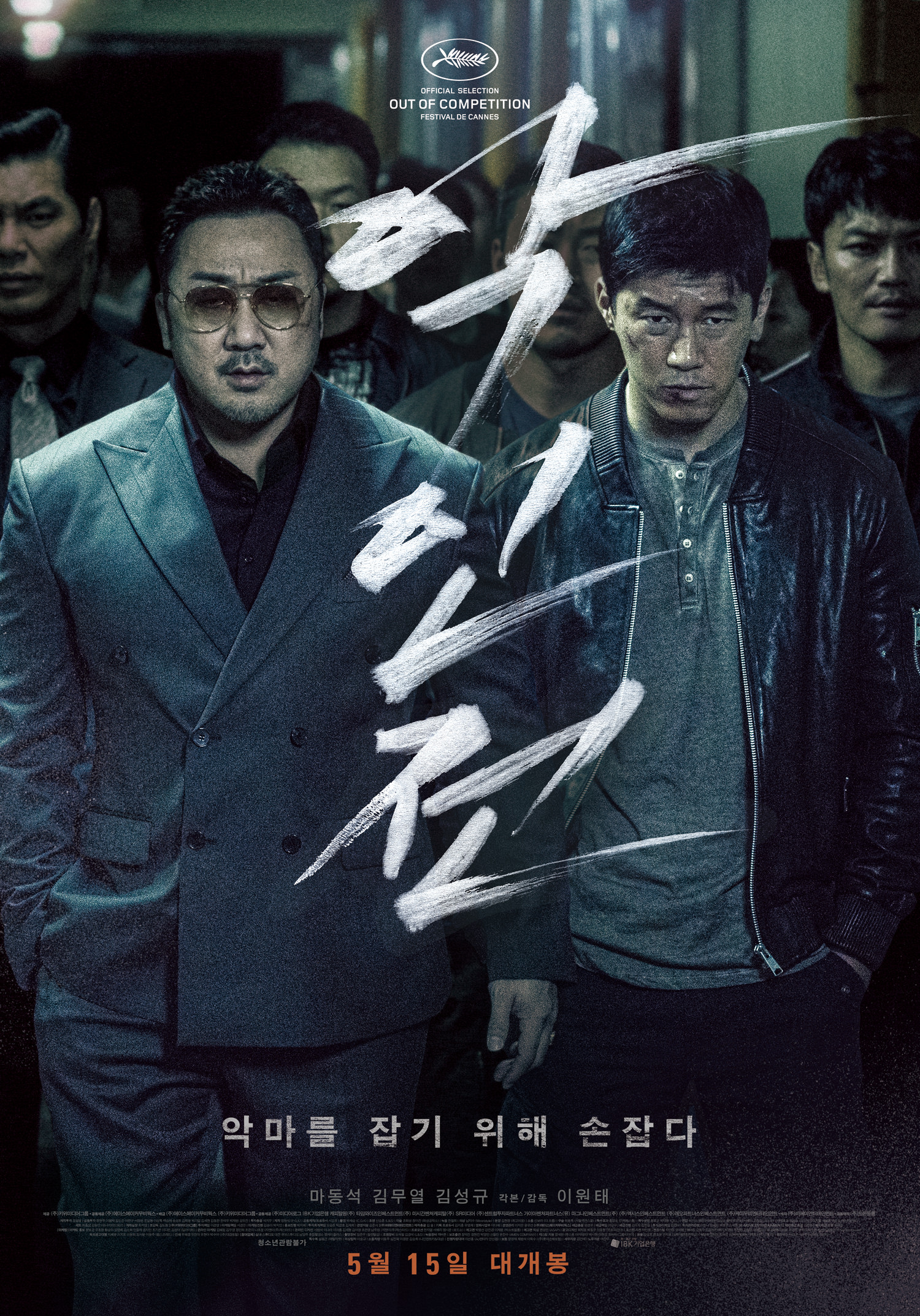
The Gangster, The Cop, The Devil (악인전, Lee Won-tae, 2019) [Fantasia 2019]

81745_1000“Two bad guys will catch the worst man” according to irritated gangster Jang Dong-su (Ma Dong-seok) in Lee Won-tae’s The Gangster, The Cop, The Devil (악인전, Akinjeon). He doesn’t quite know how right he is, even as he forms an unlikely alliance with a maverick cop himself highly irritated because his lazy colleagues won’t listen to his theory that a spate of unsolved murders are the work of a serial killer. More alike than they’d care to admit, the two “bad guys” team up to do what they have to do in order to make the killing stop but at what price?

A vicious killer (Kim Sung-kyu) has developed a habit of rear-ending solo drivers on lonely roads, stabbing them repeatedly and then leaving them for dead. Maverick cop Tae-seok (Kim Mu-yeol) has become convinced that the killings were carried out by the same perpetrator and that they have not yet been identified as a “serial killer” partly because the crimes took place in different districts and there is insufficient co-operation between precincts, and partly because his colleagues think serial killers are something you see in American movies. His superiors just want to close cases, they aren’t particularly concerned with upholding justice or protecting the innocent and so Tae-seok starts thinking outside of the box when he hears that the killer’s latest target was none other than top mob boss Jang Dong-su.

Dong-su got rear-ended after running an errand to have a word with a wayward underling, Hur (Yoo Jae-myung), who has forgotten his place. The killer made a serious mistake going after Dong-su who is a big, handy kind of guy and therefore manages to fend him off, even wounding him in the shoulder despite being badly injured himself. Though the obvious conclusion is that Hur sent someone after him, Dong-su is unconvinced seeing as he had never seen his assailant before and is pretty sure he’s not a member of the gangster underworld. Still, he’s very annoying because a gangster only has power in being respected and right now Dong-su looks a fool. If he wants to get his “professional” life back on track, he needs to get his revenge but to do that he’ll have to cross the floor and work with law enforcement, temporarily teaming up with rogue cop Tae-seok whose heart is in the right place even if he’s not averse to bending the rules.

One of the things which most bothers Tae-seok about amoral killer “K” is that, unlike most serial killers, he kills indiscriminately and purely for pleasure. He has no “type” and generally goes up against those most likely to fight back, unlike your average pattern killer who targets the vulnerable. Like Tae-seok and Dong-su, he is however quite annoyed – this time because someone has “framed” him for a murder he didn’t commit in order to further their own ends. Hugely overconfident and cooly psychopathic, he sits in the dock and asks what makes his crimes different than the state’s if the state is fixing to execute him without proper evidence. Pointedly looking at law enforcement, he affirms that the real villains are those who commit crime with kind faces (say what you like, but at least K looks the part).

When it comes to Tae-seok he might have a point. Conspiring with Dong-su to “kill him with law”, Tae-seok gleefully manipulates the system while giving Dong-su tacit permission to take his revenge as long as “justice” has been properly served. K doesn’t believe in anything, Tae-seok believes in a particular kind of “justice” if not quite in the law, while Dong-su mourns the sense of self-belief that allows you to rule the roost as an all powerful gangster. The three men are a perfect storm, each angry, each resentful, each vowing a particular kind of revenge against the forces which constrain them be they corrupt and lazy superiors, gangsterland disrespect, or the “injustice” of being accused of a crime you did not commit but not being properly credited for the ones you did. Bathed in a garish neon, Lee’s anti-buddy-cop drama embraces its noirish sense of fractured morality with barely suppressed glee as its similarly conflicted heroes pursue their violent destinies, true to their own but dragged to hell all the same.


The Gangster, The Cop, The Devil was screened as part of the 2019 Fantasia International Film Festival.

International trailer (English subtitles)