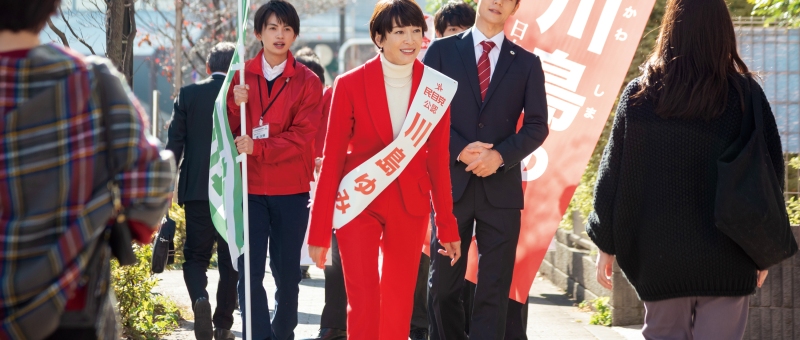
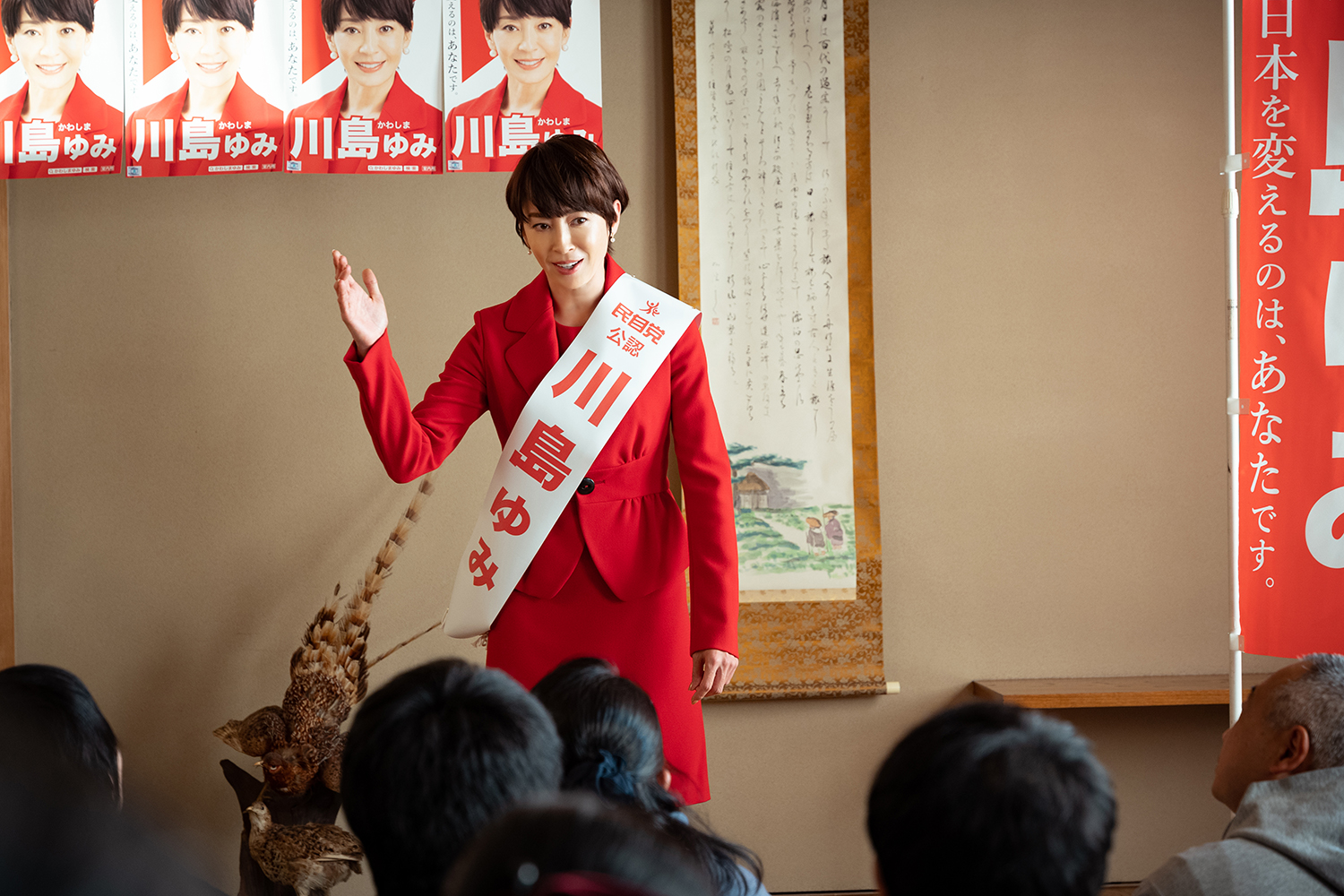
“I keep choosing a perilous path” the heroine of Yuichiro Sakashita’s political satire The Sunday Runoff (決戦は日曜日, Kessen wa Nichiyobi) explains, “But that’s where change happens”. Change, famously, is not a common occurrence in Japanese politics where the same party has remained in power for all but a handful of years since its foundation in 1955. Part of the reason for that at least according to the reluctant candidate is the nation’s rigid social attitudes in the unwillingness to question the status quo, just going along with however things have always been done, while the main cause is perhaps corruption at the local level in the interplay between supporters groups staffed by influential local businessmen and their representatives along with the collusion of civil staff who have become too blasé about the murky nature of politics.
That’s especially true for political secretary Tanimura (Masataka Kubota) who had developed a paternal relationship with former defence minster Kawashima who unfortunately is forced to retire from office due to ill health after suffering a stroke. Unable to agree on a suitable candidate to replace him, the supporters groups throw their weight behind Yumi (Rie Miyazawa), Kawashima’s middle-aged, unmarried daughter. The above lines are spoken during her introduction to her staff who find her strange and unconvincing, mocking her Western-style business speak along with her decision to refer to them as her “crew”.
If “change” was what Yumi wanted, she’s almost certainly standing for the wrong party. Though not explicitly stated, she’s obviously intended to be standing for an LDP stand in and in the opinion of her staff at least her seat is so safe you could paint a face on a rock and get it elected. Their problem is that they assumed Yumi would be easy to manage, though it quickly becomes clear that despite having grown up in politics she is incredibly naive and something of a loose cannon. As she admits, she tells it like it is and doesn’t consider the consequences. She is not media trained and the secretaries, Tanimura included, do not really bother to brief her in part because they assume the election’s a sure thing so they don’t need to. As we can see from her introductory speech, she is essentially playing the part of a politician as she imagines it to be, saying things she perhaps does mean because she thinks it’s what a politician would say such as her offensive reply to a question about the declining birthrate to the effect that childless couples were “slacking off” and “not functioning as humans” leading to a protest outside her office in large part by those who had found her comments hurtful because they had wanted to have children but for various reasons had not been able to.
It’s Yumi’s political naivety that makes her the ultimate foil for the secretaries and supporters groups as she gradually comes to realise she was never meant to be anything other than a puppet. After a particularly disastrous conference, one of her older male sponsors exasperatedly asks why they couldn’t have picked a better candidate. “At least choose a man”, he adds while one of the secretaries later snaps at Yumi that she’s way out of her league, should “know her position”, and that the only reason an “amateur woman” like her was approved as a candidate was because of the supporters committee so she’s there to do exactly what they say. Forced to apologise to them, Yumi’s face is framed in the lattice work at a restaurant as if she were in prison, a sentiment echoed by Tanimura when he tells her that she has “no choice” but to continue threatening to plant smear stories in the press if she tries to walk away or blow the whistle on all the corruption she has unwittingly uncovered in the local political office.
That would include the giving and receiving of bribes in an all too cosy relationship with local business and particularly the construction industry. Part of the problem is that the civil staff will all lose their jobs if Yumi is not elected which makes it in their interest not to act with total transparency. Tanimura hadn’t really cared about that before, each time when questioned replying only “that’s just how it is” but slowing beginning to realise that it doesn’t need to be and really it isn’t OK. Despite her eccentricity and impulsiveness Yumi would as Tanimura can see make a good politician if not one ideally suited to a conservative party. Threatening suicide from the roof of a three storey building she decries political apathy in Japan, explaining that they need to remind the people that this is really about them and that politics is not pointless because change can happen while the jaded secretaries roll their eyes and giggle setting up a crash mat in the event that she is not actually bluffing.
What she decides to do is try to loose deliberately, but everything she tries just backfires. A series of offensive racist rants far from ruining her reputation pick her up new votes from members of the far right who previously felt unrepresented while even planting false stories in the press that she is a drug user with a criminal record doesn’t seem to dent her approval rating. Just as Yumi’s comments about the birthrate echoed those of other gaffe-prone LDP politicians such as Mio Sugita, Yumi and a reformed Tanimura even film a fake video of her pretending to abuse one of her staff directly echoing that of Mayuko Toyota who was forced to stand down after an embarrassing video of her calling her aide “baldly” while beating him went viral, but her popularity only increases. As a last resort they release video footage of her father accepting bribes and have her deny it so it becomes obvious that she lied, but her dishonesty makes no difference to the average voter.
The cynical secretaries had indicated that ordinarily speaking they’d ride a scandal out because another one will be along before too long to knock it off the front page. Yumi’s whistle blowing plan fails again because of collusion with the local media who despite sniffing around for a story won’t run anything too negative lest they lose their access to the halls of government. The secretaries then get lucky when a possible North Korean missile strike bumps the bribery affair onto the back pages, a video of the staff laughing and cheering their near escape even becoming a meme on social media. Yumi’s resentment is in rooted in her powerless, refusing to be a puppet for local bigwigs, but it may also be true that once she’s elected they have no real power over her and changing the system from the inside may ironically become a real possibility if only she herself can overcome her conviction that nothing is ever going to change. “This is not the world you expected.” Tanimura admits, “accept it and fight”. A throwback to the films of Juzo Itami, Yumi is very much the kind of character Nobuko Miyamoto might have played in one of her “woman” films if perhaps a little more cynical. The Sunday Runoff is decidedly more barbed if at least as pointed in its criticism of incestous local politics, but in the end does believe that real change may indeed be possible if only you’re willing to fight for it.
The Sunday Runoff streams in Germany until 6th June as part of this year’s Nippon Connection.
Original trailer (no subtitles)


 Windows on Worlds