Sunday League (선데이리그, Yi Sung-il, 2020)

A dejected middle-aged former footballer rediscovers both a love for the game and his self respect while coaching a trio of hopeless amateurs towards competition glory in Yi Sung-il’s underdog sporting drama, Sunday League (선데이리그). A testament to the restorative power of team sports, Yi’s gentle comedy allows each of its troubled heroes to discover a positive outlet, gaining a sense of confidence that isn’t about winning or losing but mutual support and community spirit. 

As a young man, Joon-il (Lee Seong-uk) had been primed for sporting success but an injury soon brought his career on the pitch to an end. Sullen and embittered, he is a now middle-aged man with a drinking problem and a part-time job working for an old friend coaching a kids’ team while in the middle of an acrimonious divorce. As will become apparent, he is temperamentally unsuited to coaching young children, his coaching style somewhere between drill sergeant and dictatorial PE teacher essentially amounting to little more than bullying. His ill-tempered rant even reduces one small boy to tears proving the last straw for head coach Sang-man who has to field the complaints from understandably upset parents. Otherwise at a loss, he fires Joon-il from the kids team but asks him to help out on a new sideline coaching amateur players, an offer he originally turns down but later reconsiders when faced with the realities of his impending divorce and desire to maintain contact with his son. 

Each of the new students is like him in their own way stuck, looking for a way forward while blowing off steam through team games. While Bok-nam’s fried chicken shop is struggling in a difficult economy, the otherwise superrich Mr Kim is considering running for public office but privately insecure, while the last recruit Hyun-su is a shy and fragile man recently diagnosed with bi-polar who has been signed up by his wife after losing his job. It has to be said that Hyun-su’s mental health is sometimes treated as the butt of a joke in which he is often simply told to “man up” while his tendency to burst into tears on the field becomes a running gag, yet through training with the other guys he does at least begin to find a sense of purpose and contentment both on the field and off through working in Bok-nam’s chicken shop with his wages paid by the ever generous Mr Kim. 

As for Joon-il, meanwhile, he struggles both as a coach and as a father unable to get over his own sense of regret and resentment in the loss of his sporting career while his son goes quietly off the rails. Though originally reluctant and irritated by the dilettantism of his pupils, Joon-il is finally forced to face himself in realising that his own stubbornness has been the cause of all his problems and that his tendency to run away from unpleasantness rather than face it head on has only made his life more difficult. Picking up a series of innovative new coaching techniques such as using videogames to demonstrate otherwise confusing strategies while rediscovering the power of positive reinforcement he begins to coach himself back towards his best self finding a new sense of purpose on the pitch. 

Meanwhile, Yi throws in a series of of surreal gags including a lengthy sequence in which the team square off against the squad from the local church led by a football-mad pastor while a chorus of hallelujah rings out over the match as the guys finally begin to find their footing. Joon-il only took the job on the promise of a full-time salaried position if he managed to get them into the finals of a local competition, but in the end it isn’t really about winning or losing so much as self-improvement and gentle camaraderie, the guys each facing themselves while playing the game and discovering a new sense of pride in their progress Bok-nam cheerfully exclaiming that they are all footballers simply by virtue of playing the game. A warmhearted sports dramedy about positive male bonding and positivity for the future, Sunday League discovers new sides to the beautiful game in its restorative abilities affording each of the guys a new lease on life as members of a small team of plucky underdogs less interested in the winning than the taking part.


Sunday League screens in Chicago on March 13 with director Yi Sung-il in attendance as part of the 14th Season of Asian Pop-Up Cinema.

International trailer (English subtitles)
We Are Moluccans (Cahaya Dari Timur: Beta Maluku, Angga Dwimas Sasongko, 2014)

A motorbike courier finds himself torn between conflicting priorities when his community is threatened by internal strife in Angga Dwimas Sasongko’s inspirational sporting drama We Are Moluccans (Cahaya Dari Timur: Beta Maluku). As the title suggests, team sports provide a means of communal healing fostering both hope and unity among the young but even so the traumatic memories of the recent past prove hard to overcome while the older generation struggle in the wake of their own broken dreams and contradictory responsibilities. 

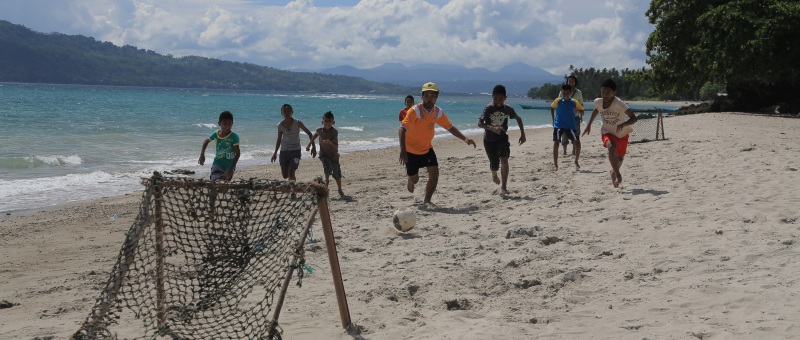
At the turn of the century, a violent conflict breaks out between Muslim and Christian communities who had until that point lived together in relative peace. With his motorcycle courier business disrupted by the ongoing chaos, former youth footballer Sani (Chicco Jerikho) begins coaching a collection of local boys mostly as a means of keeping them away from the immediate violence of the riots. As the situation begins to stabilise, his new responsibility to the children places a strain on his relationship with his wife, Haspa (Shafira Umm), who complains that he spends too much time giving back to the community while the family is struggling economically to the extent that she can no longer extend their tab at the grocery store. His old football friend Rafi (Frans Nendissa) is also struggling with his fishing business having lost most of his crew who fled the area’s violence and so the two of them begin to make the football club more formal but it soon becomes clear that they each have differing goals and responsibilities that endanger their partnership and the commitment they’ve made to the boys.  

At several points Rafi, not to mention Haspa, criticise Sani for what they see as irresponsibility while some of the other village men also accuse him of unmanliness for choosing to look after the children rather than fight with them to protect the village. His problem is that he’s too kind hearted but is entirely unable to order his priorities torn by the necessity of providing for his family and following through on the commitment he’s made to the neighbourhood boys. He often gives his hard won money away to those in need, angering his wife who cannot understand why he continues to help others rather protect his own family even giving away money he’d saved for their youngest daughter’s vaccinations and abruptly selling their goats without discussing it with her when she’d earmarked them as an emergency fund to pay the enrolment fees when the oldest daughter starts school. 

Because of the ongoing violence, many of the boys are in single parent families and live in relative poverty often needed to help out with their parent’s businesses. To begin with many are fine with them playing football so long as it keeps them safe but as they begin to grow older attitudes harden, many believing that it’s a “pointless” waste of time and too much of a distraction when the children should either be earning money or studying. Sani becomes a kind of surrogate father teaching the boys diligence and responsibility even if struggling with the same in his personal life but obviously cannot overcome the social and economic difficulties of small town life all on his own. His original goal was only to keep the children safe and ensure they had happy childhood memories that weren’t about hate, violence, and fear, whereas Rafi is much more ambitious floating the idea of opening an official football school while eventually deciding to run for public office further adding to Sani’s sense of personal inadequacy. 

“Nothing can destroy us as long as we have will to live a better life” Sani later tells the children, mistaken it seems in his belief that they would find it easier to overcome the differences between them when acting as head coach for a team representing the entirety of the local area. Many of the original team resent the introduction of “outsiders” from the nearby Christian town, but the difficulties turn out less to be about religion or community than trauma, the source of the problem being that the father of two of the Christian boys is a policeman whom another of the players blames for his own father’s death. While such tensions exist within the group the team continues to fail, losing not because of a lack of ability but because they cannot overcome the legacy of trauma to work together. The problem is only solved through a reassertion of their commonality as “Moluccans” rather than Muslim or Christian ironically forged in opposition to their current other which happens to be a team from Jakarta, the urban pitted against the rural. 

In any case, Angga Dwimas Sasongko’s inspirational drama eventually makes the case for mutual forgiveness as path toward putting the past to rest in order to move forward into a kinder and more prosperous era. The emotional closing scenes provide both a personal sense of acceptance in as Rafi begins to put his pride aside to support the local team while Muslims and Christians come together to listen to the nail-biting penalty shootout through their respective contacts in the auditorium after the TV broadcast cuts out before extra time. Demonstrating the power of sports to overcome cultural barriers, We Are Moluccans finally advocates for the right to dream as the youngsters begin to develop self-confidence and a sense of possibility while working together towards a clearly defined goal. 


We Are Moluccans streams in Poland until Nov. 29 as part of the 15th Five Flavours Film Festival.

Trailer (English subtitles)