Visitor Q (ビジターQ, Takashi Miike, 2001)

As Japan emerged from post-war privation into bubble-era comfort, the family underwent something of a reassessment. Remoulding Teorema, Yoshimitsu Morita’s The Family Game had punched a hole through the concept of the family in sending in a mysterious teacher who slowly proved to them all they were merely involved in a prolonged act of performance unpinned by social convention rather than genuine feeling. Sogo Ishii’s The Crazy Family did something much the same but ultimately opted to save the family unit by allowing them to find peace literally “outside” of the contemporary rat race. And then there comes Takashi Miike who, ever the ironist, runs the whole thing in reverse as Visitor Q (ビジターQ) comes to put the family back together again by giving them permission to bond through satisfying their previously unanswered emotional needs.

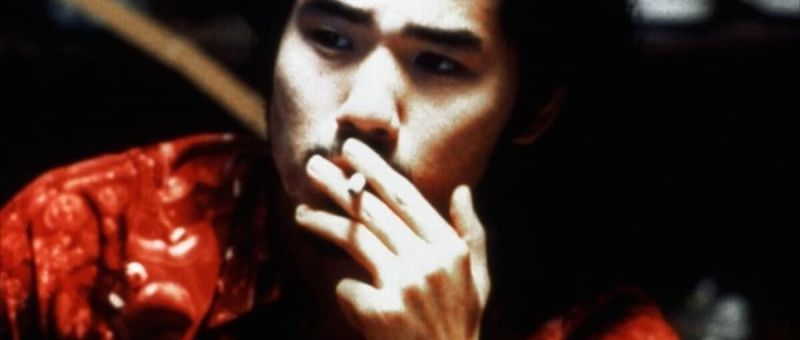
As the film opens, however, patriarch Kiyoshi (Kenichi Endo) is in a hotel room interviewing a young woman as part of a documentary investigating the youth of today. She replies only that what the youth can tell him about the future of Japan is that it’s hopeless, before getting back to business and elaborating on her price list for a menu of sex acts. Though originally unwilling, Kiyoshi ends up having apparently very exciting sex with her, but comes to his senses after climaxing too early. The girl, we later learn, is his runaway daughter, Miki (Fujiko), who has been living a life of casual sex work in the city. Kiyoshi determines to pay her in full, but explains that that he’ll give the rest of the money to her mother and she must keep everything that happened between them in that room a secret (a minor problem being Kiyoshi left the camera on and ended up documenting the whole thing, something that he will repeat later but quite deliberately). 

Stunned by his transgressive encounter, Kiyoshi looks on at a happy family with a degree of confusion while a strange young man leans through the window of the train station waiting room and whacks him on the head with a rock. Before he finally arrives home, the man hits him again just to be sure, but eventually follows him for dinner where he is introduced as an “acquaintance” who will be staying with him for an unspecified amount of time. 

Kiyoshi’s household is already falling apart, and quite literally seeing as the shoji are full of holes, partly because of the attacks of the “big bullies” who torment his teenage son Takuya (Jun Muto) by launching fireworks into his bedroom, but also because the boy takes his humiliated frustration out on his mother Keiko (Shungiku Uchida) who is covered in scars from previous beatings and has taken to using heroin to escape the misery of her family and doing part-time sex work to pay for it. 

Like the intruder of The Family Game, Visitor Q gradually infiltrates the family by usurping a place within it but begins to reawaken and reinvigorate each of the members as he goes. The first thing he takes hold of is Kiyoshi’s camera, literally observing the family and helping to document the Japan of today through the eyes of this very strange yet “ordinary” family. A man of the post-bubble era, he’s another failed provider whose career continues to flounder while his home spirals out of control, shorn of paternal authority. He feels insecure in his manhood, humiliated by his tendency towards premature ejaculation, and is raped with his own microphone by the “youth of today” while trying to interview them, which leaves him, according to his boss and former lover, looking like a fool. 

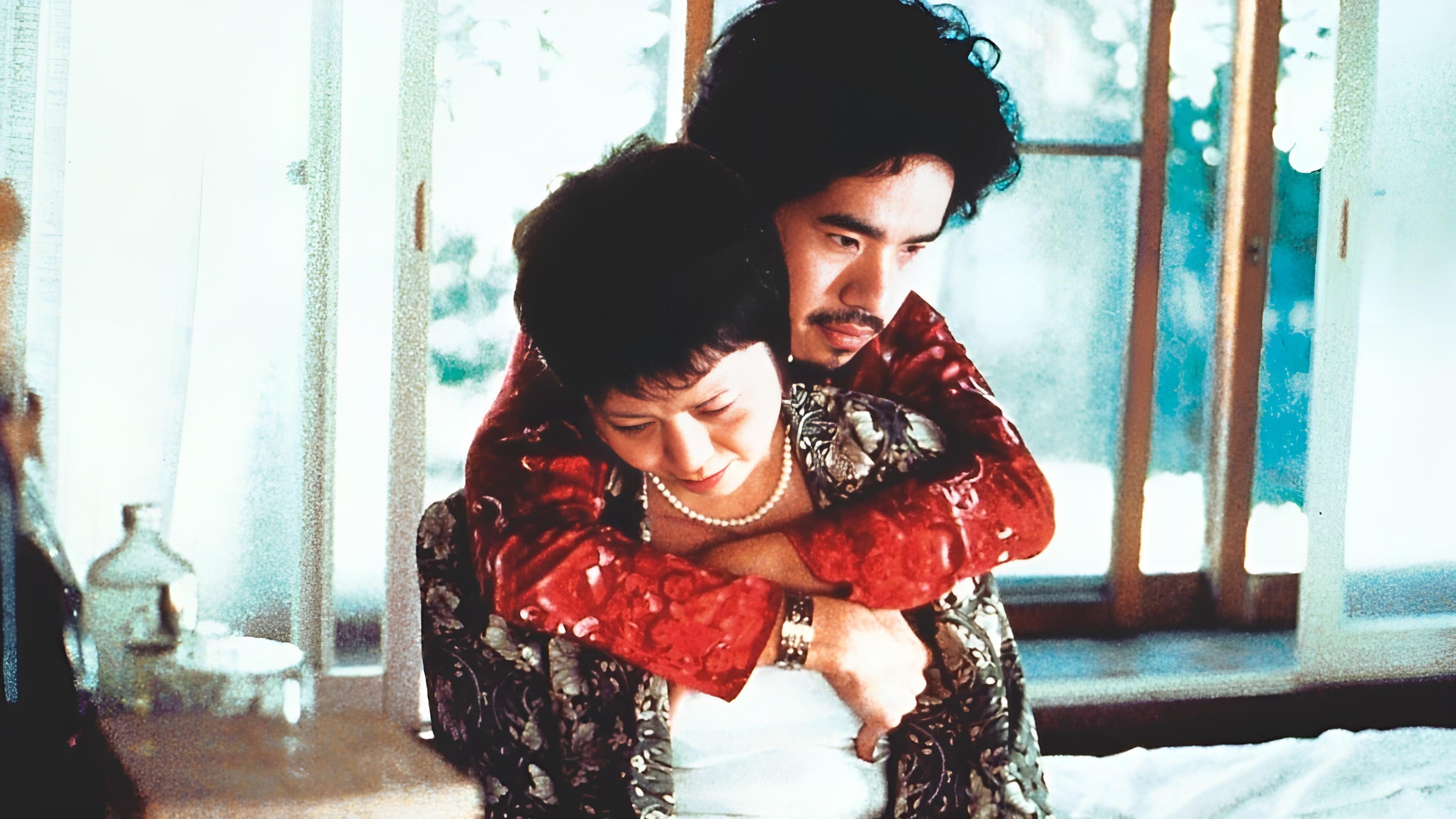
Kiyoshi is convinced he can get his mojo back through career success in making himself the subject of his own documentary, or more accurately his observation of his son’s bullying which he later reveals perversely turns him on. When his boss shuts his idea down, he rapes her, feeling humiliated again in complaining that she dumped him because of the premature ejaculation and vowing to prove himself but accidentally strangling her. Meanwhile, Visitor Q is back home getting busy with the under appreciated Keiko who describes herself as neither special nor pathetic but an ordinary woman, longing to be loved and wanted. Even one of her clients, exclaiming surprise to discover that a “nice woman” like her does stuff like this, appears to have a disability fetish remarking that is feels different with someone who has a limp. Visitor Q gets her juices running again, literally, reactivating her maternity and perhaps allowing her to reclaim her position within the household. 

“I’ve never seen her so competent since we married,” Kiyoshi exclaims after she employs some top housewife logic to help him deal with his dead body problem, after which they take a rather more active stance against Takuya’s snotty bullies, pulling together to protect him in a way they never have before. Takuya may remain outside of the family hive, but he’s drenched in mother’s milk and perhaps the only one to truly recognise Visitor Q for who he is. Nevertheless, the Yamazakis are an “ordinary” family, just taken to extremes. Dad’s an emasculated salaryman broken in spirit by economic failure, mum’s an unhappy housewife lonely in repressed desire, son is an angry young man like his dad humiliated by the big boys, and daughter is a melancholy runaway who has tried to seize agency through using her body as a weapon but still feels that the future is hopeless and that her gesture may be one of self harm. Nevertheless, through the exposure of their myriad transgressions, they begin to bond in shared perversity. Thanks to Visitor Q, the family is “restored”, not “cured” but reaching its natural state of being as a collection of individuals assume their complete selves and in mutual acceptance rediscover a home.


Trailer (English subtitles)
Albino (アルビノ, Toru Kamei, 2016)

Two women struggle to free themselves from the abuses of a patriarchal and conservative society in Toru Kamei’s tragic lesbian romance, Albino (アルビノ). Though perhaps somewhat out of touch in its tacit implication that same sex love is inherently destructive, Kamei’s sensitive drama finds its marginalised heroines seeking mutual rescue but finding only temporary respite in the bubble of their love fraught as it is with danger and confusion as they each in their own way struggle to escape their respective prisons literal and self imposed. 

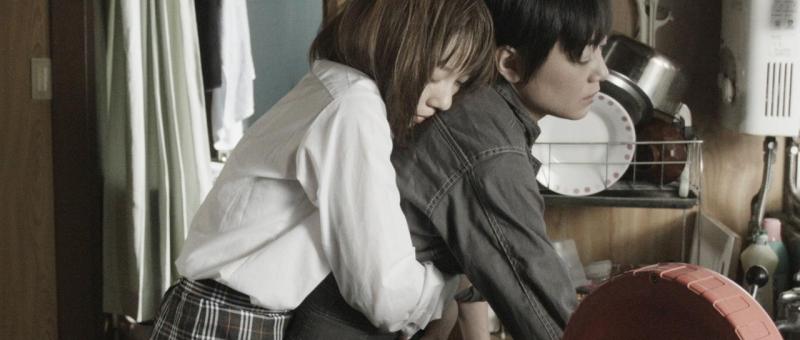
Butch plumber Yashima (Fujiko) has always felt somewhat ill at ease, that her inside doesn’t match her out, and the disconnect has made her reluctant to associate with others. On a job one day she encounters a strange young woman, Kyu (Satsuki Maue), wearing a high school uniform who can’t seem to stop gazing at her. Yashima fixes the problem with her sink which was clogged with paper tissue, but is surprised when Kyu calls back and says it happened again. On her return visit, while Kyu’s stepfather is out, Kyu asks Yashima to have a look at the bathroom where she gingerly seduces her, both women perhaps surprised by the depth of their desire. Problematic age gap aside, the two women embark on a passionate sexual affair but struggle to free themselves from the forces which constrain them outside of their intense physical connection. 

Hinting at a kind of gender dysphoria, Yashima lives as a man but feels pressured into conforming to conventional femininity. She’s the only woman at her job as a plumber, perhaps still stereotypically regarded as a male occupation, and simultaneously regarded as one of the boys made complicit in the misogynistic banter of her boss and colleague. Resented for her unwomanliness, she’s eventually assaulted by her skeevy vanmate who refuses to believe her when she says she has no interest in men. She implies that prior to her relationship with Kyu, she hadn’t considered other women but had perhaps thought of herself as male, and is immediately overwhelmed by her newfound desire. Meanwhile, she’s also dealing with familial trauma in her difficult relationship with her alcoholic mother who frequently turns up only to ask for money to spend on drink. 

Kyu, meanwhile, is more directly oppressed, trapped in an abusive environment with violent stepfather who repeatedly rapes her, his tissues the ones which eventually clog the sink after she tries to wash them away. She claims that the uniform is a fashion statement, though the implication seems to be that her stepfather does not allow her out of the house even to go to school if indeed she is still a student despite her claims to the contrary. That might also explain why she continues to clog the sink and call the plumber, potentially alerting Yashima’s boss not to mention the colleague who seems to have realised there’s something going on, rather than simply ring her directly even after she’s really only coming for sex. Kyu makes a habit of giving Yashima hard candies after each of their meetings, Yashima eventually realising that they spell out the word “help”, but she remains too traumatised to escape convinced that her stepfather would find her wherever they went. 

Somewhat awkwardly, the implication is that Yashima’s relationship with Kyu is the force which motivates her to accept her femininity, the younger woman transgressively kissing her after staining her lips with menstrual blood as if to ram the point home. Kyu meanwhile agrees that she too hates being a woman, though her resentment is perhaps more towards her constant victimisation, her utter powerlessness at the hands of the hands of the stepfather who abuses her and whom she cannot escape. Yashima too finds herself victimised as a woman, assaulted by her colleague who leaves by coldly telling her it was her own fault for refusing him, or perhaps simply for her “failure” to conform to conventional social norms, a crime for which he has punished her as means of correction. Yet they each struggle to free themselves, Kyu too traumatised to embrace her freedom despite her literal cry for help, while Yashima is continually punished for her atypical gender presentation. Only in sex do they find release. Shot with a detached realism which extends to the naturalistic though passionate, erotic love scenes Kamei’s melancholy drama offers little in the way of hope for either woman, subtly suggesting that their romance is a forlorn hope because there is no escape from the forces which oppress them in such a rigid and conformist society. 


Trailer (no subtitles)

Antiporno (アンチポルノ, Sion Sono, 2016)

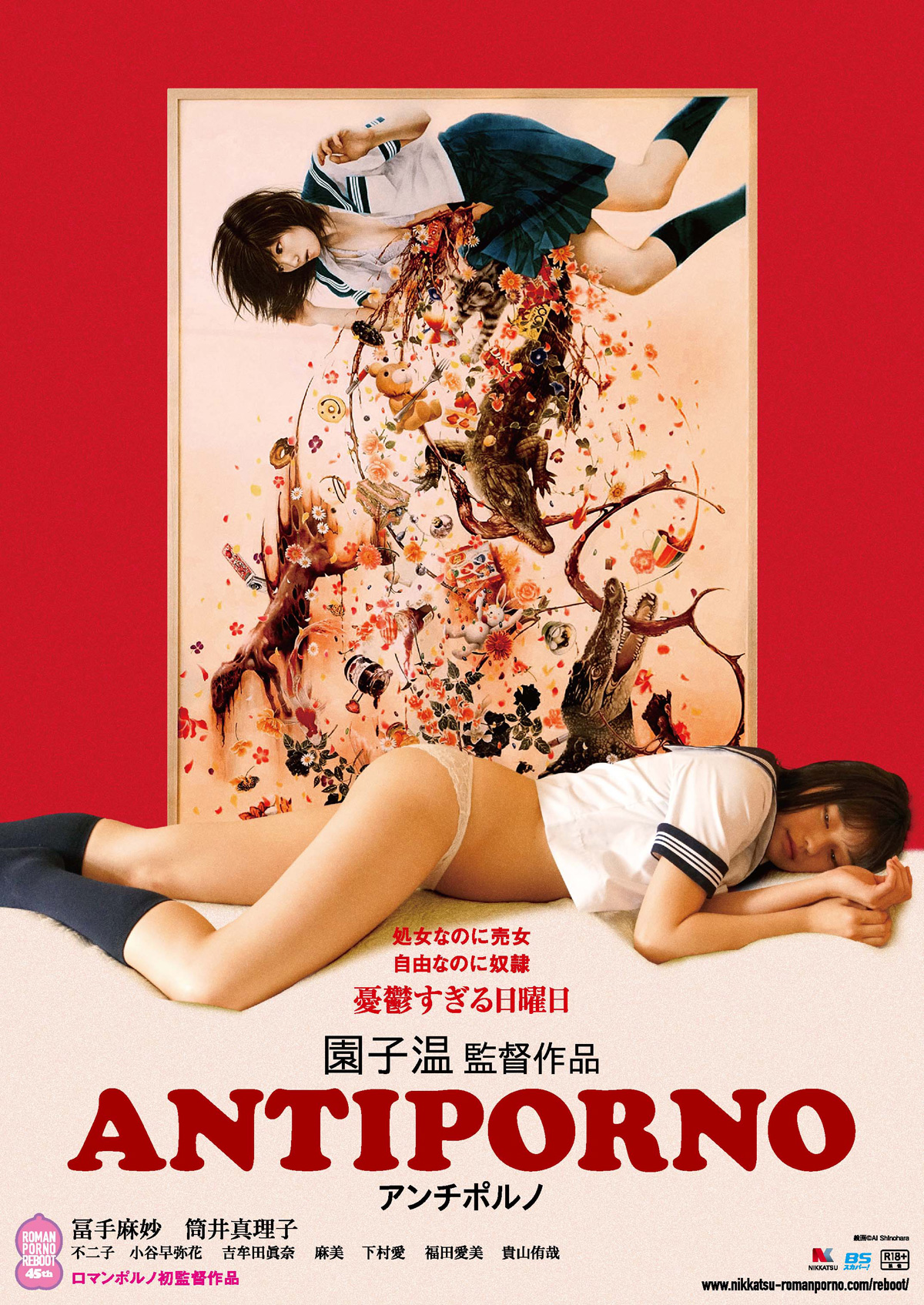
Antiporno posterIf freedom exists in Japanese cinema, it exists only through sexual liberation. Only in this most private of acts can true individual will be expressed. Sion Sono, ever the contrarian, wants to ask if that very idea of “freedom” is in itself oppressive and he’s chosen to do that through his contribution to the Roman Porno Reboot Project in which five contemporary directors attempt to recreate Nikkatsu’s line in ‘70s soft-core pornography.

Opening in a room of bold primary colours – the sunlit walls of the yellow bedchamber and the garish red of the doorless bathroom, Sono homes in on the figure of Kyoko (Ami Tomite) who lies face down on a bed with her underwear around her ankles. She seems somehow broken and exhausted, staring into a piece of glass from a shattered mirror and making ominous statements to herself. Suddenly her mood changes, no longer the maudlin woman she transforms into the cute and quirky high schooler so beloved of certain genres of Japanese entertainment. When her assistant arrives, Kyoko delights in humiliating her, forcing Noriko (Mariko Tsutsui) to crawl around on all fours wearing a dog collar and then ordering her to allow herself to be raped by an (all female) team of newspaper reporters.

So far, so Petra von Kant, but Sono doesn’t stop here. He shows us that this brightly coloured room is a stand-in for Kyoko’s fracturing psyche, a failed attempt to order her chaotic world. Someone shouts “cut” and we’re on a film set – roles are reversed, Kyoko is no longer in control. Her memories enter free fall as she flits between an awkward (possibly imagined) childhood, and her present predicament as, alternately, plaything and dominatrix.

The roots of Kyoko’s confusion stem back to the contradiction in her parents’, or really her society’s, attitude to sex. During a very strange family dinner, Kyoko and her younger sister have a frank discussion with mum and dad about male and female genitals and how they fit together. The language is pointed, but Kyoko’s father has very clear ideas about what is obscene and what isn’t – “Cocks” are what men stick into prostitutes and they’re obscene, but he has no sensible answer when pressed on how exactly “cocks” and “male genitalia” can be all that different. Her parents tell her sex is indecent and shameful while continuing to talk about their own sex life openly and refusing to shield their daughters from their obvious appetites. They offer no answer for this continuing paradox, only the affirmation that Kyoko’s desires are “indecent” and must be rejected.

Kyoko’s sister finds her freedom in another way, but Kyoko pursues hers through sexuality, looking for a connection in midst of true liberation. She wants to become a “whore” which the adult version of herself describes as “a woman so pure it breaks her own heart”, but what she’s looking for is the freedom which eludes her in her day to day living. Kyoko and later Noriko repeat the mantra that they will dismantle the “annoying freedoms which restrict me”,  lamenting that there is no freedom of speech in a country like Japan and that no woman has ever been able to attain their own freedom in a world entirely controlled by men. A protest against the renewal of the ANPO security treaty runs on the TV while Kyoko’s sister holds up a book of butterflies, exclaiming that all the free things fly away. The women of Japan, according to Noriko, praise free speech but reject their own freedom, forced to chase false liberations and endlessly allowing themselves to be manipulated by a culture they themselves willingly create.

The fly away butterflies hit the ceiling, and Kyoko’s captive lizard cannot escape its bottle. Sono seems to suggest that there is no true freedom, that the very idea of “true freedom” as mediated through the idea of sexual liberation is itself another fallacy used to manipulate women into doing what men want. Kyoko ends up in a “Roman Porno” to empower herself, but is disempowered by it – rendered an anonymous object trapped inside an entirely different kind of tube. Blinded by colours and memory she searches for an escape but finds none, groping for the mechanism to set herself free from the delusion of liberation but grasping only empty air.


Antiporno is available to stream in the UK via Mubi until 8th January and will be released on blu-ray by Third Window Films in April 2018.

Original trailer (English subtitles)