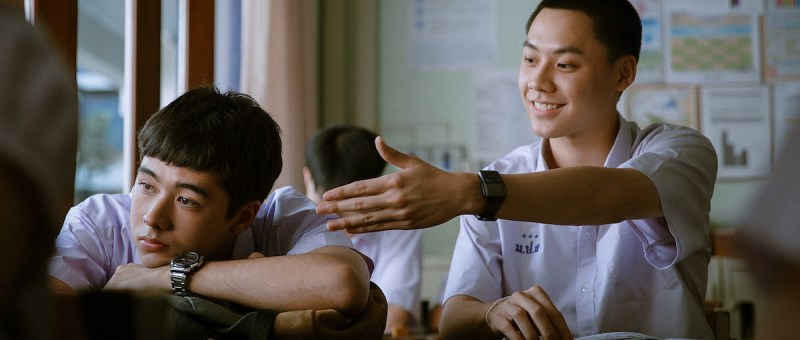
Not Friends (เพื่อน (ไม่) สนิท, Atta Hemwadee, 2023)

There’s a gentle sense of loss that runs through Atta Hemwadee’s quirky Thai dramedy Not Friends (เพื่อน (ไม่) สนิท), not only for those who are now absent and exist only in our memories but for missed opportunities and things left unsaid. Then again, its hero, Pae (Anthony Buisseret), takes a while to warm up to the benefits of friendship, like many teenage boys resentful and alienated, unable to accept the hand extended to him by his infinitely cheerful new deskmate, Joe (Pisitpol Ekaphongpisit), who walks around with a beatific smile permanently plastered across his face. 

Before he can make amends, however, Joe is hit by a car after returning from a school trip sending the school into a period of shocked mourning that for some reason includes a talent contest. After hearing of a competition that offers entrance to film school as a prize, Pae decides to enter and to make his late “best friend” Joe the focus of the film only to immediately be caught out in his duplicity by Joe’s former best friend Bokeh (Thitiya Jirapornsilp) who resents his intention to exploit Joe’s death for his own ends. 

It has to be said, that Pae does not come out of this well though his predicament does highlight a social stigma towards working class boys in his intense desire to escape having to take over his dad’s flour mill having been teased by his former classmates about his “stinky shirt” because he has to air dry his clothes in an area adjacent to the factory. A similar sense of lonely alienation is found in a short story Joe had submitted to a story contest which is about a boy who feels hopelessly ordinary and looks up to the stars thinking about all the other versions of himself on other planets who are “special”, top athletes or super spies or dim but loved by those around him. The boy wants his other selves to see him and know that he is special too, but seems not to feel it himself. 

Coming late to the idea, Pae slowly realises that Joe is special because “Joe is our friend” though he’d mostly ignored his attempts at friendship while he was alive. In any case, he doesn’t really notice the friendships he’s making with Bokeh or the others working on the film either but remains focussed on his own goal of winning the contest and escaping the flour mill. In the end the film he’s making ends up becoming less about Joe himself and more of an ode to absent friends, something echoed in Bokeh’s valedictory speech in which she bids goodbye to her “best not friends” and hopes that though they may not meet, they’ll miss each other every now and then. 

It comes down to a question of what friendship really is and whether Pae can be persuaded to abandon his sense of self interest to defend it. He realises that Joe had a lot of dreams too, ones he never got to fulfil and a couple that could be fulfilled for him if not in reality than in fantasy imagining how their lives might have turned out if Pae had been less self-involved and Joe had lived. Still, on finding out something unexpected he’s forced to confront the idea that perhaps you don’t really know anyone. Everyone knows a slightly different version of the same person but friendship is really about shared intimacy and a willingness to be open and vulnerable while simultaneously respecting the boundaries of others.

To that extent it really is about the friends we make along the way. Pae slowly comes to realise that he’s accidentally become friends with the crew on the film and lets go of some of his resentment becoming less self-centred and more willing to interact with others even warming to his father and family business he’d previously been ashamed of while also gaining the courage to pursue his dream of a career in film. Cineliterate, Atta Hemwadee breaks the action with a filmmaking rap and makes frequent references to popular film but invests the high school movie with a wistful sense of loss and nostalgia for the absent friends of youth whom we miss once in a while but are in another sense always with us. 


 Not Friends screened as part of this year’s Osaka Asian Film Festival.

Trailer (English subtitles)
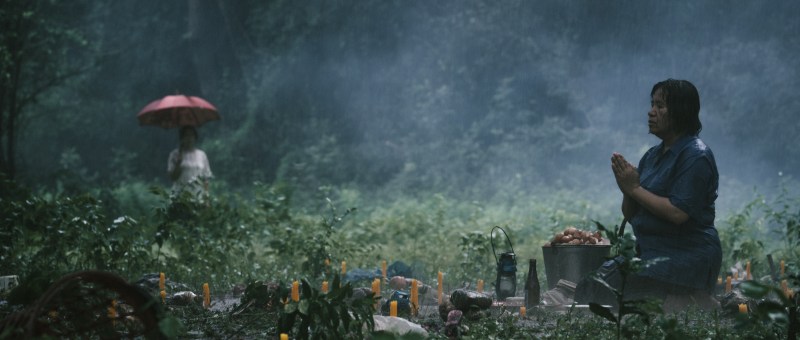
The Medium (ร่างทรง, Banjong Pisanthanakun, 2021)

A young woman finds herself caught between the contradictions of the modern Thailand in Banjong Pisanthanakun’s eerie forest-bound supernatural folk horror, The Medium (ร่างทรง). Produced by The Wailing’s Na Hong-jin and based on his original story, Banjong Pisanthanakun’s shamanistic drama is in many ways an exploration of the vagaries of faith but also of the price to be paid for abandoning the traditions of your nation and the slowly mounting karmic debt that visits itself solely on the young. 

A documentary film crew exploring indigenous religious practice has settled on shamaness Nim (Sawanee Utoomma) as a subject, getting her to provide a brief explanation of the area’s animist beliefs. According to her, there are good spirits and bad, those who protect and those intent on causing harm. As a conduit of the goddess Ba Yan, the local protective deity, she is able to intervene when the villagers need her help though only, she is keen to point out, where the problem stems from something “unseen”. She takes no money for her services, though sometimes people bring gifts, and is clear that she cannot treat conventional illnesses such as cancer only those a direct result of supernatural manipulation. 

Nim had not originally wanted to become a shamaness and at one point attempted to take her own life in order to escape it, but claims that after deciding to accept Ba Yan everything changed for the better and she’s since grown to like it because it allows her to help people as well as affording her a special status in the village. A maternal deity, Ba Yan only seeks female hosts and the original target had been Nim’s older sister Noi (Sirani Yankittikan) who went so far as to convert to Christianity in order to reject her. According to older brother Manit (Yasaka Chaisorn), the sisters have never got on, a degree of animosity between them obvious on attending the funeral of Noi’s husband Wiroj (Prapruttam Khumchat). Wiroj, however, a had traumatic family history of his own, his ancestors apparently having committed a terrible crime, while his grandfather was stoned to death by his employees, and his father burned his factory down for the insurance money later taking his own life. The couple’s son Mac (Poon Mitpakdee) was also tragically killed in a motorcycle accident some time previously.  

All of this might explain why Nim’s 20-something niece Mink (Narilya Gulmongkolpech) seems to be behaving strangely at the funeral, having too much to drink and kicking off at an uncle for supposedly insulting her. Witnessing other strange events, Nim starts to suspect that Mink is beginning to awaken as a shamaness and that Ba Yan is looking to move on, but whatever it is that’s troubling Mink may not be as benevolent as the protective deity. The clash between the sisters comes to represent a clash between tradition and modernity, ritualistic animist religion and Western Christianity, as mediated through the body of Mink a young urbanised woman working at a recruitment centre who thinks all this shaman stuff is backward and superstitious. Interviewed by the documentary crew she rolls her eyes and recalls a story of a so-called Doraemon Shaman who is compelled to sing the theme tune to the famous children’s cartoon about a blue robot cat from the future on entering a trance. 

As the film progresses, a series of questions arises in relation to the dubious ethics of the documentary film crew particularly in their decision to continue following Mink as her mental health deteriorates. Later events imply they did not edit this footage themselves, but the decision to film the aftermath of a suicide attempt seems unjustifiable as does the inclusion of CCTV footage featuring clearly recognisable people engaging in acts of intimacy even if admittedly in public places. 

In any case, the central question is how much faith you can have in things you can’t see, Noi ironically asking Nim how she knows Ba Yan is with her if they’ve never “met” while simultaneously refusing to ask herself the same question in regards to her Christian faith. Then again, we can’t be sure if Noi’s faith is “genuine” or solely a way of rejecting her traditional beliefs in order to shrug off the burden of shamanism. Even Nim finally admits that she no longer feels certain that she really is possessed by Ba Yan and not the victim of localised hysteria. Her final conclusion is that Mink’s illness is a result of Noi’s rejection of shamanism and only by convincing her to finally accept the goddess can they gain her assistance in freeing Mink from the ancestral curse and bad karma that have apparently made her a magnet for evil spirits. 

Having originally believed the spiritual pollution lay firmly in the present generation with the suggestion of an uncomfortable taboo, Nim later realises she’s been tricked and the problems lie far in the distant past if exacerbated by the karmic debts accrued by Wiroj’s immediate forbears. Noi’s reluctance to listen to her guidance, however, eventually leads to a series of escalating consequences, further bearing out the message that it was her own betrayal of her traditional beliefs that laid a spiritual trap for her daughter. Capturing a sense of eeriness in the Thai forests,  Banjong Pisanthanakun leans heavily into a sense of spiritual confusion and existential dread asking some key questions about the nature of faith, the costs of sophistication, and effects of failing to deal with the legacies of historical trauma while raising a sense of palpable evil in its demonic trickery. 


The Medium screened as part of this year’s BFI London Film Festival and will stream exclusively on Shudder in the US, Canada, UK, Ireland, Australia, and New Zealand from Oct. 14.

Teaser trailer (English subtitles)