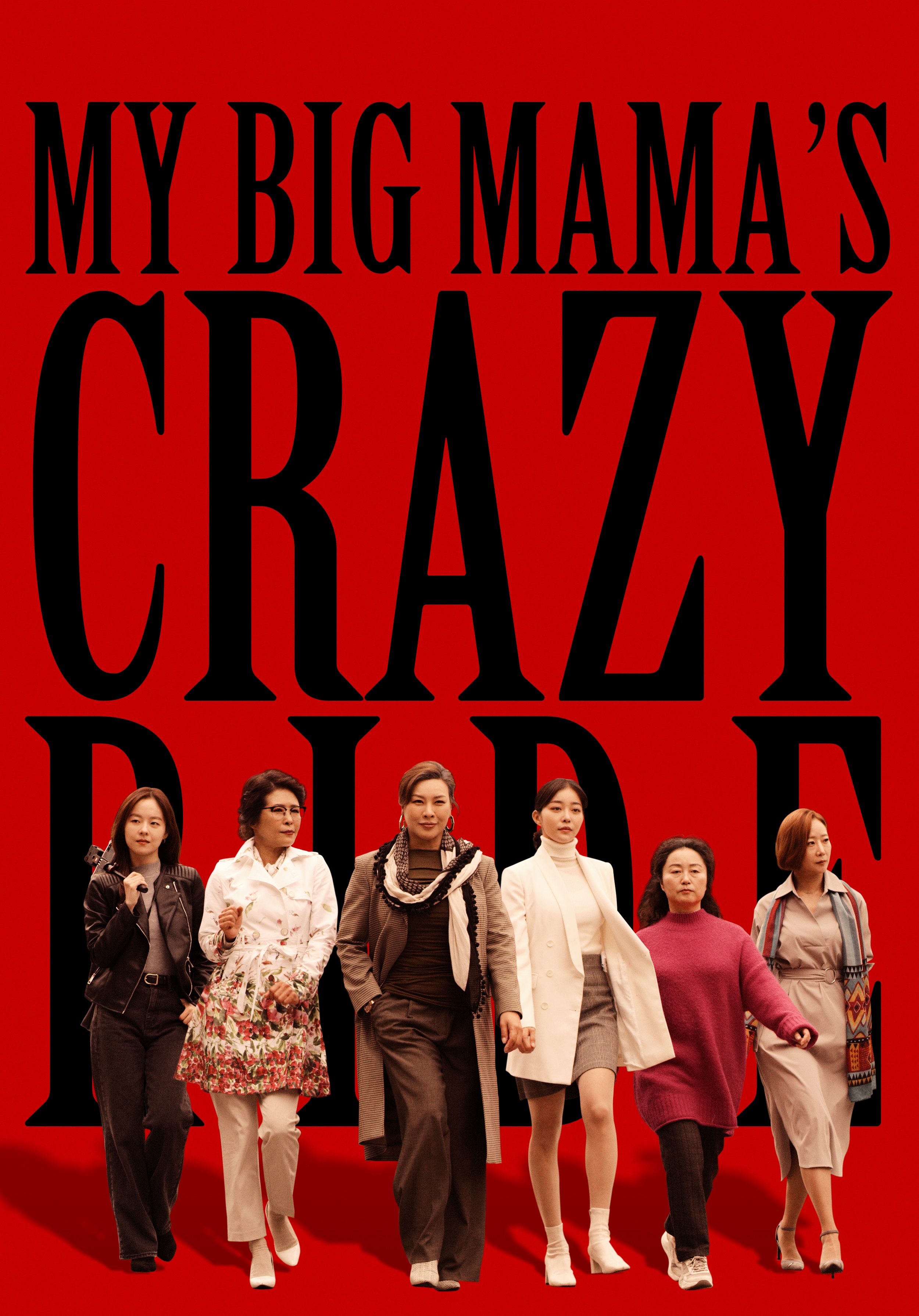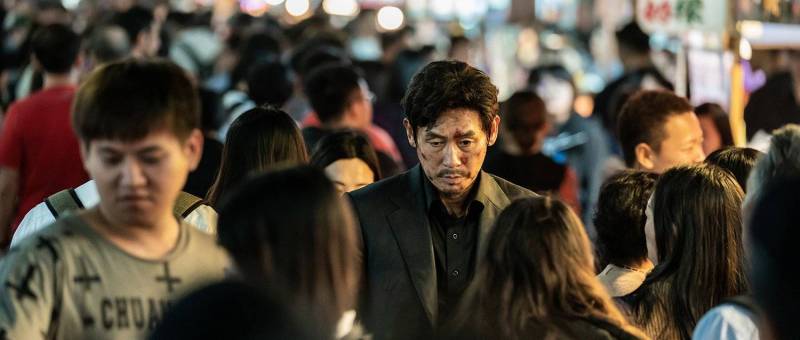
Yaksha: Ruthless Operations (야차, Na Hyeon, 2022)

“Justice is preserved by being just” according to the idealistic hero at the centre of Na Hyeon’s Yaksha: Ruthless Operations (야차, Yacha) , though he’ll eventually come round to his sometime mentor’s belief that “Justice must be preserved by any means necessary”. Any means necessary is indeed the motto of the titular hero named for the unpredictable Buddhist deity and regarded by his superiors as a dangerous maverick though as it turns out he does indeed have justice in mind even if his idea of justice might not fully align with those whom he is intended to serve. 

The failure of the regular justice system is signalled in the film’s opening as idealistic prosecutor Ji-hoon (Park Hae-soo) finds his case against a corrupt CEO falling apart because of procedural mistakes by his own rookie team. Humiliated on the courthouse steps, Ji-hoon is given a punitive transfer to the NIS where he is kept out of trouble, told to draw a salary but given very little work. He and his jaded colleague who was once known as the “bulldozer of justice” but has been ruined by this bizarre form of punishment and no longer has the will do to anything much at all mostly spend their time doing jigsaw puzzles stave off boredom. When his colleague admits there’s no more hope for him and turns down an offer of reinstatement, Ji-hoon agrees to travel to Shengyang, a hotbed of international spies in China, to find out what’s going on with a series of false reports from their agents on the ground led by maverick black ops officer Yakska. 

What he soon discovers is that he’s been dragged into some murky geopolitical shenanigans between North Korean spies, his target’s possibly corrupt team, and the Japanese who are once again up to no good trying to prevent a possible alliance between North and South believing such a union would present too much of a threat to their economic position in North East Asia. His problem is that Yaksha’s field craft does not measure up to what he regards as appropriate conduct. He engages in firefights and commits what seem to be summary executions while later threatening to torture a hostage to force her to reveal the location of their missing asset, a North Korean financial kingpin, Moon (Nam Kyung-eup), who had been acting as a double agent for the Japanese but had become disillusioned with their imperialist outlook and decided to defect to the South bringing valuable information with him. 

It has to be said that however uncountable it may be to see a Japanese spy who behaves like a gangster committing acts of torture in a well appointed lab on a Chinese woman in China, Yaksha cannot exactly claim the moral high ground having attempted to do something similar only in his filthy hideout in an abandoned mine. Ji-hoon’s dilemma is that he doesn’t know whose side, if any, Yaksha is on or if he’s after the North Korean trillions Moon had been managing rather than a hugely beneficial national asset. Exposed to this morally grey world, however, Ji-hoon’s idealist edges begin to soften as shifts towards Yaksa’s “by any means possible” philosophy while trying to stop evil Japanese spy turned lobbyist from recovering the valuable data Moon had to sell and going on to do even more nefarious deeds undermining the possibilities for reunification along with the Koreas’ economic potential. 

Somewhat uncomfortably, the film does then more or less condone torture, betrayal, and summary execution if conducted in the pursuit of “justice” even while simultaneously approving of Ji-hoon’s idealistic pursuit of the rich and powerful who continue to misuse their position and cause pain to ordinary people. It comes to something when the safest ally is a gang of human organ traffickers with whom Yaksha seems to be suspiciously familiar. Nevertheless, what Yaksha eventually asks Ji-hoon to do is to “clean things up” hinting at the duo’s complementary qualities as they pursue “justice” in both the legal and more immediate senses. Filled with some quite literally explosive action sequences along with some admittedly broad comic book antics as the guys face off against Hideki Ikeuchi’s Japanese arch villain Yaksha is certainly a good looking film if one with a dark heart beating at its centre. 


Original trailer (English subtitles)
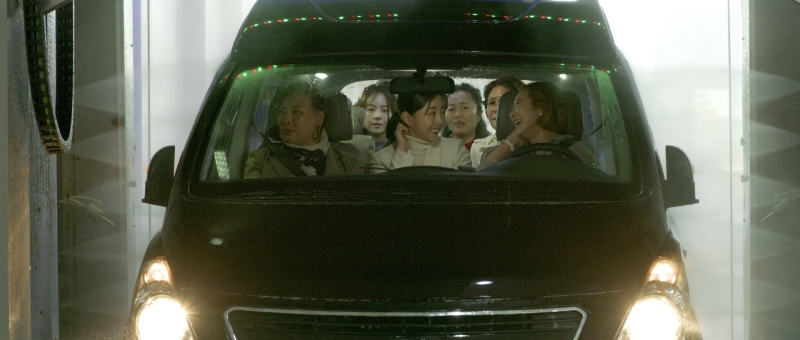
My Big Mama’s Crazy Ride (큰엄마의 미친봉고, Paek Seung-hwan, 2021)

A veteran matriarch suddenly decides she’s had enough in Paek Seung-hwan’s indie comedy, My Big Mama’s Crazy Ride (큰엄마의 미친봉고, Keuneommaui michinbonggo). Taking aim not only at the deeply ingrained and hopelessly outdated patriarchal social codes of contemporary society, Paek also asks a series of questions about the concept of family with the wives and daughters-in-law repeatedly finding themselves described as “outsiders” yet expected to sacrifice their hopes and aspirations in dedicating themselves entirely to the “family” which more often than not treats them as unremunerated housekeepers. 

It’s easy enough to see why “Big Mama” Yeong-hui (Jung Young-joo) is fed up as her husband Han-il (Yu Seong-ju) barks orders from upstairs while she tries to sort out the food for the ancestral rites knowing the men are up there lounging around drinking just expecting everything to be done for them without needing to lift a finger to help. This year she’s choosing chaos, rounding up all of the other women in the family including Eun-seo (Kim Ga-eun) her nephew’s fiancée meeting the family for the first time and packing them into her minivan leaving the men to fend for themselves.  

This is a problem for them for several reasons the biggest being that it soon becomes clear they have no idea how to do anything for themselves, drill sergeant Han-il ordering his brother and sons to finish all the food prep within the hour while they search for YouTube videos to teach them basic cooking. They can barely even figure out how to make themselves some instant noodles while they wait, becoming progressively drunker to avoid facing the reality of their situation or accept that perhaps their treatment of their wives has been unfair or that they’ve taken all of their labour for granted. Old-fashioned authoritarian Han-il even approves of Yeong-hui’s flight in the beginning in the belief that she’s taken the other women out to teach them some discipline despite her having brought up the subject of divorce because of his own treatment of her. He doesn’t see his behaviour as essentially abusive because of the patriarchal social codes in which he operates believing this is simply the way that husbands are supposed to boss their wives. His brother and sons are little different though subordinate to him as head of the family, oldest song Hwang-sang (Song Dong-hwan) eventually kicking back but only after realising his mother may really leave profoundly shaking his foundations even as a grown man with a son of his own. 

Then again, aside from a potential divorce Yeong-hui is otherwise described as an “outsider” having married into the family most particularly when it comes to light that Han-il has sold some ancestral land and intended to keep the money for himself rather than share it amongst the other family members. When he sends the proceeds to Yeong-hui in a last ditch effort to get her to come home, it causes division on both sides with his brother Han-san (Yoo Byung-hoon) in particular objecting to the money leaving the family as Yeong-hui is technically a Lee and not a Yu while the women also think she should share the money with them rather than keep it for herself little knowing she was already planning to do so. Having serious doubts about marrying into this crazy family, Eun-seo, who is in any case Christian, isn’t sure why she was attending their ancestral rites anyway but if none of these women are actually “family” why is it they’re the ones expected to prepare the rites for the Yu ancestors? Yeong-hui sees the money in part as compensation for the unpaid labour she’s performed over the last 40 years while being shouted at and ordered around by her overbearing authoritarian husband. 

Thanks to YouTuber niece Hyo-jeong (Ha Jung-min) and sleazy tabloid journalist nephew Jae-sang (Cho Dal-hwan) the women’s flight ends up going viral and even making the evening news where they find mass support from other women in similar situations along with unexpected male solidarity though a big thumbs up from a series of male policemen seems a little unlikely given the threat they present to the entrenched social order in rebelling against the same kind of patriarchal male authority the police force itself represents. In any case, it becomes clear that Yeong-hui has simply chosen to celebrate her own ancestral rights in paying tribute to another woman whose name she only belatedly found out, the other women also revealing that they don’t even quite know each other’s given names because they’re so used to addressing each other only as daughter/sister-in-law or else as X’s mum to the extent that they’ve been robbed of an individual identity. Nevertheless through their transgressive road trip the women rediscover a sense of female solidarity while the men are forced to reckon with the way they treat their wives realising that if they want to keep their family together they’ll have to move with the times. 


My Big Mama’s Crazy Ride streamed as part of the 14th season of Asian Pop-Up Cinema.

Original trailer (English subtitles)