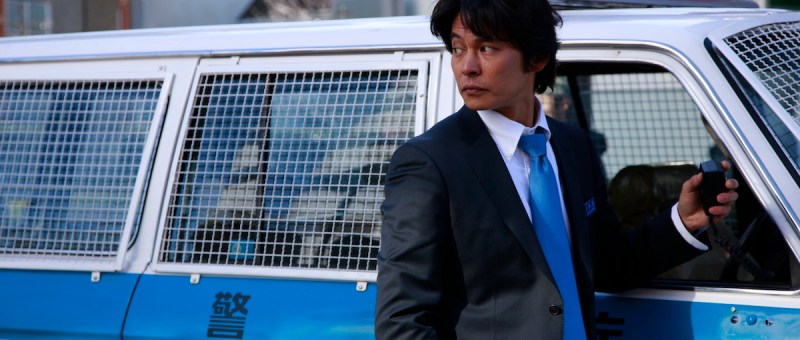

It’s all change at Wangan police station in the third instalment in the Bayside Shakedown series, Let the Guys Loose (踊る大捜査線 THE MOVIE 3 ヤツらを解放せよ!Doru Daisousasen the Movie 3: Yatsura wo Kaihou seyo!). Seven years on from the previous film, many things have changed. Aoshima (Yuji Oda) is now in charge of his team and the precinct is set to move to new purpose-built premises boasting the latest high-tech security systems which will aid them in combating potential terrorism and safeguarding local dignitaries. Even so, the gang will have to deal with some unfinished business from the past before they can fully move on as the circular tale takes us right back to the original film’s villain.
Following the familiar formula, Motohiro opens with a gag sequence in which Aoshima prepares to give a briefing only it’s not about a case it’s about the logistics of moving offices of which he is in charge and characteristically vowing to do the best job possible. Hindering his progress, however, are two bizarre crimes, the first a bank robbery investigated by his colleague/long-term love interest Sumire (Eri Fukatsu) in which no money is stolen, and a bus hijacking he investigates himself in which the hijackers simply left the scene again without stealing anything. Ironically enough a theft does take place during the move involving three pistols which happen to belong to Aoshima, Sumire, and a new recruit from China, Wang (Kenichi Takito). Soon enough a body turns up on a boat along with Aoshima’s gun sending the gang on the chase for the mysterious thieves.
The thing we’re constantly told about the new building is how secure it’s going to be, which makes the theft even more ironic, but the truth is that in true franchise style pretty much anyone and everyone is walking in and out carrying moving boxes so nothing is ever really “secure” even in the police station, harking back to the minor villain in the first film who was able to sneak in because he was wearing a fake cosplay police uniform and no one noticed him. Inevitably, this invisible vulnerability eventually comes back to haunt them when the criminals are simply able to steal the manual for the security system and replace it with one of their own to render it unusable to the police later trapped inside the building. Meanwhile approaches to public safety become a matter for debate when it arises that the criminals’ demand is that all of the villains we’ve seen Aoshima arrest so far including psychopathic serial killer Manami (Kyoko Koizumi) who still has a sizeable following online should be released. Counter-intuitively, the police bigwigs are in favour of acquiescing with only Muroi (Toshiro Yanagiba), who has now been promoted to sit at the table himself, objecting on the grounds that it simply isn’t safe to release such dangerous criminals back into society.
Rather than simply bureaucracy and funding concerns, Bayside Shakedown’s third instalment is more directly critical of the interplay between politics and justice as it becomes clear that the majority of police chiefs care more about public opinion than the law while also mindful of the upcoming general election. Meanwhile the same problem arises with the local police being sidelined by the elites from HQ, a smooth liaison officer Torikai (Shun Oguri) arriving to solve any disputes insisting that the locals be fully respected and allowed to turn their jobs only to turn dark and authoritarian after suffering a catastrophic injury on the job. Once again, Aoshima is forced to consider if his work has real value not only because of the way he’s treated by the cops from HQ but subjected to a healthcare crisis which leads him and many others to assume he’s not long to live. It’s later discovered that he’s been misdiagnosed during his annual checkup, but his boss unethically decides to keep that from him noticing he’s become depressed and lost his mojo, hoping that he’ll be easier to manager but quite the reverse turns out to be true. Again mimicking their previous heart-to-hearts throughout the series, Aoshima perks up after some encouraging words from Sumire in addition to some words of wisdom from the late Waku presented by his rookie nephew and decides to live as if there’s no tomorrow going flat out for justice while caring nothing for his safety.
Even more than ten years on from the TV series and first big-screen outing, the romance between Aoshima and Sumire still hasn’t quite blossomed despite their respective brushes with death. Many things seem set to change for the Wangan police, the new building acting as a kind of reset while Muroi prepares to move into a more political role and a new, somewhat surprising, local police chief is selected to lead them into a new future just as dedicated to compassionate local policing defined by fairness and justice as they have ever been.
Trailer (no subtitles)
 There ain’t no cure for the summer time blues! Unless, of course, you have a time machine. For the boys of the sci-fi club the long, boring summer vacation is just getting started. They mess around playing baseball while the two girls from the photography club who’ve been unceremoniously ousted from their club room in favour of the boys take photos of them. Then some weird stuff starts happening and their air con remote gets broken and it’s just so hot! When the boys somehow end up with a mysterious time machine, the solution is obvious…
 Windows on Worlds