
Nothing Serious (연애 빠진 로맨스, Jeong Ga-young, 2021)

Through her first three features in which she also played the lead, Jeong Ga-young had established herself as a provocative indie voice casting herself as an often unsympathetic if transgressively frank heroine contending with the vagaries of the modern society. Nothing Serious (연애 빠진 로맨스, Yeonae Bbajin Romance), by contrast, marks her debut as a commercial film director and perhaps softens some of her harsher edges but nevertheless maintains her characteristic saltiness and often witty dialogue in what is otherwise closer to Nora Ephron than Hong Sang-soo. 

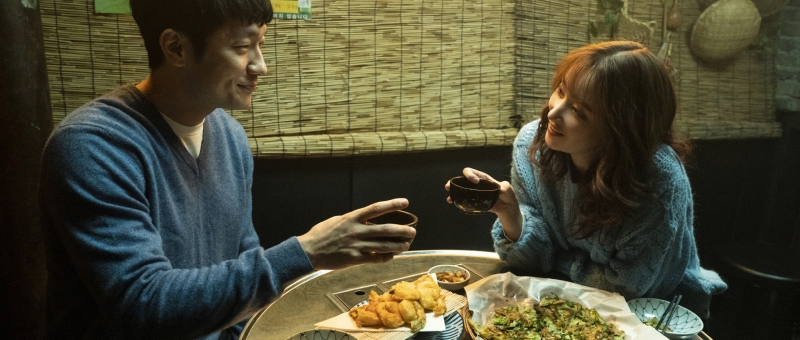
Though played by Jeon Jong-seo rather than the director herself, 29-year-old Ja-young is a classic Jeong heroine transgressively frank in terms of her sexuality and finding herself in something of a tailspin as she approaches her 30th birthday as a single young woman drowning in debt with neither career nor relationship success to boast of. Meanwhile across town nerdy magazine staff writer Woo-ri (Son Suk-ku) finds himself having to write almost all of the magazine himself in part he suspects as punishment for having helped a friend leave to start up their own online publication. His particular problem is that his boss has asked him to take over his friend’s sex column which is really not his thing especially as he’s in an on again off again non-relationship with colleague Yeon-hee (Lim Sun-woo) who has just informed him she’s getting engaged to her old boyfriend. 

Inevitably the pair end up meeting through dating app Love Bridge to begin with just for a no strings New Year one night stand only to inconveniently realise they quite like each. Even so, their personal issues continue to overshadow the relationship, those being Ja-young’s hurt and anxiety on hearing that an old boyfriend who treated her badly and broke her heart is getting married, and the fact Woori signed up to Love Bridge mainly to find inspiration for his column which becomes an unexpected hit with readers who prefer the slow-burn tease of their romance to the X-rated content of Woo-ri’s predecessor. 

While not really “dating” the couple continue to share their relationship woes with each other, Ja-young continually fed up with her attempts to meet “normal” men who don’t invite their mother on dates, turn out to be married, or are just plain odd. Her previous boyfriend branded her an insanely jealous “alcoholic nymphomaniac” while she simply tells it like it is as a sexually liberated young woman who refuses to feel ashamed for feeling desire but is also in her own way lonely and looking for companionship as perhaps is Woo-ri while conflicted in his betrayal of her even if he is careful not to use any identifying details in his column. 

Along with their romantic woes, the pair also share a sense of hopelessness about the future, Woo-ri disappointed in himself for his lack of success as a serious writer and Ja-young staking her hopes on a career in podcasting after being forced to leave a job at a radio station because of the awkwardness between herself and a colleague she’d previously dated. Interviewing her grandmother and a series of other women she fears were denied the right to become the protagonist of their own lives, always someone’s wife or mother looking after children or in-laws, she wonders if she’s managed it herself or if things are really as different now as she had thought them to be while she continues to struggle drowning in debt and loneliness with very little hope for the future. 

Jeong’s prognosis is, however, a little more hopeful than in her previous films Ja-young and Woo-ri each flawed but basically good falling in love despite themselves only to see their connection undermined by its superficial inauthenticity. If nowhere near as caustic, she retains her sense of playfulness, even throwing in a reference to her first film Bitch on the Beach not to mention the tiny animated heads emerging from the pair’s phones, through sophisticated dialogue instantly capturing a sense of the everyday life of the average 20-something in the contemporary society longing to overcome their sense of cynicism and believe in a genuine romantic connection. Strangely charming in its breeziness, Jeong’s commercial debut loses none of her wit but gains a little in warmth as these crazy kids learn to put their anxieties aside and give love a chance even if it turns out to be nothing serious after all. 


Nothing Serious screens at UltraStar Cinemas Mission Valley, San Diego April 23 as part of this year’s SDAFF Spring Showcase.

International trailer (English subtitles)

Heart (하트, Jeong Ga-young, 2019)

Heart Still 2Director Jeong Ga-young has begun to make a name for herself as the female Hong Sang-soo since her indie breakout debut Bitch on the Beach. Unlike Hong, Jeong also stars, taking her meta concepts to a whole new level in her leading role as a typically Hongian feckless filmmaker on the prowl. Where Bitch on the Beach, a monochrome two-hander, found her toying with an ex, Hit the Night saw her experiment with role reversal as a skeevy director “interviewing” her crush about inappropriate topics under the guise of research for a screenplay. In Heart (하트), her latest awkward self-confession, she neatly brings the two together as a conflicted movie director turns to a married man she once had a short affair with to get advice about her crush on another man who is also married.

Ga-young, a 30-ish film director, suddenly shows up at the studio of artist Seong-bum after six months looking for a shoulder to cry on. Some time previously, the pair had a short affair in which Seong-bum slept with Ga-young on the very day that his wife gave birth to their son. Now Ga-young has come looking for someone to talk to about her ambiguous relationship with another married man who has just become a father. Seong-bum is not particularly happy to be consulted on this topic as if he were some sort of expert, but finds himself going along with Ga-young’s whims until they eventually end up having sex on the studio couch.

Ga-young (like the protagonists of Jeong’s previous films) essentially regards men as pathetic and faithless, willing to betray their wives and girlfriends with another woman with nary a second thought. Manipulating them is, partly, a kind of revenge though one that often seems to backfire. Later, talking to an actor about her script which forms the basis of the conversational scenes with Seong-bum, Ga-young outlines her desire to destigmatise affairs with married men. Taking an obvious soap opera scenario but lending it realism and relatability she hopes to open a dialogue for people to talk seriously and without judgement about something that really happens every day. The dialogue is, however, immediately hijacked by the actor who judges her on realising the screenplay is partly (well, largely?) autobiographical in that Ga-young herself has really had relationships with married men. After all, married men Ga-young says, like the Cannes film festival, are apparently something you do so you can tell people that you tried it and it wasn’t all it was cracked up to be.

Ga-young seems to have fallen into the same trap as the director in Hit the Night in assuming the hot young actor would be an idiot but quickly finding herself out of her depth when he begins turning the tables and asking her awkward questions about her screenplay. Talking to Seong-bum about her relationship with the other married man, she tells him that her attraction is largely based on her perception of him as the sexiest man alive along with his persistent vanity in constantly asking Ga-young to tell him that she likes him. Seong-bum thinks the other guy is a jerk for cheating on his wife while they have a newborn baby, conveniently forgetting that he did exactly the same thing himself, later offering only the excuse that his circumstances were “different” when Ga-young reminds him.

In an odd relationship analogy, Ga-young outlines a scenario in which couples are cosmically paired off on separate islands but professes admiration for those who actively defy their romantic destiny to chase love of their own choosing. Probed, however, she proclaims that she herself is waiting on her island for her lover to arrive. Lamenting to Seong-bum that her heart hurts because of all the leftover feelings she doesn’t know what to do with, Ga-young remains passive, allowing herself to be dominated by the judgemental actor while casting herself in the opposite role wilfully manipulating Seong-bum in her screenplay. Yet even within the constructed narrative of the conversations, she undercuts herself by inserting a Korean drama-esque sequence of herself and her married crush accompanied by a swooning K-pop power ballad. The actor sniffily tells her that he doesn’t get the point of making a film like this, that he simply doesn’t see the meaning. That he doesn’t get it might in itself be the point. Ga-young lets her heart lead her where it may and despite herself there is a kind of truth in that, even if its meaning is hard to discern.


Heart was screened as part of the 2019 BFI London Film Festival.

Clip (Englis subtitles)

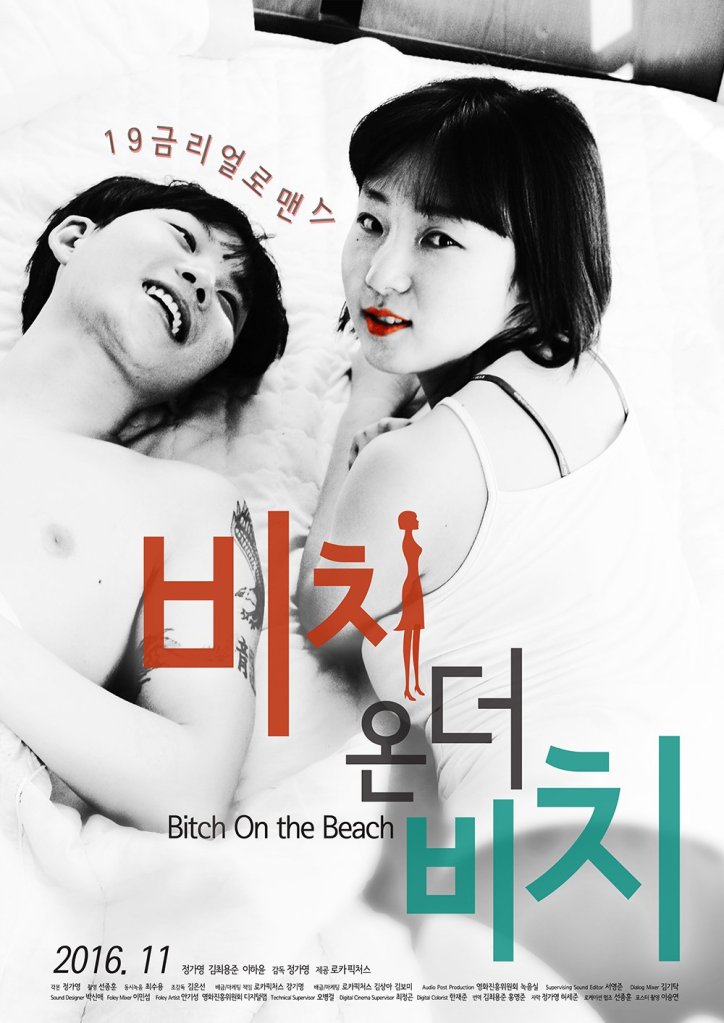
Miss Ex (비치온더비치, AKA Bitch on the Beach, Jeong Ga-young, 2016)

bitch-on-the-beachDo you know Hong Sang-soo? So asks the heroine of Miss Ex (비치온더비치, Bitch on the Beach) as part of her nefarious mission to win back her childhood sweetheart. Unfortunately, his reply is to ask if he directed The Host, so Ga-young (Jeong Ga-young) is out of luck with her Dark Knight loving former love, but possibly in luck with us as her movie obsessed ramblings and strange stories about accidental AIDS tests during wisdom tooth extractions continue to dominate the screen for the next 90 minutes. Divided into three chapters and filmed in an oddly colourful black and white, director and leading actress’ Jeong Ga-young’s debut feature channels Hong Sang-soo by way of Woody Allen and the French New Wave but may prove funnier than all three put together.

Drunken Ga-young has invited herself over to her ex’s flat with the express intention of seducing him. Jeong-hoon (Kim-Choi Yong-joon) is sort of fed up with this kind of thing, in fact he has Ga-young listed in his phone under the name “do not answer” but she manages to bamboozle him into opening the door anyway. Ga-young has quit her job to pursue a career in the movies, though it seems she’s not having much success. Jeong-hoon knows she only calls him for a shoulder to cry on when she’s fed up but falls for it anyway. He has a girlfriend and makes it clear he’s not up for any funny business, but Ga-young is quite determined – only time will tell if Ga-young will get what she came for, or if she even really even knows what that is.

Miss Ex was originally titled “Bitch on the Beach” in Korean which, seeing as there are no beaches in this film, seems to be an obvious reference to the Hong Sang-soo movie Woman on the Beach – a similarly reflexive exercise about a film director and his relationships with a number of women who only really become fodder for his screenplay. Filming in black and white with simple, static camera set ups and concentrating on the amusing banter between its two leading characters credited only as “woman” and “man”, Hong’s influence is palpable. Ga-young is, however, a true cinephile who, after finding time to express her boredom with The Dark Knight, goes on to detail her strange dreams about other famous directors such as Bong Joon-ho (who really did direct The Host) and arguably Korea’s greatest living filmmaker Lee Chang-dong whom she asks to be her assistant director(!).

It’s fair to say the banter is more or less one sided as Jeong-hoon is forced to listen to Ga-young’s increasingly bizarre stories. Surprisingly frank and forthright in talking to her ex-boyfriend, Ga-young proceeds to tell him about various other men in her life, her sexual desires and preferences, and even those of her friends. Jeong-hoon listens patiently with occasional bemusement, but their relationship is close enough to be totally open without causing too much of a problem. Despite his protestations it’s clear Jeong-hoon is still on the hook for Ga-young, which she clearly knows, but it’s a little less clear whether she’s just keeping him there for convenience’s sake or is actively trying to win him back.

Even if Hong Sang-soo is the obvious reference point, he is after all referenced in the text, Miss Ex also owes a debt to the breeziness of the French New Wave and its freewheeling absurdity. Cutting between amusing silliness and understated emotional drama Miss Ex is perfectly posed to examine the various trials and tribulations of romance among contemporary young people. Ga-young is, perhaps, too modern for the slightly more conservative Jeong-hoon who tells her that her problems with men mostly stem from being too quick to take the lead and also constantly picks her up on her “unladylike” colourful language. One gets the impression Ga-young might not be very good for Jeong-hoon who eventually jeopardises his relationship with his current girlfriend to keep her happy, but whatever anyone else thinks about it, it seems as if he won’t be giving up on her any time soon. Cute, quirky and extremely smart, Miss Ex is an accomplished debut from director and leading lady Jeong Ga-young who marks herself out as an interesting new indie voice in Korean cinema.


Reviewed at the 2016 London Korean Film Festival.

Original trailer (no subtitles)

https://www.youtube.com/watch?v=ZS7pvzH_qvc