A Water Mill (물레방아, Lee Man-hee, 1966)

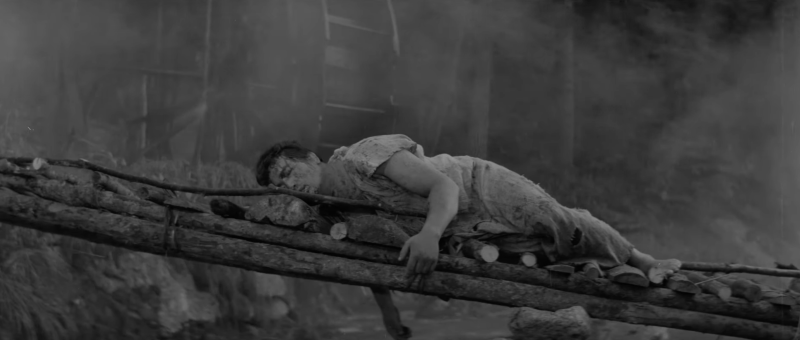
It’s not every day you wander into your own funeral. Or to be more precise, the death rite that Bong-won (Shin Young-kyun) unwittingly intrudes on in Lee Man-Hee’s feudal era fable A Water Mill (물레방아, Mullebanga) is for someone who died in a time no can remember. The old lady who explains it to him says that it happened long before she was born, implying at least the villagers have been enacting this ritual since time immemorial yet it’s almost as if Bong-won were walking towards a point of origin, drawn inexorably by forces beyond his control to play his part in this immortal ritual dance.

To that extent, Bong-won becomes a kind of “everyman” in this cautionary tale by virtue of the fact that he is nameless. Asked for his surname, he says he isn’t sure. It might be Kim or Park, later someone else says Lee which fills out the triumvirate of Korea’s most common family names. He says at one point that he doesn’t remember his mother, but thinks that she may have been a sex worker and his father a man who didn’t pay. But the fact he has no last name places him firmly at the bottom of the feudal hierarchy and most at the mercy of its hypocrisies and contradictions. He was on his way somewhere else when he fatefully found a sock floating the river that seems to flow towards him from his own future but that he will later gift perhaps to its original owner, the mysterious Geum-boon (Ko Eun-ah) with whom he falls in a deep, obsessive love that takes over the whole of his life.

Others in the village tell him that there is no such woman. An old man assures him she must have been some kind of ghost or supernatural creature come to trick him and Geum-boon does indeed take on a kind of eeriness. After deciding to stay in the village and look for her, Bong-won catches sight of Geum-boon in a forest glade bathing naked in a pool as the bright summer sun beats down on her but when he eventually makes his way down the mountain she has already disappeared. In chasing Geum-boon, he chases death but most evidently in the ways his obsession with her causes him to contravene the feudal order. He rebels against the landlord he was working for in refusing to collect her debt, then contracts himself to another in order to pay it so that he might marry her.

But ghost or not, Geum-boon is herself constrained by feudalism’s aggressive patriarchy. Force married to an invalid, she cared for him for three years until his death and then is pressed for his debts by the local landlord who wields them against her in order to claim her body. Married to Bong-won who has become an indentured servant, she is once again pursued by a landlord insistent on his droit du seigneur who exiles Bong-won to the pottery fields to get him out of the way. Geum-boon’s ambivalence does seem to give her a sometimes demonic quality as she laughs in the face of the landlord like something possessed and though she at first seems to like Bong-won and fear the attentions of the landlord she is also intrigued by the frankness of his current mistress who sees in her relationship with him the possibilities of transgressing class boundaries not to mention escaping a dull husband who will never be anything other than a servant. 

The film seems to suggest that Bong-won is powerless, while Geum-boon does at least have some power to wield. Even the landlord tells her that he has nothing to offer other than his money and power and even if becoming lady of the manor is a little far-fetched it seems unreasonable to criticise her if she did decide to become the landlord’s mistress as the path towards overcoming her circumstances lies in trading her body for influence. One could argue Bong-won does the same in leveraging his strength and his labour, but all it buys him is further exploitation and the eventual humiliation of knowing the landlord has been sleeping with his wife. 

Feudalism therefore destroys natural human emotions such as love when all life is transactional in a constant, and largely futile, struggle for survival. Bong-won turns to the spiritual realm for help, asking a shaman how he can win back his wife but she gives him the rather bizarre instructions to steal three sets of underwear and throw them in the river on 3rd August while bowing to the west. Needless to say, that doesn’t work out very well for him. The fates truly do seem to be against Bong-won. Lee adds a touch of supernatural dread as Bong-won finds himself surrounded by howling winds as he fatefully makes his way towards the water mill and his destiny. The ritual dance is perfectly recreated as Bong-won and Geum-boon retake their roles in the play, their actions matching those of the masked players as Bong-won collapses on the bridge just as the demon had though there is no positive resolution in what is now both reality and fable. What we’re left with is the tragedy of feudalism, but also the maddening futility of obsessive desire for that which is and has always been ever so slightly out of reach.
The Devil’s Stairway (마의 계단 / 魔의 階段, Lee Man-hee, 1964)

devils-staircase-poster.jpg

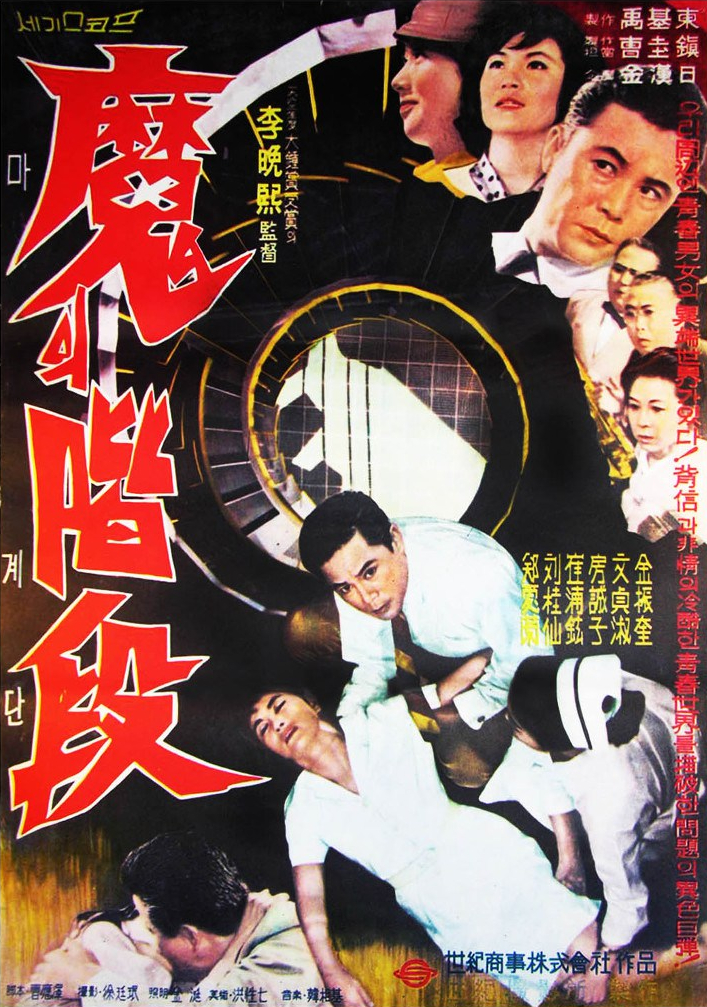
By 1964, Korea’s economic situation was beginning to improve and for many there seemed to be a bright light shining in the distance, a fixed point to which they could aspire and felt was in their grasp if they could only catch a lucky break. Throughout Lee Man-hee’s relatively short career (the director sadly passed away at the young age of only 45 – apparently a casualty of his fondness for drink and intensive work habit which accounts for his high output), his protagonists struggle with a conflict between the desire for the new kind of “success” their society promises them, and a feeling that they can never truly obtain it. Ambitious surgeon Dr. Hyeon (Kim Jin-kyu) attempts to climb The Devil’s Stairway (마의 계단 / 魔의 階段, Maui Gyedan, AKA The Evil Stairs) by abandoning the compassion that ought to define his profession for coldhearted pragmatism but discovers that the path has its price while his victims are not quite so passive as he’d assumed them to be.

When we first meet Dr. Hyeon he’s lounging around in bed while his female companion, Nurse Nam (Moon Jeong-suk), dresses and prepares to leave. Somewhat coldly, Hyeon tells her to exit via the back stairs and avoid being seen by the security guard on her way. Irritated, Nam leaves and the pair go back to work at the hospital the next morning pretending there’s nothing more between them than the relationship between a nurse and a chief surgeon. This situation might have continued indefinitely were it not for the fact that Jeong-ja (Bang Sung-ja), the daughter of the hospital’s head doctor, has taken a liking to Hyeon and seeing as her father has no sons to take over when he retires, an arranged marriage is in the offing. Dr. Hyeon, who is ambitious and emotionally cold, considers accepting the offer but Nurse Nam is unwilling to let him go, especially as she is pregnant with his child. When she threatens to spill the beans about their illicit relationship, he decides to kill her by dosing her up with sedatives and throwing her body in the pool behind the hospital to make it look like she drowned herself in heartbreak and shame, but Nurse Nam refuses to go quietly.

The titular “Devil’s Stairway” is a literal staircase from the hospital floor to the head doctor’s office. There has recently been accident in which the bannister was broken and a woman was killed. The banister is repeatedly mended throughout the film but represents a point of fracture in the spiritual path to success. Nurse Nam is another early casualty when she and Hyeon argue in the middle of the stairs and the recently mended bannister breaks as he struggles with her. Despite the minimal drop to the floor, Nam is left with serious injuries requiring surgery, loses her baby, and gains a conviction that Hyeon bears her ill will. Her position is extremely difficult – the accident has exposed the fact that she had conceived a child outside of wedlock and though she has not yet disclosed the name of the father, Hyeon fears that she will destroy his bright future either by speaking out or through forcing him to marry her to avoid social disgrace.

Hyeon gives in to darker instincts. He tells Nam that his heart is hers, perhaps intending to carry on an arrangement even after he’s decided to accept the marriage proposal, but excuses himself for stringing her along by reminding her of his lack of financial stability and comparatively low social status. We are reminded later that he is old be unmarried and, even stranger, is assumed to be a “virgin” – a solitary, perhaps dull, bachelor not known for mixing with women. This again signals his coldhearted ambition – he waits and he calculates. He wants a hospital of his own and knows his only way to get one is to marry into it, and so he does even if it means sacrificing “love” and emotional happiness for the cold comforts of conventional success and the false acclamation of social status.

Hyeon thinks he’s got away with it, but his crime haunts him. Going slowly out of his mind, Hyeon sees Nam everywhere, placing a strain on his relationship with his new wife who grows wary of his increasing violence and bad temper. His madness culminates in a tense surgery scene in which everyone around him has Nam’s face and he finds himself surrounded by his crime, forced to confess himself as a murderer in order to free himself of her ghost. Yet, things are not quite as they seem and it is not he alone who finds his grand plan floundering.

Hyeon posits his poverty as a reason for his crime, but it’s his greed which guides him towards the Devil’s Stairway. He could have married Nam, had his child, and led an ordinary middle-class life of relative comfort perhaps even opening his own clinic in good time, but he chose the quick fix in marrying for money and (literally) throwing over the woman he claimed to love to ease his feelings of insecurity and resentment at his position in the social order. His murder is cowardly but, as Nam points out, the law may protect him while there are precious few looking out for her, a betrayed woman, pregnant outside of marriage, and without a family to press her case.

As he did in the same year’s Black Hair, Lee co-opts the murkiness of the film noir, sending its sense of betrayed morality into the realms of the gothic with an ever increasing atmosphere of supernatural dread. The pond seems to emanate evil while the stairs beckon ominously, the wind rattles the doors open without warning and the rain pours down outside adding to the claustrophobic gloom of the creepy old hospital as if attempting to embody the evil that lies at its centre. Drawing heavily from Les Diaboliques, Lee declares no winners in his tale of fractured morality and emotional betrayal, painting it as a symptom of a confused era in which all emerge tarnished from a struggle to gain some kind of personal agency in an otherwise oppressive environment. Taut to the last, The Devil’s Stairway is a forgotten masterpiece of psychological horror and a mild condemnation of a society’s slide into national paranoia and greedy consumerism at the cost of true human feeling.


Available to stream online via the Korean Film Archive’s YouTube Channel.

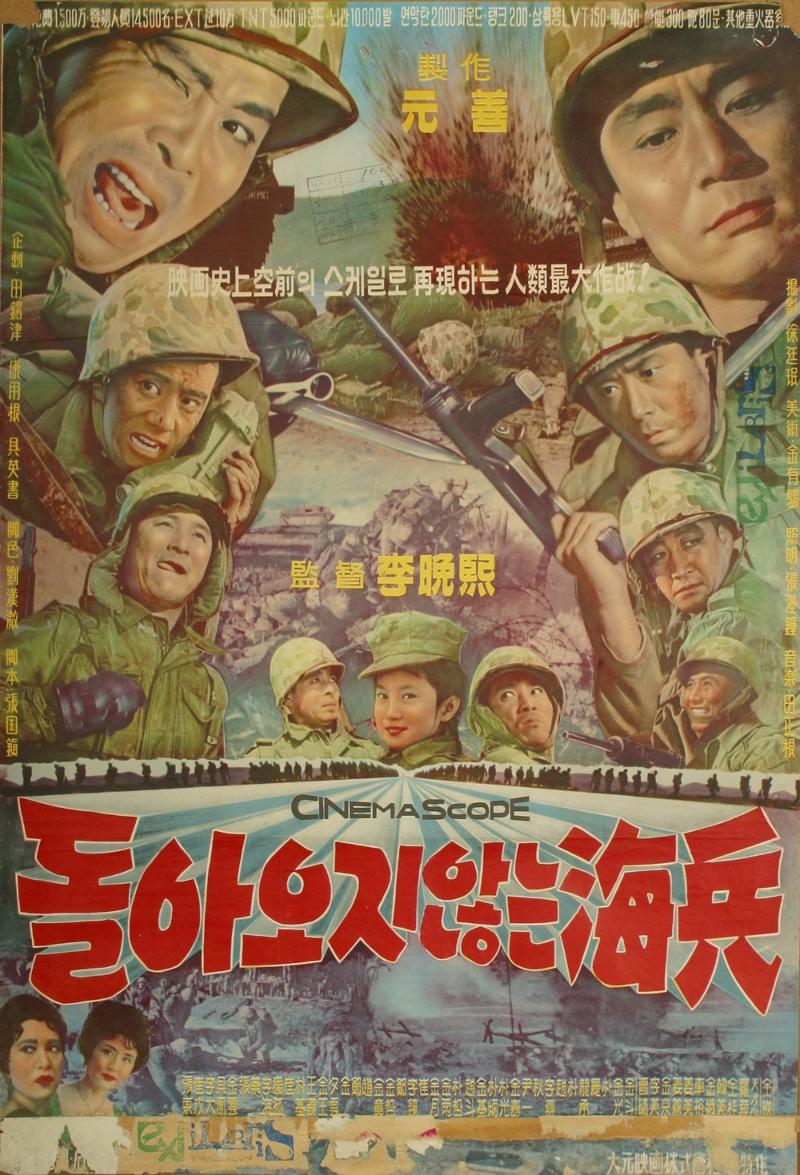
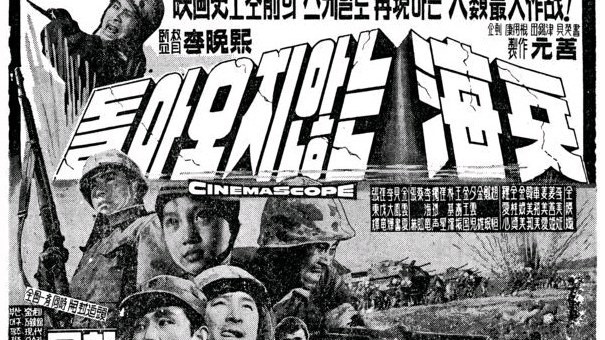
The Marines Who Never Returned (돌아오지 않는 해병, Lee Man-hee, 1963)

Marines Who Never ReturnedLee Man-hee was among the most prolific of Korean directors until his untimely death at the age of just 43 in 1975, but even among so many well regarded works The Marines Who Never Returned (돌아오지 않는 해병, 돌아오지 않는 해병, Doraoji Anneun Haebyong) has taken on an especial place in Korean film culture. Lee had himself served in the Korean War and brought his own ambivalent attitudes to the piece, expressing both an abject rejection of the senseless loss of life but also a warmth and nostalgia for the camaraderie born only out of such immediate danger. The film’s title, as melancholy as it is, points to this same ambivalence by signalling the eventually unhappy fates of these ordinary men but also according them a ghostly, unresolved future.

In the midst of the Korean War, a squad of South Korean soldiers is on patrol and taking fire from the Chinese in an urban environment. While they bide their time in a trench, a young girl and her pregnant mother run out of a nearby building. The girl runs clear but the mother is shot and killed in the crossfire. One of the soldiers is deeply struck by the scene and insists they at least make sure the little girl is safe. Pushing deeper into the building, the soldiers come upon a truly horrifying, hellish scene of men trussed up and hanging from the ceilings while bodies of the townspeople lie piled along the floor. The same soldier who wanted to save the little girl finds his own sister among the dead, just one face among so many.

From this point on the tale is narrated by the little girl, Young-hui (Jeon Young-sun), who is adopted by the troop of marines and smuggled around inside an old army kit bag so that the superiors do not find out about her presence. Young-hui proves a resilient little girl who obviously misses her parents but begins to care deeply for the soldiers who have taken her in. Giving each of her new uncles nicknames, Young-hui becomes the squad’s mascot and a symbol of everything it is they’re fighting for. Yet this makeshift family also has its share of difficulties. A problem arises when Young-hui recognises a new recruit, Choi (Choi Moo-ryong), as a man from her village. Choi is the brother of the man who joined the other side, took Young-hui’s father away and killed the sister of Private Goo, discovered so casually among the many dead in Young-hui’s village alone.

The conflict between Choi and Goo is emblematic of many ordinary families throughout Korea as fathers and sons, brothers and sisters, decided on different paths and found themselves on opposing sides of a war. Choi, as is pointed out, is not responsible for his brother’s actions – he clearly does not condone or agree with them, but still he feels responsible enough to understand Goo’s anger and resentment. Goo in turn realises his anger is pointless and misdirected but is powerless to change the way he feels. This situation is no one’s fault, but they’ll all pay the price anyway.

Lee spares no expense in recreating the hellish battles scenes more akin to the first war than the second with its outdated tanks, dugouts, and trenches. The easy, familial life of the camp soon gives way to action and danger as the squad meet their ends one by one. Away from the battlefield the men feel displaced within their own country – caught in the midst of a civil war yet also subjugated by foreign forces, barred from UN only bars and referred to as “tuppenny Koreans” by the “hostesses” in comparison to their big spending compatriots. Making his goodbye speech, the commanding officer instructs his comrade to return home and ask if anybody really needs to go to war, but rising from the trenches their thoughts are all for their fallen friends who will never see home again. These men remain “lost” on the battlefield, a lingering memory of loss and sacrifice which is impossible to resolve even so many years later.


The Marines Who Never Returned is the first in The Korean Film Archive’s Lee Man-hee box set which comes with English subtitles on all four films as well as a bilingual booklet but the film is also currently available to stream via the Korean Film Archive’s YouTube channel.