
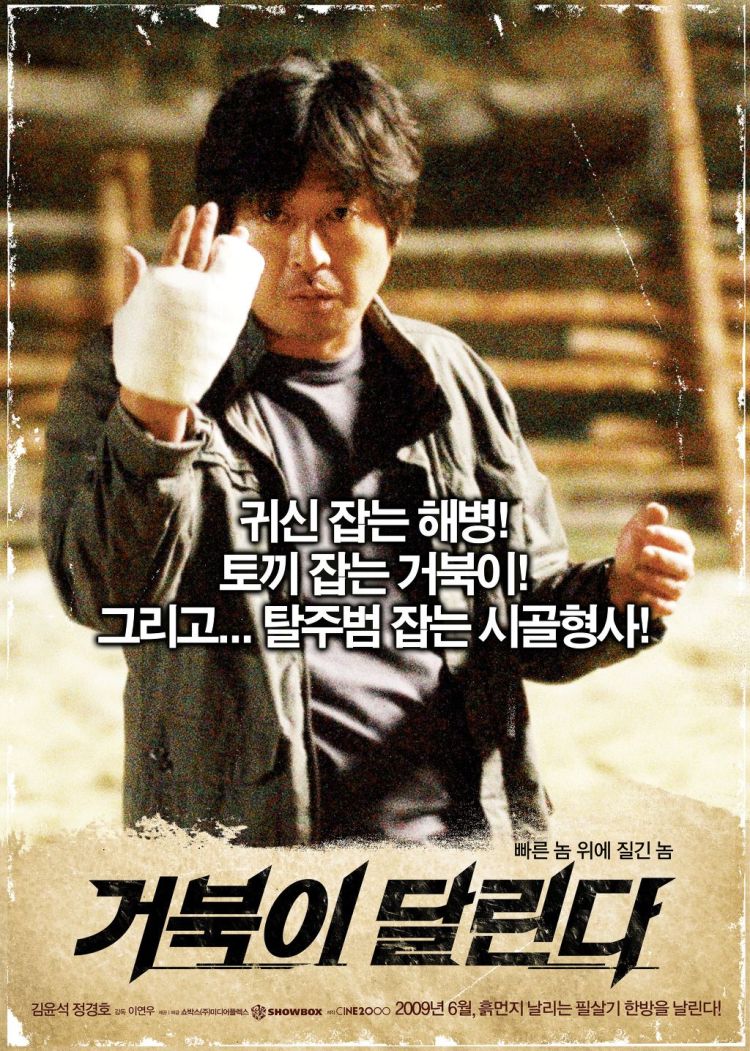
 One has to wonder why anyone becomes a policeman in Korea, or at least in the world of Korean movies. A policeman’s work is never done, yet they rarely prosper and often succeed in making themselves look ridiculous. The hero of Running Turtle (거북이 달린다, Geobuki Dalinda), played by The Chaser’s Kim Yoon-seok, is a case in point. Unlike Joong-ho, Pil-seung is still on the force (for the time being) but even for a small town beat cop he’s pushing his luck. It’s not surprising then that he gets himself all fired up when he comes into contact with a notorious fugitive from justice.
Pil-seung (Kim Yoon-seok) is among the least well-respected on a small team of police officers nominally upholding justice in a tiny fishing village. Mostly his day job involves harassing local sex workers which he mostly does by means of entrapment whilst hanging out with petty crooks like local loser gangster Yong-bae (Shin Jung-geun). Looked down on at work, things don’t improve much for Pil-seung at home where, despite the admiration he receives from the older of his two daughters, Pil-seung fails to pull his weight leaving his wife to supplement the family income by running a moribund manwha cafe whilst reduced to folding socks for the extra pennies. Then again, home is a place Pil-seung rarely goes, preferring to waste his life drinking and gambling.
On a rare occasion of busting his gut for justice, Pil-seung takes things too far with a pimp who’s a little on the heavier side and ends up almost dying after an “undue force” provoked heart attack. Suspended, Pil-seung has another set of problems in being without money for three months and being too afraid to tell his wife the truth. Stealing her savings and betting them on a local bull-fight Pil-seung’s luck comes up only to go down again when escaped fugitive and martial arts expert Gi-tae (Jung Kyung-ho) pinches the money off Yong-bae in payback for Yong-bae getting fresh with his girl (to be fair, Yong-bae had it coming).
What follows is a locking of horns as filled with macho posturing as the central bullfight between the “Bear” and “Typhoon”, though possibly not as elegant. Gi-tae, softly spoken and melancholy, has returned to an old love and means to leave the scenes of his crimes behind him for good. This whole thing with Pil-seung is a major irritation but he has no especial interest in the portly policeman other than needing to get rid of him long enough to escape with his patient lady-love.
Pil-seung’s motivations are different. Yes, he’s originally pissed off and wants his money back, but Gi-tae also represents an opportunity for him prove himself as everything he’s hitherto failed to be – a success, a strong man, someone worthy of respect. Sadly, Pil-seung will have to work quite hard to convince himself he can be any of these things, let alone convince anyone else. Trapped in his tiny rural town, Pil-seung has long felt impotent and oppressed. He can’t provide for his wife whose lack of respect for him is real enough, though noticing the holes in her underwear as he goes in for a not altogether romantic overture reminds Pil-seung that perhaps he needs to shape up and make something of himself before it’s too late. Generally he eases his feelings of inadequacy and existential despair through alcohol, gambling, and being the big guy around petty gangsters to whom he is useful but again, not a figure to be feared, loved, or respected.
Going up against a top criminal like Gi-tae all alone is a fairly stupid proposition in the first place, one only someone as deliberately pig-headed as Pil-seung would ever attempt. It’s his particular quality of bloodymindedness which becomes Pil-seung’s trademark as he absolutely refuses to give up on clawing his way back into the hearts of his wife and family through an act of officially recognised heroism though it’s true enough that if he’s going beat a man like Gi-tae (who often seems the unfair target of Pil-seung’s petty quest) he’ll need to reawaken some of those little grey cells to do it. The turtle of the title, Pil-seung chases his hare with furious, if plodding, determination only to see victory within his grasp through no fault of his own. It just goes to show, slow and steady wins the race but obsessive hard headedness doesn’t hurt either.
Currently available to stream in the UK (and possibly other territories) via Netflix.
Original trailer (English subtitles)

 Windows on Worlds