My Elder Brother (私の兄さん, Yasujiro Shimazu, 1934)

A wastrel son and runaway daughter get a few lessons in filiality in Yasujiro Shimazu’s genial ‘30s comedy, My Elder Brother (私の兄さん, Watashi no Niisan). Reflecting the changing the times, the film is in many ways about navigating the sometimes fraught relationships among a blended family though like many hahamono, it’s the stepson who is most devoted to his mother while the birth son is consumed by a sense of guilt and inadequacy in his accidentally awkward positioning within the family hierarchy.

The filial piety of eldest son Shige (Reikichi Kawamura) is established early on by the fact he’s not at work because his mother is ill and he’s off visiting her. He does in fact return late at night, though there’s a question mark over his qualities as a boss as the drivers at the taxi firm he runs remark that he’s been ignoring their attempts to negotiate with him for better conditions not least the provision of assistants which has been given additional weight by one driver’s experience with a disturbed fare who attempted to strange him with his belt.

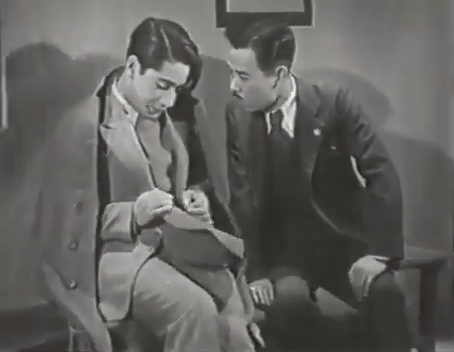
The strange and violent opening sequence in which a cabbie is attacked by a crazed passenger is never referenced again and out of keeping with the otherwise lighthearted tone of the film though does add to a sense of danger later echoed in the appearance of two guys who first seem like yakuza but are actually just two grumpy old men trying to retrieve a young woman who’s run away in defiance of an arranged marriage. In any case, tearaway brother Fumio (Kazuo Hasegawa), who arrives drunk in the back of a cab, has indeed fallen into bad company with yakuza whom he describes as his friends though Shige warns him they’re probably just after his money.

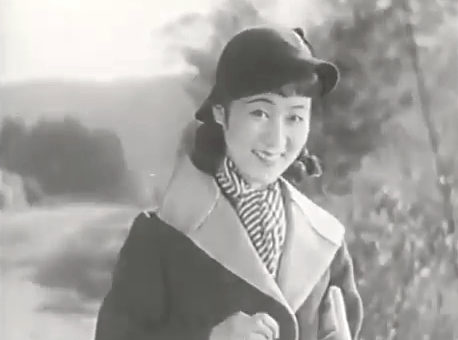
Fumio has returned because he’s learned his mother is ill, though he’s reluctant to see her given his present condition. When he does actually meet her, she says that she hates him and calls him a good-for-nothing, worthless man. It seems her animosity is partly motivated by a sense of guilt and embarrassment that her biological son has brought shame to the family she married into and especially to Shige. For his part, Shige acknowledges that he also felt resentful when Fumio and his mother moved in but explains that he was still a child clinging to the memory of his late birth mother. Fumio explains to the young woman he picks up, Sumako (Kinuyo Tanaka), who is on the run from her uncle and the man her stepmother wants her to marry, that he left home because of his precarious status and sense of inadequacy but liked the sense of freedom his independence gave him even if he is ashamed of the kind of life he’s lived on the fringes of the underworld. 

Sumako is experiencing a similar dilemma as she feels herself unable to bond with her stepmother to the extent that she has not been able to articulate that she objects to the arranged marriage her relatives have set up for her. She laments that if it were her birthmother she should be able to tell her everything, but Fumio counters that Shige had been jealous of him because he could exchange harsh words with his mother because of their closeness in a way he never could because he is not her biological son. Reinforcing a sense of obligation between parents and children might have been an important message in the mid-1930s, but the film is perhaps unexpectedly progressive in its openness and desire to embrace these then considered less usual family arrangements born of second marriages in emphasising the brotherly bond between the two men and Sumako’s successful escape from an unwanted marriage simply by speaking her true feelings to her mother not to mention the suggestion of a cross class romance between rich girl Sumako and the middle-class Fumio.

Meanwhile, the film also has an international bent in the prominent signs for Chevrolet and Hollywood-esque aesthetics, drawing inspiration from American and European crime films for the violent opening sequence and underworld setting. Shimazu hints at the shadiness of Fumio’s backstreets life, but equally of Sumako’s uncle and his moustachioed friend lending an undertone of darkness to the mid-30s society but otherwise keeps things light in the innocent courtship between Fumio and Sumako who can mediate their attraction only by remarking on the beauty of a sunset. 

Family Meeting (家族会議, Yasujiro Shimazu, 1936)

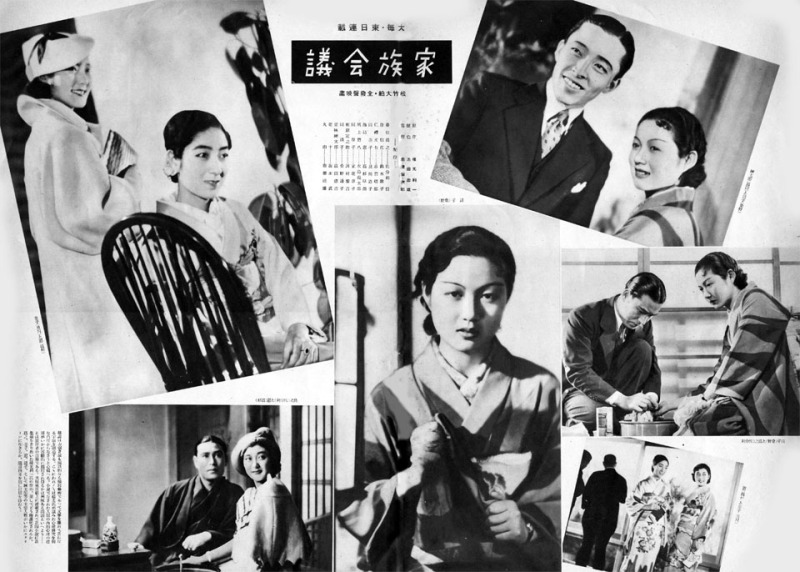
Family Meeting horizontal posterGiven the strident tone of the times, it was perhaps becoming more difficult to avoid politics altogether by the mid-1930s, but Yasujiro Shimazu manages it well enough in Family Meeting (家族会議, Kazoku Kaigi) – a romantic melodrama set in the world of the high stakes family business. Shimazu is best remembered as the pioneer of the shomingeki – stories of ordinary lower-middle class life in the contemporary era, but Family Meeting shifts up a little way in its focus on a young CEO who discovers it’s lonely at the top, not least because of the burden of family legacy and its unexpected impact on his difficult love life.

Shimazu opens on a noisy trading room floor at the Shigezumi Company before shifting to the equally chaotic boss’ office. Young CEO Takayuki (Shin Saburi) is called out by a family friend, Haruko (Yasuko Tachibana), who insists he come to the theatre to meet a young lady, Kiyoko (Michiko Kuwano), with whom she hopes to set him up. Takayuki’s love life is somewhat complicated in that he’s in love with “that woman from Osaka” – Yasuko (Michiko Oikawa) who also happens to be the daughter of a former business associate whose dodgy dealings some say pushed Takayuki’s late father to suicide. Yasuko is coming to Tokyo for the memorial service for Takayuki’s dad in company with her friend, Shinobu (Sanae Takasugi), but is also being pursued by another suitor – Rentaro (Kokichi Takada), a businessman who is secretly attempting to undermine Takayuki’s business through merging with another company.

Difficulties abound for Takayuki as his business suffers and he’s pestered from all sides as regards his romantic inclinations. Despite his personal feelings, he is unable to fulfil his romantic desires with Yasuko because of their difficult family history while Haruko attempts to push him towards Kiyoko. Kiyoko, the daughter of the businessman undercutting Takayuki’s business wouldn’t be such a good match either if anyone but she knew about the machinations, but currently they’re a well kept secret. Having fallen in love with Takayuki she eventually decides to spill the beans which gives him an all important advantage though he has to mortgage his house and approach Shinobu’s father, a wealthy Buddhist monk, for a loan in order to stay afloat. Takayuki isn’t interested in Kiyoko and finally has to resort to bluntness to make her understand but the eventual outcome is as positive as it could be and, in any case, works out well enough once she realises she’s developed an attraction for Rentaro who is finally beginning to go off Yasuko.

The romantic and the corporate increasingly overlap but the general message is that the modern business of commerce is chaotic and messy. The shouting of the trading floor and the backroom dealing of Rentaro’s nefarious plan are not exactly the rarefied world of gentleman’s agreements which often passes for the salaryman life in Japanese cinema, but the central irony is that the wealthiest man of all is the monk who “earns” his money passively through the largely silent practice of donation. The monk’s modern girl daughter, Shinobu, by contrast is a spendthrift with a taste for the spirt of the age – fast cars, feather boas, fancy hats and a confident forthrightness that stands in stark contrast to the shy diffidence of the permanently kimono’d Yasuko. The final irony is that it’s Shinobu who ultimately ends up “in charge” not only of Takayuki’s business arrangements – receiving the debt from her father and deciding to run the company herself with Takayuki as the boss, but also of his romantic life when she engineers a reunion with Yasuko before valiantly driving off alone into the mountains, her work here well and truly done.

Only once Takayuki is freed from his workplace burden is he able to address his romantic difficulties, and only by leaving the city behind is he able to free himself of his father’s legacy. Thanks to the gentle machinations of Shinobu, everyone is able to move forward with a little more certainty and little less preoccupation as she alone decides to shoulder all their burdens without thought for herself. Unlike many ‘30s films, Family Meeting’s central message seems to be slow down, let others help when things get hard, and try to avoid being so noble you make yourself unhappy. All good lessons though perhaps inexpertly delivered and without Shimazu’s usual wit.