Terror in the Streets (悪魔が呼んでいる, Michio Yamamoto, 1970)

How much bad luck can one person have before they start thinking someone’s out to get them? Released as part of double bill with The Vampire Doll and based on a novel by Kikuo Tsunoda, Terror in the Streets (悪魔が呼んでいる, Akuma ga Yondeiru) draws inspiration from contemporary folk horror and the paranoia thriller as one young woman finds herself in the crosshairs of mysterious forces seemingly hellbent on derailing her otherwise very ordinary and aspirational existence. 

Yuri (Wakako Sakai) worries that her status as an orphan has set her back in life, attributing her inability to find permanent employment after managing to put herself through university by working as tutor to a societal stigma against people with no families. Up to now, things had been going pretty well. Though she was only a temp, she had a good gig as office admin staff at big company in the city, lived in a modest but homely flat complete with a small television, and was dating her college sweetheart. But then one day her boss looks at her with an odd expression and then abruptly drops the bombshell that he’s terminating her contract without offering a reason why. When Yuri calls her boyfriend he gives her the same look and says he’s breaking up with her, also refusing to give any kind of explanation aside from not wanting to see her anymore. If all that weren’t enough, her landlady then explains that someone else is very interested in her flat and will pay double for it so she wants Yuri out by the end of the month. 

It’s undoubtedly been quite a bad day, but Yuri tries to stay upbeat reflecting that she didn’t particularly like the job anyway and intends to apply for a position as an editor on literary magazine which would suit her better. But after that nothing quite goes to plan and everything she tries to improve her situation backfires until she finally considers taking her own life at railway crossing only to be rescued by a mysterious man, Fujimura (Takashi Fujiki), who appears as her saviour but then convinces her to take some kind of pill to calm her nerves which predictably leaves her dazed and confused. He then takes her back to her apartment and claims they’re legally married, but when Yuri wakes up the following morning he’s dead with a knife in his chest. 

It’s not the first time that Yuri has experienced an apparent gap in her memory which causes her re-evaluate her sense of reality. She’s beginning to feel as if something or someone is out to get her, realising that Fujimura was the same sinister man she’d caught sight of before staring into her window. Meanwhile, she often hears a strange tune played on an ocarina that sounds like a medieval fugue. The film’s Japanese title is “the Devil calls” and it’s not a huge stretch to assume that Yuri’s been caught up in some kind of dark magic or supernatural curse, yet it’s also the collision of outdated and feudalistic notions of class and patriarchy that have her in their clutches. All of these weird men seemingly want to marry her or at least make her theirs with less than romantic overtures while chief among her aggressors Katagiri (Hideji Otaki) describes himself as an Earl and insists that noble blood is the most valuable thing in the world.

But far as she knows Yuri has no noble blood and is alone and friendless as an orphan with only a “distant relative” she mentions in passing who does not live in Tokyo. She has in effect been made a pawn in a cruel and ironic game played by a distant aristocracy which makes sport of the innocent and powerless by wielding the privileges of wealth and class. The only way she can escape is by renouncing her claim on its legacy, declaring herself uninterested in their games or rewards while ceding the prize to another woman who seems to have been driven out of her mind by a similar series of torments that may have lasted her entire adult life. Yamamoto films the contemporary city in an eerie light, a place of greed and darkness inhabited by sinister and shady forces that prey on the innocent and earnest like Yuri but then there is something to be said for the idea that in the end you can’t con an honest man and Yuri’s pure hearted rejection of unearned wealth just might be her salvation.


Original trailer (no subtitles)

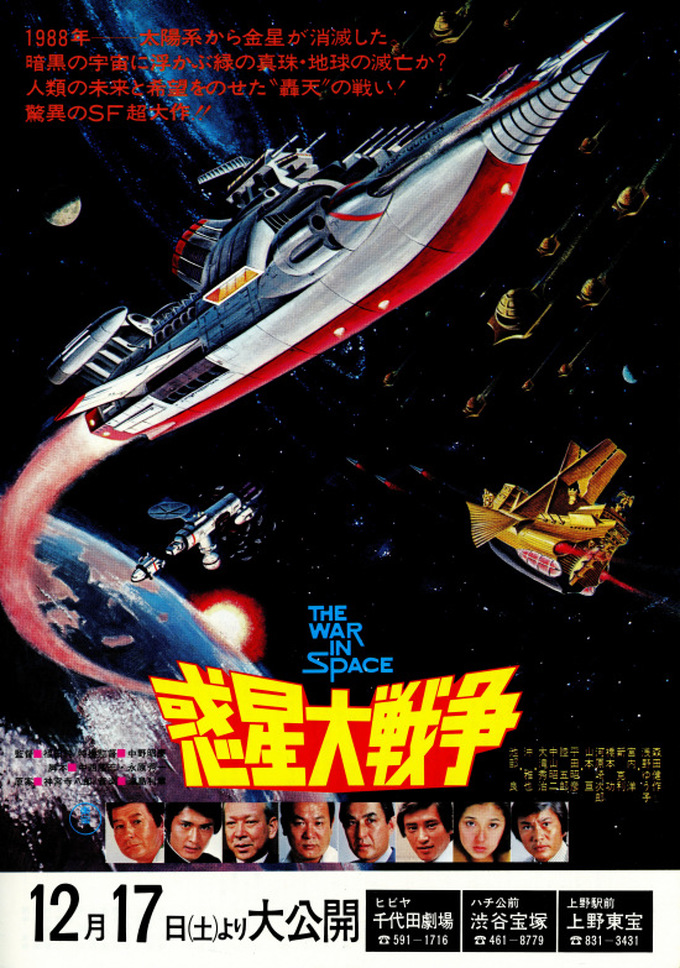
The War in Space (惑星大戦争, Jun Fukuda, 1977)

War in Space posterThe tokusatsu movie had been Toho’s signature line since the mid-‘50s, but 25 years later it was more or less played out. The late ‘70s saw the studio diversifying into other types of populist cinema while trying to find new directions in a rapidly changing industry. 1977’s The War in Space (惑星大戦争, Wakusei Daisenso), technically a “sequel” to Ishiro Honda’s Gorath from 1962, very much exemplifies the decline while trying to meld a fairly standard Star Trek-esque tale of interplanetary conflict with Star Wars-inspired fantasy.

In the distant future of 1988, the United Nations Space Force in Japan has been having trouble contacting the space station because of continued electromagnetic interference. Miyoshi (Kensaku Morita), a former team member making an unexpected return from America, tells them that they’d been having the same problem over there and not only that, there had been a worrying increase in UFO sightings across the nation. Making brief contact with the space station confirms their fears when the pilot suddenly starts screaming about a giant Roman spaceship approaching at speed before contact is lost once again. It seems that the Earth is now under attack from an extraterrestrial invasion, and the electromagnetic interference appears to be coming from Venus.

Miyoshi reconnects with his mentor, Takigawa (Ryo Ikebe), and tries to persuade him to resume an old research project to develop a high powered spaceship known as Gohten, but he remains reluctant. Part of the reason for his lack of enthusiasm is that Miyoshi had been his best student and Takigawa still bears him some resentment for his abrupt decision to leave for America rather than staying to contribute to Japan’s future while his feelings are further complicated by the fact that Miyoshi had been in a serious romantic relationship with his daughter, Jun (Yuko Asano), whose heart was broken when he left. A Space Force employee, Jun is now engaged to fellow officer Muroi (Masaya Oki) who is glad to see his old friend Miyoshi return, but also a little anxious.

With the Earth facing imminent destruction, however, there’s little time to worry about past heartache. Takigawa finds himself forced into restarting the Gohten project when he realises that the “Venusians” can pose as regular humans by possessing their bodies. As usual, everything rests on the team pulling together to finish the mammoth project in a record three days before the aliens obliterate their base just like they’re doing to most of the Earth’s major cities. Eventually, the team realise that the aliens aren’t from Venus at all, but from another major solar system and led by a man calling himself “Commander Hell” (Goro Mutsumi) who, for some reason, is dressed like a Roman emperor. Like the Romans, their aim is colonisation. They’ve worn out their home planet and are looking to move, but want somewhere kind of the same so they’ve set their heart on one three away from the sun, like the Earth. 

Aside from the classical trappings, War in Space was apparently rushed out to cash in on the success of Star Wars and even includes a scene which seems to anticipate Leia’s capture by Jabba the Hut in Return of the Jedi when Jun is kidnapped and forced into hotpants while chained to a Chewie-esque furry minotaur carrying a giant axe, which might be mixing their classical metaphors somewhat as Jun and Miyoshi, arriving to rescue her, attempt to escape from Commander Hell’s ship. Takigawa and co. make their way to Venus to try and take out Commander Hell’s base, but are faced with a terrible choice. The reason Takigawa didn’t want to finish the Gohten project is that the ship is armed with a terrifyingly powerful, universe destroying bomb which he worries it was irresponsible of him to invent. Hypocritically, he now knows he’ll have to use it but is hoping that in doing so it will be destroyed along with everything else except perhaps the Earth.

Unlike in Star Wars, it’s the good guys who blow up a planet to save their own though at least no one seemed to be living there, only Commander Hell’s evil minions. Bowing out with a slightly more bombastic evocation of the original tokusatsu messages about the dangers of irresponsible science, War in Space is a fairly generic exercise in genre but has its moments in its bodysnatching spy aliens, groovy ‘70s production design, and charmingly earnest sincerity.


Original trailer (no subtitles)