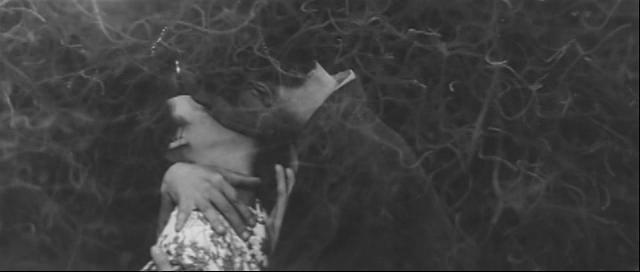
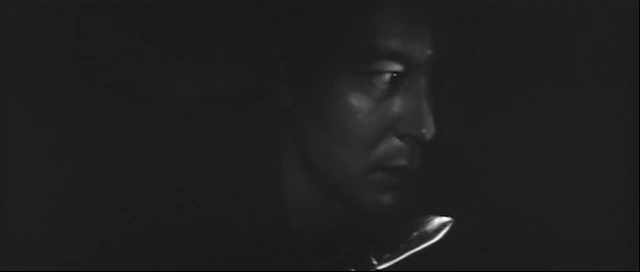
A intellectual professor and his wounded wife find themselves trapped in a toxic marriage after returning from Manchuria in Ko Nakahira’s fatalistic drama, Whirlpool of Flesh (おんなの渦と淵と流れ, Onna no Uzu to Fuchi to Nagare). Set in the late ‘40s, the film does indeed position Manchuria as a point of corruption while otherwise suggesting that Japan itself has been emasculated by the Occupation, but otherwise demonstrates how the couple drag each other into a cycling whirlpool of jealousy and obsession that it seems neither of them are really equipped to understand let alone escape.
Claiming to have been struck by her bright and smiling face in her omiai photo, Keikichi (Noboru Nakaya) married Sugako (Kazuko Ineno) in Manchuria without actually meeting her before the wedding. Apparently uninterested in sex, Keikichi was a virgin on their wedding night but harbours doubts Sugako may not have been. In any case, he seems put out that Sugako is not in his opinion his intellectual equal. He chances on her diary in which she details how bored she is by his constant lectures about English literature and that she feels him to be more schoolteacher than husband, but he merely scoffs that it’s not particularly well written. He begins to suspect that she’s sleeping with customers who come into the speakeasy she opens in their home during the days between the Russian invasion and repatriation and succumbs to a generalised sense of impotence hiding out in his room upstairs reading while she takes care of business below.
In the present day, convinced that she’s having an ongoing affair with a merchant, Otani (Kazuo Kitamura), Keikichi pretends to go to a hot springs resort and then sneaks back to spy on her from an adjacent room. Though he feels no desire for her as his wife, through the eyes of these other men he rediscovers a sense of Sugako as the woman from the photograph for whom he does feel some attraction and satisfies his latent sexual desires through watching her sleep with Otani. As an escape from the war, he’d been working on a translation of Shakespeare’s Troilus and Cressida the heroine of which he seems to superimpose on Sugako in wondering if she is a faithless woman or true, angel or devil.
Yet from Sugako’s point of view, she begs him for physical intimacy which he refuses to grant despite his jealousy over her relations with other men. Traumatised by her sexual abuse at the hands of her uncle, Sugako believes that she has a body designed to satisfy men’s desires and is drawn into meaningless, and often transactional, sexual relationships. When Keikichi later questions her, it seems she doesn’t remember any of them in detail for to her they were simply “men” and nothing more. The situation is somewhat complicated by the fact that her uncle was a scholar of Chinese literature, which in part aligns him with Keikichi, but also points back to Manchuria as a source of corruption though coming uncomfortably from the opposite direction.
Sugako equates this corrupted sexuality with the great emptiness inside her that frequently leads to thoughts of suicide. Nakahira constantly shows us shots of Keikichi’s knife as if implying some kind of violence is inevitably going to take place, though in the end it signals nothing so much as Keikichi’s impotence. Then again, the emptiness is also linked to a sense of despair in Japan’s defeat that is manifested most obviously in the house next-door where the widowed mother may have been having an affair with Sugako’s uncle and unsubtly tries to blackmail her by threatening to expose the secret of her sexual abuse about which she had tried to tell Keikichi but he had refused to listen. The daughter has become a sex worker catering to American servicemen to support the family while her brother, Kenichi (Tamio Kawachi), allows her to sacrifice herself for him justifying himself that it’s for the greater good as he’ll eventually become a doctor and save countless other lives. He’s also masquerading as a Christian to get a scholarship to an American university through the church which is all very contradictory not to mention selfish and cynical. The sister, meanwhile, appears to have lost her mind and frequently rants and raves, blaming her mother by claiming that walking in on her with Sugako’s uncle permanently corrupted her sense of self and sexuality. Like Sugako, she exorcises her trauma through abusing her body, in her case through sex work with “nasty GIs who don’t always pay.”
Keikichi refers to this as “post-war nihilism” like the frequent strikes and workers parades that take place around him, but partially repairs his sense of masculinity after moving to Tokyo and getting a job. At work he meets another young woman who is a mirror of the young lady from next-door in that she was also repatriated from Manchuria where her father was a member of the government. With her mother dead and father unable to work, Shimura (Kaori Taniguchi) also supports her family with her secretarial job and often goes without lunch herself to make ends meet. Keikichi notices this and offers her his bento claiming to be feeling unwell, but fails to notice how his pity wounds her dignity even if he meant in kindness while acknowledging that he’s never known hunger. Unlike the mismatched Sugako, Keikichi and Shimura are an ideal match. She also wanted to study English literature and can meet him on his level discussing politics and culture though he does not seem to be aware that he is attracted to her and acts almost paternally in offering to pay her university fees to help her escape her life of poverty, echoing Sugako’s claims that he had become her “little boy” rather than her husband.
The irony is that Sugako insists Keikichi, who does little but look down on her and alternately complain that she’s either impure or unattractive, is the only man she’s ever loved and blames his lack of sexual interest in her on the unresolved trauma of her childhood abuse. Having asked Kenichi to help her get her hands on some cyanide, she is shocked and disgusted when despite his need he rejects her money and asks for her body instead. He insists that it’s “only the friction of mucus membranes” and that she might as well sleep with him first if she’s going to die, though her refusal is in part a desire to die “pure” and finally overcome the emptiness and despair inside her. This inability to reconcile herself is also aligned with Keikichi’s vision of “post-war nihilism” and suggests that in the end this trauma can’t be healed and must necessarily lead to destruction. Meanwhile, Keikichi seems to have discovered a path towards his rebirth in his friendship with Shimura only to potentially have the rug pulled from under him. His new future too, may end up poisoned by Sugako’s unilateral decision to facilitate it. Dark and twisted in true Nakahira fashion, the film paints the post-war society itself as a deepening whirlpool from which there is no escape or at least not for those like Keikichi and Sugako forever locked in a deathly embrace and drawn ever deeper into the waves.


 Windows on Worlds