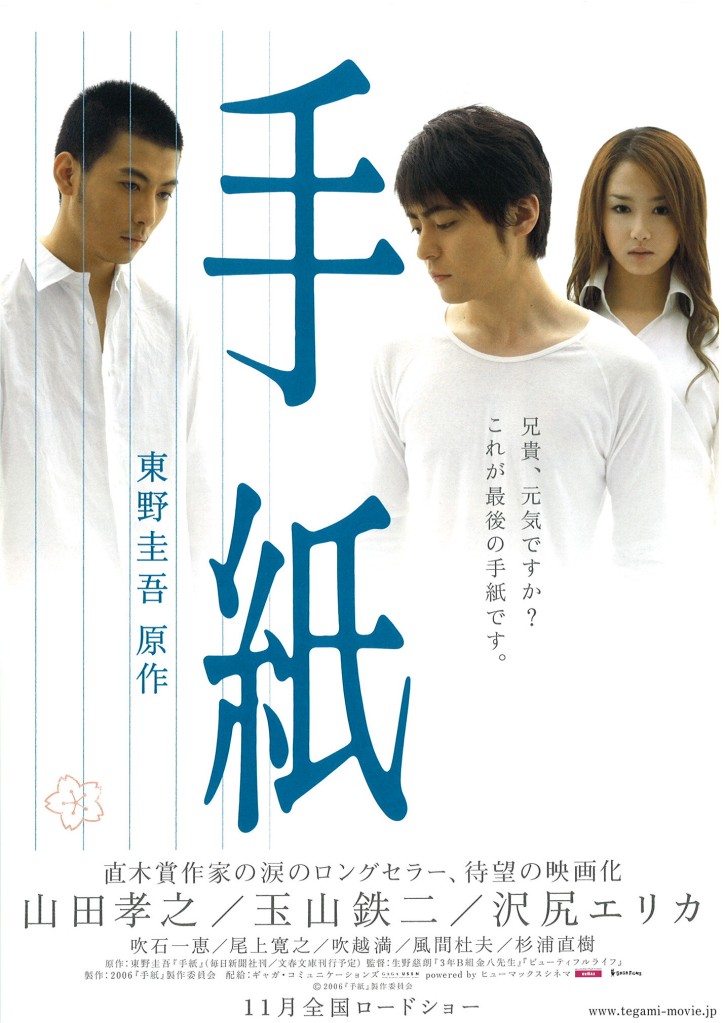
 When it comes to cinematic adaptations of popular novelists, Keigo Higashino seems to have received more attention than most. Perhaps this is because he works in so many different genres from detective fiction (including his all powerful Galileo franchise) to family melodrama but it has to be said that his work manages to home in on the kind of films which have the potential to become a box office smash. The Letter (手紙, Tegami) finds him in the familiar territory of sentimental drama as its put upon protagonist battles unfairness and discrimination based on a set of rigid social codes.
Nao (Takayuki Yamada) is a bright young man who had the chance to go to university and progress into a normal middle class life but is now slumming it as a blue collar worker at a factory. It transpires that his dismal circumstances began when he and his brother were orphaned meaning that his older brother Takashi (Tetsuji Tamayama) left school to get the money for Nao’s education. Working himself to the bone, Takashi was injured in a workplace accident and subsequently laid off. Desperate to provide for his brother, he turned to crime and unfortunately ended up killing an elderly woman during a burglary gone wrong and will spend the rest of his life in prison. The once close brothers now communicate through letters alone. With his university dreams shattered, Nao moves from place to place, forced out of employment and friendship groups each time someone finds out about his brother. Increasingly he comes to resent Takashi for the shadow his foolish actions continue cast over his life.
It is sadly true that this kind of social stigma towards the relatives of criminals is more prevalent in a society like Japan’s which prizes the overall harmony of the group (though I wouldn’t say it’s entirely absent here either). Every time Nao thinks he’s about to get somewhere, a background check throws up his imprisoned brother and it’s all over. Especially considering that his brother’s crime is a violent one perpetrated against an elderly lady, nobody is prepared to extend an understanding hand to Nao even though the crime itself has nothing to do with him (save being committed in his name) and its price should not be hanging on his shoulders.
It’s unsurprising then that Nao tries to conceal his brother’s existence, often claiming to be an only child with no living family. Though originally communicating warmly with Takashi in the letters, his growing resentment leads to a decline in their frequency and he rarely visits in person. The desire to hide his problematic past becomes a trigger in itself which leads to his having to give up on a dream of becoming a TV comedian just when it looked like his career was about to take off, and failure to tell a fiancée that he lied about being an only child also presents a serious crack in the couple’s relationship. Had he been more upfront and faced out the resulting reaction, he might have been able to work through it but once you’ve tried to lie sympathy dissipates entirely.
At the end of the day Nao is a young man with no one to guide him. He’s angry and he’s ambitious so he’s filled with resentment that he can’t have everything he thinks he deserves simply because of a series of things which happened to him none of which were his fault. Because of this, he makes a series of poor choices failing to see the things that are right in front of him. The dowdy girl next-door type from the factory is clearly in love with Nao but he isn’t interested – she doesn’t fit his slightly arrogant view of himself with her plainness and straightforward goodness. On the other hand, he’s immediately captivated by a beautiful and wealthy socialite who’s way out of his league. Of course, this is likely to end in tears – even if Nao didn’t already have skeletons in the closet the girl’s father has other plans for her which don’t include a marriage to a jumped up poor boy comedian.
The Letter suffers slightly in its focus on Nao and his troubles rather than being evenly split between the brothers. Takashi has paid a heavy price for his crime – he’ll be in prison for the rest of his life and the bright future he tried to buy for his brother has been ruined forever precisely because of the actions he was taking to ensure it. His only lifeline is the letters and the news he gets of Nao’s prospering in the outside world. Nao’s final decision to stop writing and not even tell his brother his new address so that the letters will no longer reach him is therefore a doubly cruel and selfish one. However, Takashi is only presented in relationship to his brother and his own pain and struggle becomes an undeveloped facet of the film.
As in all of Keigo Higashino’s work, secrets are the great enemy. The film only partially addresses the extreme unfairness of Nao’s plight as he’s continually persecuted for something that’s nothing to do with him. Guilty by association only, he is also in prison with no parole board to consider his case. The film even states that this kind of stigma is a perfectly natural thing which just has to be accepted – accept the truth, it says, and the world will open up to you. On balance this is a good message, but the idea that prejudice and social discrimination are things which just have to be endured is an uncomfortable one which sits at odds with the film’s otherwise positive messages of personal redemption and the importance of familial bonds. Uneven and occasionally tipping over into sentimentality, The Letter is something of a missed opportunity but nevertheless offers a thought provoking and emotionally satisfying melodrama in the best traditions of the genre.
Reviewed as part of the Japan Foundation Touring Film Programme 2016.

 Windows on Worlds