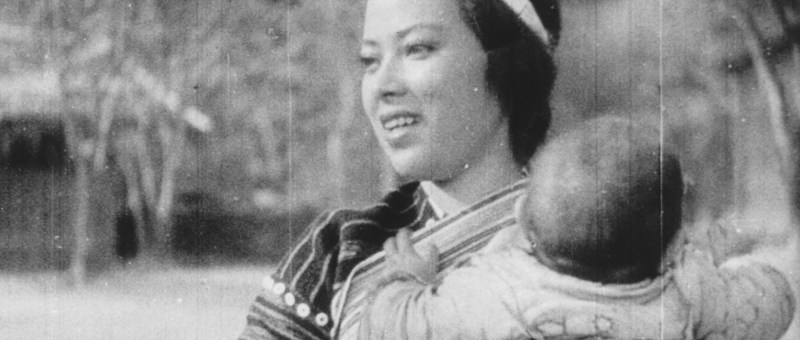
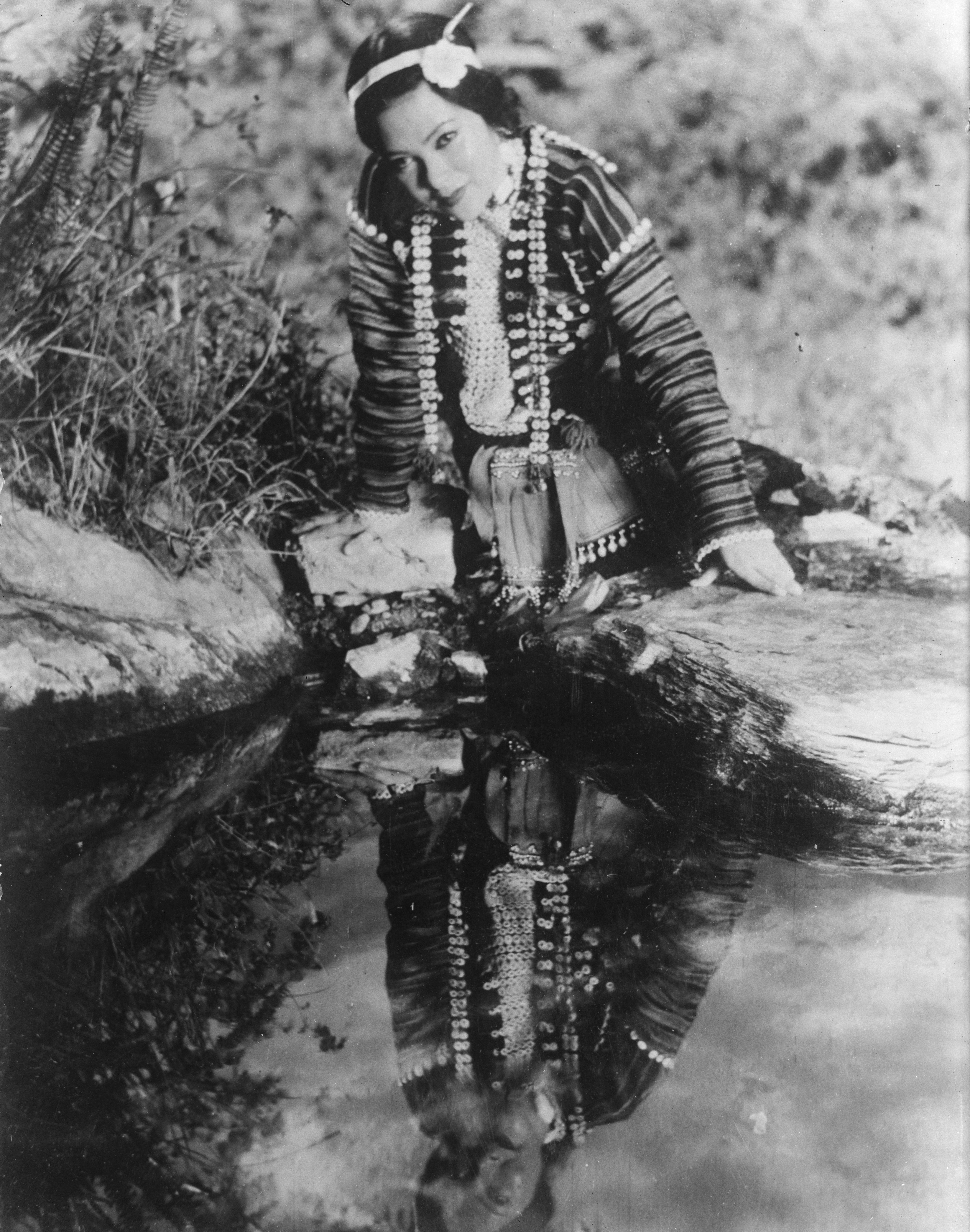
Sayon’s Bell (サヨンの鐘, Hiroshi Shimizu, 1943)

Like all directors of his era, Hiroshi Shimizu made a series of National Policy propaganda films though he was often able to circumvent their requirements by focussing on themes that interested him more directly such as teamwork or childhood. Sayon’s Bell (サヨンの鐘, Sayon no Kane) is however an unavoidably propagandist film filled with praise for the Japanese empire and to modern eyes incredibly problematic in its depictions of the indigenous peoples of Taiwan many of whom did “volunteer” to serve in the Japanese imperial army a notable example being that of Li Kuang-hui who was the last Japanese soldier to be discovered hiding in the Indonesian jungle in 1974 having been recruited from the Amis people.

The film opens with a lengthy series of title cards explaining that the film is dedicated to the Takasago Volunteers, “Takasago” being, aside from the title of a famous noh play, the name Japanese gave to the indigenous people of Taiwan believing them to have been “civilised” by Japanese rule. Thus in the opening sequences, we see the role of the Japanese military personnel as essentially paternal. They are policemen, doctors, teachers, instructors, and directors of construction who are dedicated to raising the aboriginal people to level of Japanese citizens through forced assimilation. 

Inspired by a real life incident that also inspired a popular song of an indigenous woman who drowned in a river while carrying the belongings of a Japanese policeman, the film uses the titular Sayon as an arbiter of Japaneseness enhanced by the casting of Li Koran, later known as Shirley Yamaguchi/Yamaguchi Yoshiko, who was actually Japanese but presented as Chinese in the propaganda cinema of the time having been born in Machuria and fluent in Mandarin. Somewhat awkwardly given that Sayon is supposed to be an indigenous woman herself, she is the one schooling the local children in how to be Japanese reminding them that they should “use Japanese properly” rather than their indigenous language and praising one young boy for abandoning his indigenous name and adopting that of “Taro” instead. Japanese rule in Taiwan was not as oppressive as it was in the other parts of the empire and they did have some local support thanks to their investments in infrastructure and modernisation. Nevertheless, they did attempt to enforce the use of the Japanese language and the taking of Japanese names though it should also be noted that the KMT government did exactly the same thing only with Mandarin when it gained control of the island. 

That aside the indigenous people were often treated poorly in comparison to the rest of the of the population and we can see that the framing of them is often racist and derogatory such as when an abandoned baby is taken to the police and they remark that the indigenous community have too many children and they all look alike. The eligible men from the village, including Sayon’s love interest Saburo (Hatsu Shimazaki), have been sent to Japan for a kind of militarist re-education and are eagerly awaiting their opportunity to serve the emperor in the army. Though this may seem surprising, it apparently reflects a real fervour among indigenous men who were convinced to enlist by the money on offer and a campaign of rumours that suggested men who did not do so were unmanly and therefore unattractive to the local women. When the first round of volunteers is selected, a great amount of time is given to consoling the men who were not chosen many of whom protest and plead to volunteer their services. 

In an effort to inject some drama the film includes a love triangle between Sayon, Saburo, and Mona (Kenzo Nakagawa) who is said to be moody out of jealousy and unrequited love for Sayon but later reveals he was only jealous of Saburo in respect of playing second fiddle to him as a worthy man of the village again eager to serve the Japanese emperor. Led by Li Koran, there are several renditions of a patriotic war song singing the praises of the Taiwanese army that read that like a call to arms, though the audience for this film is certainly domestic and it seems unlikely that it would be screened in these mountain villages in Taiwan.

The first part of the film is basically ethnography featuring picturesque scenes of the local scenery and footage of the indigenous people living the “simple, peaceful life” patronisingly described in the opening titles while there is some exoticisation of the aboriginal culture in the elaborate costumes and scenes of indigenous rituals. Perhaps the most shocking aspect is that Sayon is encouraged to break a traditional taboo by entering a sacred lake where women are forbidden to go lest they anger the god Uttofu. With her new cultural re-education, Sayon thinks Uttofu is a myth and goes to the lake to help Saburo assess it because the Japanese are planning to drain it to create a rice paddy. For this she is expected to drown herself in the water to placate Uttofu and is urged to do so by the tribal elders with the Japanese basically agreeing with them deciding that they should catch an animal to sacrifice and if that doesn’t work, while it’s “unfortunate”, Sayon should indeed hurl herself into the lake if the for the good of the empire rather than Uttofu. 

It is quite odd to think that the Japanese military personnel would go along with human sacrifice rather than clamp down on a practice they would otherwise term backward, though in that light it’s impossible not to see her later death by drowning as a rejection of the “modernity” the colonial authorities represent and a re-assertion of indigenous culture. The bell referenced in the title refers to one given to the village to commemorate the incident bearing an inscription of Sayon’s name. When the KMT gained control of Taiwan, they erased the inscription on the bell and removed it as a symbol of Japanese rule though it was later restored after the end of martial law and the monument re-erected beside the bridge which was also named “Sayon’s Bridge” in a evocation of the complicated relationships between the three nations. The film is however rather uncomplicated in its themes which to modern eyes prove extremely unpalatable despite the often beautiful cinematography capturing the idyllic Taiwanese countryside.


Sayon’s Bell screens at the Museum of the Moving Image May 11 as part of Hiroshi Shimizu Part I: The Shochiku Years.
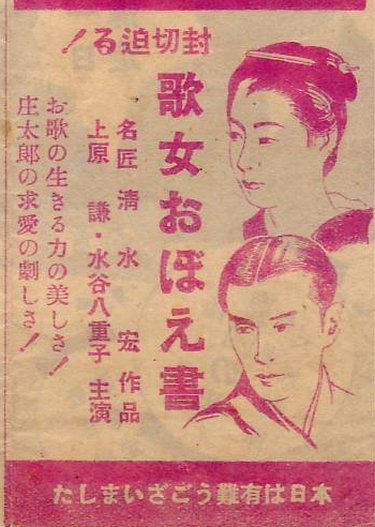
Notes of an Itinerant Performer (歌女おぼえ書, Hiroshi Shimizu, 1941)

notes-on-an-itinerant-performerFilmed in 1941, Notes of an Itinerant Performer (歌女おぼえ書, Utajo Oboegaki ) is among the least politicised of Shimizu’s output though its odd, domestic violence fuelled, finally romantic resolution points to a hardening of his otherwise progressive social ideals. Neatly avoiding contemporary issues by setting his tale in 1901 at the mid-point of the Meiji era as Japanese society was caught in a transitionary phase, Shimizu similarly casts his heroine adrift as she decides to make a break with the hand fate dealt her and try her luck in a more “civilised” world.

At 25 years old, Uta (Yaeko Mizutani) jumps ships from one acting company to another having been promised better work by a roguish fellow performer. Tired of the strenuous life of travelling from village to village, putting on folk plays and street performances, Uta is thinking of quitting the business and looking for a job as a maid or something similar which is at least in the same place everyday. In a stroke of luck, she comes into contact with a kindly tea merchant who takes pity on her and suggests she come to live with him where she can teach his teenage daughter how to dance.

Uta becomes a member of the Hiramatsu household but not all of the inhabitants are as generous of spirit as Mr. Hiramatsu (Hideo Fujino) himself. The oldest son is away at college but the daughter, Nuiko (Kyoko Asagiri), has no interest in learning to dance and resents her father’s “adoption” of such a “common” woman. Youngest son Jiro (Haruhiko Tsuda) is similarly unimpressed with Uta’s presence, making her new home less than welcoming. To make matters worse, Mr. Hiramatsu abruptly dies leaving his business and household in disarray. Oldest son Shotaro (Ken Uehara) returns and feels as if he ought to abandon his studies and take over the company, but as a student he has no experience of running a business and lacks his father’s knowledge of the tea industry. Uta encourages him to return to university and finish his studies if only so that the prestige of a degree might help him later if he decides to restart the business. She also volunteers to act as a guardian for Jiro and Nuiko though Shotaro is wary seeing as they know each other so little. He then makes a surprising suggestion – that he and Uta marry, making it perfectly natural that she take care of everything at home while he’s away studying in the city.

Like many a Shimizu hero, Mr. Hiramatsu is a good hearted man but perhaps lacking in practical skills. Though he seemed to be prosperous and successful, the business was on the rocks and he dies leaving a number of debts behind him and total admin chaos for Shotaro as there is no clear successor to keep the business running in Mr. Hiramatsu’s absence. Luckily for Uta, Shotaro is also a kindhearted man like his father (in contrast to his siblings) and has no desire to suddenly throw her out when his father promised to look after her. He is, however, at a loss as of how to take care of everyone with no money coming in.

Even before Mr. Hiramatsu died, not everyone was happy about his decision to take in a travelling performer and an old friend begins to warn him about the danger of rumours. Friend of the family Kajikawa feels he has a stake in this as he intends his daughter Ayako to marry Shotaro and thinks it’s a done deal (though Mr. Hiramatsu does not seem particularly wedded to the idea). Ayako and Nuiko are also good friends and Ayako does seem like the ideal bride for Shotaro as a member of his own social class and a business connection for the family. Shotaro, however, proposes to Uta without really thinking things through. It is, in one sense, a purely practical decision but one that is likely to meet with a degree of social opposition.

Uta left her life as a travelling performer because she wanted something more conventional. Her mother died when she was six and she never knew her father. Her only happy memory of family is the time spent with her grandmother who died when she was twelve. Uta resents her lack of status as a member of a lowly order of entertainers and longs for something grander but has also internalised a deep seated sense of inferiority. Hence when Jiro and his school friends refer to her as a “monster” living in the house, she half accepts their prejudiced view of her. Nevertheless, she wants to honour the kindness that Mr. Hiramatsu offered her and also deeply respects his son, Shotaro, possibly even developing romantic feelings for him. Despite continuing to feel herself unworthy, Uta does the unthinkable by almost singlehandedly resurrecting the tea business when presented with an opportunity from a foreign company. Even after becoming a formidable business woman and winning the respect of Nuiko and affection of Jiro, Uta still feels herself out of place in the mercantile world and ultimately opts to leave in order to pave the way for the “proper” union of Ayako and Shotaro.

When Shotaro and Uta meet again she tells him that she left because she found his middle class world of “decency” too rigid and full of dull formality. Her “housewife” life was a hard one – getting up early, no smoking, no drinking. At least as a travelling performer she can sleep in and have her share of fun. This produces a quite shocking and strange scene in which Shotaro strikes Uta violently, knocking her to the floor. He repeats his earlier promise to marry her and invites her to come home as his wife, a “decent” woman, and full member of his social class whatever anyone else might have to say about it. Shotaro is apparently a man of his word but there is real feeling implied in his actions as opposed to duty or obligation. Nevertheless, this quite surprising scene of domestic violence used as a tool of coercion does not speak to Shotaro’s otherwise kindly personality and undercuts the “romantic”, if melodramatic, quality of the scene. This may be another instance of Shimizu’s aversion to romantic resolutions or romance as a solution to crisis, but one expects better from a director generally so keen to underline the hardships faced by women in his society.

Despite being filmed well into the era of the talkies and long after Shimizu himself had made the jump to sound, Notes of an Itinerant Performer makes use of frequent intertitles setting the scene or providing explanatory background material. Conversely, it also anticipates a more recent trend by allowing the discussions between the “American” (actually heavily accented European) and his interpreter to take place in English with Japanese sidetitles for parts not subsequently translated in the dialogue. In fact, this broadly positive foreign presence seems an odd inclusion for the fraught political world of 1941 (the film was released in March, just nine months before outright hostilities would commence with the USA which had been effecting a series of trade sanctions with the expansionist nation since 1938) even if the deal itself is taking place in the comparatively more open society of 1901.

In many ways about transitionary periods both in terms of society and of the self, Notes of an Itinerant Perfomer seems conflicted right up until its “Reader, I married him” inspired intertitle. Uta crosses a class border, transcending her lowly origins through selfless sacrifice, pure heartedness, and perseverance yet finally she is dragged across by violence and condescension rather than self acceptance or personal transformation. Filled with ambiguity, Notes of an Itinerant Performer reflects the uncertainties of its times and is noticeably less forgiving than Shimizu’s general outlook as its problematic finale demonstrates.


Ornamental Hairpin (簪, Hiroshi Shimizu, 1941)

ornamental hair pinShimizu goes on holiday! Again! Actually, when you think about it going on holiday is always inherently sad because just like everything else holidays end and you have to return to whatever it was that made you want to go on holiday in the place only with the painful reminder that a more cheerful world exists and you’re no longer in it. That rather depressing preamble out of the way, it’s time to join the temporary residents of a small hot springs resort in the picturesque countryside where a mislaid hairpin is about to kickstart a series of mini epiphanies in the diverse collection of guests.

We arrive at the inn in the company of Emi (Kinuyo Tanaka) and her friend Okiku (Hiroko Kawasaki) on a brief visit from the city. The inn is very full right now with a festival in town and everybody seems to want a massage! Another guest, the extremely grumpy professor Katae (Tatsuo Saito), is put out that the tour groups are sapping all the hotel’s resources and complains vociferously to his go partner who is staying at the inn with his two grandsons Jiro and Taro. Other guests at the inn include a mild mannered husband and his wife, Mr. (Shinichi Himori) and Mrs. (Hideko Mimura) Hiroyasu, and a recuperating soldier, Mr. Nanmura  (Chishu Ryu). Eventually the tour groups go home taking Emi and Okiku with them, but Emi discovers she’s left her ornamental hairpin behind and sends a letter offering to pay for the return postage if anyone should find it.

Mr. Nanmura finds it in his foot one day as he’s enjoying the hot springs and even though he’s not that bothered about it, complaining expert Professor Katae can’t make enough of a fuss about the supposedly shoddy conditions at the hotel. When the hotel owners write to Emi and explain to her what’s happened she jumps straight on a train to apologise in person.

Nanmura had actually been quite happy about getting skewered by the pin. He says he found it “poetic”, as if the atmosphere of the place had penetrated deeply into his skin. The supposedly learned Katae doesn’t quite understand the soldier’s poetic leanings and starts debating whether the owner of the pin will be pretty or not, as if that would make a difference to the soldier’s romantic construction of events. Emi is indeed very beautiful, through perhaps a little sad and obviously contrite about the pin. Everyone in the inn is quite invested in witnessing a true love miracle between the bizarrely crippled soldier and the wounded beauty from Tokyo.

Once again the inn is a constructed world, a safe haven far away from the trouble and strife which exists outside it. The guests indulge themselves in the tranquil atmosphere taking in the beautiful scenery and killing time on otherwise trivial pursuits which occasionally include projecting a kind of narrative on their new found friends. The two boys, totally bored by this deliberately unstimulating environment, turn everything into a competition – even cheering on their grandfather as snores along side the equally noisy professor with the result that pretty much no one else is getting any sleep. Later they help the injured soldier recover with a set of endurance games which see him trying to walk unaided from one tree to another and eventually across a bridge.

Further comic relief is provided by the Hiroyasus with the husband being the sort of mild-mannered man who has no idea what he actually thinks so he just goes along with everything everyone says (and later checks with his wife who has the ultimate authority). Hiroyasu often defers to the professor whose authoritative tone gets things done for him though he is in fact an extremely self centred prig who just loves to complain out of a desperate need to be validated. He’s the loudest snorer of all and is keeping everyone awake yet he constantly complains about the noise of the other guests and is quick to shout at the inn keeper when he can’t get a massage because they’ve been booked by the visiting tour groups the very presence of which also annoys him. Eventually he gets so grumpy he just goes home which is probably a win/win for everyone.

But what of Emi herself? She too is escaping from something. The loss of the ornamental hair pin and its rediscovery leading her to the inn and perhaps to Nanmura has pushed her into a further consideration of her life in Tokyo. She doesn’t want to go back, this brief respite has been too pleasant and she wishes it could go on like this forever, though she knows, of course, that it can’t. She doesn’t know what she’s going to do now, but at least while she stops at the inn the sun will light the way. This is 1941, Nanmura will probably be going back to the war, the future is uncertain for everyone, but in here everything is beautiful, calm, safe. It’s just a shame it can’t last.


Ornamental Hairpin (簪, Kanzashi) is the fourth and final film in Criterion’s Eclipse Series 15: Travels with Hiroshi Shimizu box set.

Clip of one of Nanmura’s “trials” (no subtitles):

https://www.youtube.com/watch?v=WojtILzbaBk