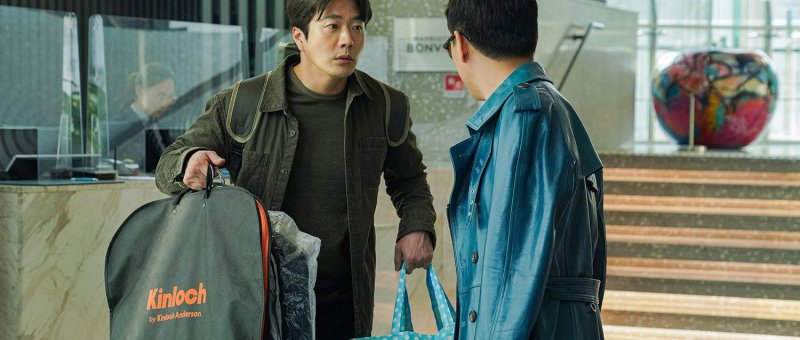

Switch (스위치, Ma Dae-yun, 2023)

An egotistical actor is given an unexpected lesson in what it is that makes life worth living when he’s suddenly transported to a parallel world in Ma Dae-yun’s charming Christmas dramedy, Switch (스위치). Rather than the body swap comedy the title might suggest, Ma’s warmhearted morality tale is a more a meditation on what might have been and may be again while contemplating the emptiness of a life of fame and riches when there’s no one to share it with. 

“What matters more than money?” top star Park Kang (Kwon Sang-Woo) chuckles after telling his manager he’ll accept a job he just described in quite insulting terms after being informed it comes with a hefty paycheque. Kang is currently riding high. He’s become enormously successful and even a recent sex scandal involving his co-star in a TV drama has only boosted his profile. Yet he tells his analyst that he can’t sleep and attributes it to “depression and anxiety”. He treats those around him poorly and most particularly his long suffering best friend from his fringe theatre days, Joe Yoon (Oh Jung-Se) who now works as his manager, while struggling to accept his loneliness and meditating on lost love in the memory of the woman he broke up with in order to chase stardom. 

After getting into a weird taxi one Christmas Eve, he’s suddenly granted the “wish” of getting to find out what would have happened if he’d made a different choice. After waking up in an unfamiliar house he discovers that he’s married with two children and slumming it fringe theatre while Joe Yoon is now the superstar having aced the audition Kang ran out on to chase Soo-hyun (Lee Min-Jung) to the airport and convince her not to leave. Of course, Kang is originally quite unhappy about all of this. He doesn’t understand why no one recognises him anymore and resents that he’s suddenly subject to the rules of “ordinary” people again after a decade as a pampered star. In his acceptance speech after winning an award, he’d stated his intention to “forget” his roots as a humble actor and embrace his new role as a member of the showbiz elite fully demonstrating his sense of alienation and insecurity along with his intense loneliness. As the taxi driver had said, Kang has “everything”. He’s achieved his dreams and lives the high life he’d always dreamed of, yet he’s deeply unhappy.

But his “new” life immediately challenges his sense of masculinity in realising that he has little power without money and is in fact financially dependent on Soo-hyun whom he may also have robbed of a bright future by preventing her from studying abroad and achieving success as an artist. Meanwhile he looks down on himself for continuing to follow his artistic dreams in fringe theatre when his plays attract few audiences members and make little money. Just as Joe Yoon had become his manager, so he ends up getting a taste of what it’s like trying to manage a “star” while coming to appreciate that Joe Yoon may be feeling just as lonely and unfulfilled as he once had. 

Yet even as Kang settles into his new life as a husband and father while slowly rebuilding his acting career though a combination of talent, supportive friendship, and good luck, he fails to learn the right lessons continuing to yearn for external validation through material success. He spends money on fancy dinners and tries to move the family into a swanky apartment in Seoul without realising that he’s already got a “home” in the quaint little provincial house he and Soo-hyun set up together filled with memories (that admittedly he doesn’t actually have) of the children when they were small. Slowly, he begins to look beyond himself while developing a new sense of security that means he doesn’t need to chase status-based affirmation in empty materialism but now has a new sense of what’s really important. A charming season morality tale with a little more than a hint of A Christmas Carol, Ma’s gentle drama never suggests that success itself is wrong or that Kang must give up his movie star persona to become a happy everyman but only insists that true happiness is brokered by treating others well and being treated well in return much more than it is by consumerist success.


Switch screens at UltraStar Cinemas Mission Valley April 22/24 as part of this year’s San Diego Asian Film Festival Spring Showcase.

International trailer (English subtitles)
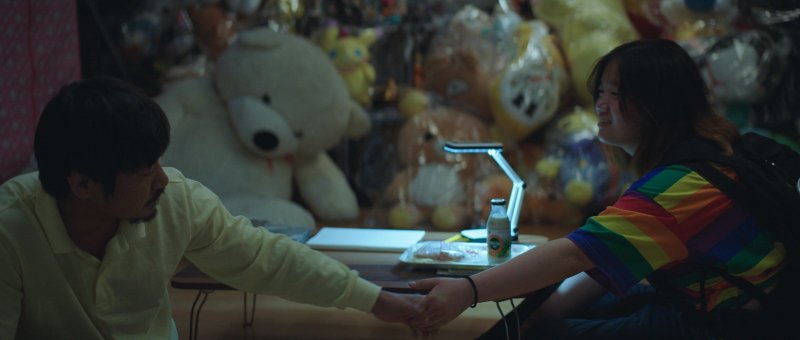
Not in This World (이 세상에 없는, Park Jung-bum, 2019)

“What is love? Have you seen it?” a dejected young man asks, wondering how if he can’t even afford a ticket to the movies he’s supposed to find the energy to feel love. Love may be the substance the title of Park Jung-bum’s nearly three hour epic of human misery Not in this World (이 세상에 없는, I Sesange Oebsneun) refers to, each of its wandering youngsters deprived of a sense of hope or of emotional fulfilment by the cruelties of contemporary capitalism. Unable to feel their own pain, they inflict it on others, their despair leading to nothing other than violence and cruelty in a mistaken effort to exert control over their lives. 

Despair colours the lyrics that aspiring rapper Ji-su (Moon Ye-ji) performs in a courtyard by day detailing her insecurity and longing for “a warm spring to melt my frozen heart”. Seemingly no one is very interested in listening to her, least of all her father in whose tiny workshop she also toils. With his business strained, Ji-su’s father is an exploitative employer berating his daughter for not working hard enough while otherwise telling her that she is free to do something else with her life but only if it makes money. After smashing her microphone in a mistaken attempt to make her come around, he later burns her sheet music and recklessly tells her to find somewhere else to live while she in turn points out that he unfairly projects his resentment onto her knowing that his dream of owning a family home will never become a reality seeing as the business barely makes enough money to pay the interest on the mortgage he will never be able to pay off. 

This sense of despair born of failure passing from one generation to the next leaves Ji-su and her similarly troubled friends with an even greater sense of futility. She discovers a temporary source of hope after accidentally bonding with a strange middle-aged man, a kind of holy fool living all alone in the forest in a house he calls a “spaceship” seeing as it’s surrounded by complete darkness with only he aboard as if existing in an entirely different dimension. Jeong-cheol (Park Jung-bum) is Ji-su’s only “fan”, encouraging her with her music but also infinitely naive advising her to share it with her friends and family in the conviction that they would then begin to understand her but the result is quite the reverse. Ji-su’s few friends, all of whom have become sex workers, simply laugh at her while apparently offended by what they perceive as “hypocrisy”, an attempt to exploit their pain for her gain. 

Forced at knife point to witness the reality of sex work, Ji-su’s illusions are shattered while her only other source of hope in her relationship with intense childhood friend Won-ho (Park Young-Duk) also begins to crumble. Won-ho too had a dream, working as a delivery driver while saving up to buy a taxi license he hopes will enable him to earn a steady living leading to a traditional middle-class sense of stability with a wife and family home. Yet he too is eventually forced to acknowledge his dream won’t come true, again projecting his sense of resentment onto Ji-su in unfairly blaming her for a bike accident that brought them both into contact with a source of infinite corruption that is a remote sex work campsite hidden in the woods where a gang of obnoxious rich kid students get their kicks humiliating those they perceive as their social inferiors. 

Pushed to breaking point, Ji-su commits a transgression of her own and embarks on a path of self-destruction aiming to become what she hates and burn her world to the ground. Becoming the campsite’s bookkeeper she terrorises the former friends who laughed at her song and left her with lasting trauma while taking an indirect revenge against Won-ho for his indifference towards her. While she decides to become an oppressor in order not to be oppressed, Jeong-cheol wrestles with himself believing that he cannot abandon Ji-su because to do so would mean she had been abandoned by the world, while also realising that the world has many Ji-sus and he can’t help them all. Jeong-cheol believes himself alone, conversing only with the ghost of his late father who seems to represent his inner goodness something which he alternately feels he should bury along with his father’s ashes yet is unwilling to part with. 

Unlike Park’s previous films of similar length and bleakness, Not in This World swaps crushing naturalism for a touch of magical realist imagery as Park’s holy fool tries to repair the world around him armed only with his own inner goodness which simultaneously makes him an exile of contemporary society. Even as Ji-su continues to destroy herself, Jeong-cheol continues to believe she can be saved, his conviction perhaps borne out as the traumatic events of the film’s conclusion appear to break the spell she’s cast over herself though whether she will ever be able to accept everything that led her there is far less easy to discern. Once again an attack on an inhuman, ultra capitalist society defined by class conflict and petty humiliation, Park’s latest epic of human misery is also in its closing minutes at least quietly hopeful in the innocent power of a newborn baby’s cries. 


Not in This World streams in Poland until Nov. 29 as part of the 15th Five Flavours Film Festival.

Trailer (English subtitles)