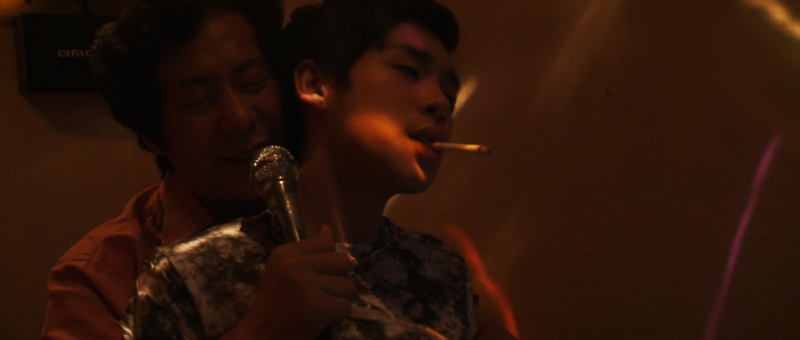

Stateless Things (줄탁동시, Kim Kyung-Mook, 2011)

“We looked everywhere for a place for us to stay, but we could not find it anywhere” one of the twin heroes of Kim Kyung-mook’s indie drama Stateless Things (줄탁동시, Jooltak Dongshi) confesses. As the title suggests, Kim’s eventually surrealist drama follows those who no longer have a home and are instead condemned to wander the margins of an unforgiving city. Finding only loneliness and exploitation they long for an escape and perhaps find one if only in a moment of eclipse. 

Shooting in a more naturalistic, documentary style, Kim first focusses on the figure of Jun (Paul Lee), a young North Korean refugee who lost his mother in the crossing and his father to another woman in Busan. He works in a petrol station but is treated with disdain by his boss who has his eye on his female colleague, Soon-hee (Kim Sae-Byuk), who is a member of the Korean minority in China where most of her family reside. Though originally hostile towards each other, each wary of their mutual isolation and concurrent vulnerability, the pair later bond in a shared resentment of their boss who exploits Jun physically for his labour and seeks to exploit Soon-hee sexually. After each saving the other from the nefarious boss, the pair have no choice but to go on the run taking in a series of tourist spots while looking for another place to settle. 

Meanwhile, across town, a young gay man, Hyun (Yeom Hyun-Joon), is a virtual prisoner in the home of his wealthy, married and closeted lover. He looks out across the midnight city and dances sadly alone in a luxury apartment in the sky while occasionally venturing out to meet other men, mostly older, who similarly only intend to exploit his body. “You have nowhere to go.” the exasperated Sung-woo/Sung-hoon (Lim Hyung-Guk) insists, thrown into jealous anxiety on visiting the flat and finding Hyun absent, yet he cannot really offer him a “home” and is all too aware of the transactional nature of their relationship. Though Hyun is also in a sense “stateless”, he has a power over Sung-woo and is able to wield his youth and beauty like a weapon if one he may not fully be able to control. In any case, he too is excluded from the mainstream society by virtue of his sexuality and socio-economic background. 

When Soon-hee and Jun visit a temple, he remarks on the incongruity of seeing a painting that features both a sun and a moon. She explains a folktale to him in which sun and moon are embodiments of siblings who climbed a rope into the sky to escape a hungry tiger. In his diary, Hyun also envisages a pair of twins one opening a door with his right hand as the other closes it with his left. In the surrealist sequence which closes the film, after a title card that appears 90 minutes in, the two men blur into one another as if they shared the same soul in an almost literal eclipse of the self. Kim nevertheless characterises them as sun and moon who cannot ordinarily share the same space. Jun occupies a world of street level sunniness until the light finally begins to dim leaving him alone in a dusky, rain-soaked city. Hyun meanwhile lives by night in his high rise apartment, a prisoner of luxury who flirts with danger for a sense of escape. 

Then again we might ask if Jun and Hyun are two sides of one whole, a sun and moon protecting the king who finds himself an exile. Kim shifts to scenes of emptiness, rooms without presence and streets without life as if the two men were ghosts of themselves hovering above a rootless Seoul, the sense of eeriness only deepened by Kim’s lengthy takes as he follows Jun walking a lonely path towards nowhere in particular because in the end he too has nowhere to go. Departing from the realism with which the film opened, the final sequence gives way to a kind of rebirth if only one of wandering that leaves its heroes at the mercy of a society continually unwilling to recognise their personhood. 


Stateless Things screened as part of this year’s Queer East .

Trailer (English subtitles)

No Mercy (언니, Lim Kyoung-tack, 2019) [Fantasia 2019]

No Mercy poster 2Sad as it is, there will always be those who prey on the vulnerable. Even sadder is the way the world seems to reward them. There can be No Mercy (언니, Eonni) for the wicked, however, in Lim Kyoung-tack’s old school B-movie. Though tastefully appointed, Lim’s action drama harks back to the exploitation movies of old as its lady in red cuts through a host of sleazy misogynists, hoping to rescue her little sister from a life of lifetime of cruelty and abuse at the hands of unscrupulous men.

When we first meet her, In-ae (Lee Si-young) is being released from prison with no one waiting. She is, however, ecstatic to be reunited with her little sister Eun-hye (Park Se-wan) who has mild learning difficulties. In-ae misinterprets Eun-hye’s reluctance to go to school as the normal teenage rebellion, little realising that her sister is being mercilessly bullied by delinquents who have already passed her on to their sleazy friends. Forced to participate in a scam to lure salarymen to hotels then rob/blackmail them, Eun-hye just wants to go home but ends up being kidnapped by an amoral gangster they mistakenly target.

Worried when Eun-hye doesn’t return home or answer her phone, In-ae puts on the pretty red dress and shoes she bought her and goes out looking, quickly realising that something quite untoward has befallen her sister. In this situation she does what anyone would do – call the police, but the police won’t help. Teenage girls run away and usually they come back on their own, the policeman’s logic says, little caring that Eun-hye is a vulnerable teen and In-ae has evidence to suggest she has been kidnapped by thugs. If In-ae wants her sister back, she’ll have to go get her herself. Which is exactly what she does.

A full throttle action fest, there’s little point trying to pretend that No Mercy has serious intentions but it does, in true exploitation movie fashion, highlight a series of pressing social concerns, chief among them Eun-hye’s constant misuse at the hands of unscrupulous men who regard her disability as an excuse to do what they like with her on the grounds that she almost certainly cannot tell on them and is unable to resist. Molested by convenience store owners, photographers, mechanics, and finally an all powerful politician, Eun-hye silently bears all while longing to go home to her sister. In-ae, meanwhile, a talented martial artist, ended up in prison for going too far trying to protect her. Now that she’s out, she can’t find a job thanks to the stigma surrounding her conviction and worries about what’s been going on in the 18 months she’s been away.

Aside from being misused by sleazy men Eun-hye is also targeted by those like the delinquent girls in her class who think it’s OK to mock and humiliate her because she’s somehow “less” than they are. Aside from In-ae, no one seems to consider that Eun-hye is a real person with her own hopes and desires, they only see her as a strange and inconvenient girl. This kind of mentality is itself informed by the hierarchal society and sense of superiority it allows some to assume. Eun-hye finds herself passed to the sleazy politician by those hoping to curry favour. He in turn regards his right to rape her as proof of his status, that his position makes him untouchable and entitled to break the strongest of taboos without fear of repercussions.

Of course, In-ae isn’t having any of that. She wants her sister back, yes. But she also wants to teach these awful men a lesson so they stop treating women like identical faceless objects while perhaps showing other women they don’t need to let the guys get away with this. Giving them a taste of their own medicine, In-ae puts her martial arts skills to good use as she plows on running after Eun-hye while dragged back into the past despite herself. In-ae has no mercy for those who exploit the vulnerable, or for hypocrites, or for the self involved. All she wants to get her sister home and safe and she’ll do whatever it takes to make that happen. A charmingly retro B-movie throwback, No Mercy revels in its sense of anarchic violence as its enraged heroine takes her revenge against an unjust society while protecting what is most precious to her.


No Mercy was screened as part of the 2019 Fantasia International Film Festival.

International trailer (English subtitles)