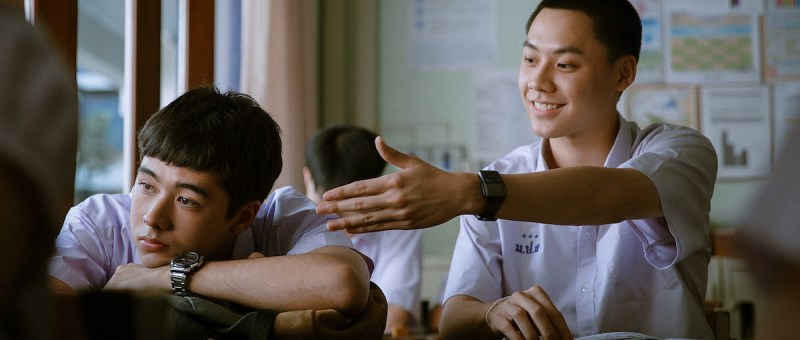
Not Friends (เพื่อน (ไม่) สนิท, Atta Hemwadee, 2023)

There’s a gentle sense of loss that runs through Atta Hemwadee’s quirky Thai dramedy Not Friends (เพื่อน (ไม่) สนิท), not only for those who are now absent and exist only in our memories but for missed opportunities and things left unsaid. Then again, its hero, Pae (Anthony Buisseret), takes a while to warm up to the benefits of friendship, like many teenage boys resentful and alienated, unable to accept the hand extended to him by his infinitely cheerful new deskmate, Joe (Pisitpol Ekaphongpisit), who walks around with a beatific smile permanently plastered across his face. 

Before he can make amends, however, Joe is hit by a car after returning from a school trip sending the school into a period of shocked mourning that for some reason includes a talent contest. After hearing of a competition that offers entrance to film school as a prize, Pae decides to enter and to make his late “best friend” Joe the focus of the film only to immediately be caught out in his duplicity by Joe’s former best friend Bokeh (Thitiya Jirapornsilp) who resents his intention to exploit Joe’s death for his own ends. 

It has to be said, that Pae does not come out of this well though his predicament does highlight a social stigma towards working class boys in his intense desire to escape having to take over his dad’s flour mill having been teased by his former classmates about his “stinky shirt” because he has to air dry his clothes in an area adjacent to the factory. A similar sense of lonely alienation is found in a short story Joe had submitted to a story contest which is about a boy who feels hopelessly ordinary and looks up to the stars thinking about all the other versions of himself on other planets who are “special”, top athletes or super spies or dim but loved by those around him. The boy wants his other selves to see him and know that he is special too, but seems not to feel it himself. 

Coming late to the idea, Pae slowly realises that Joe is special because “Joe is our friend” though he’d mostly ignored his attempts at friendship while he was alive. In any case, he doesn’t really notice the friendships he’s making with Bokeh or the others working on the film either but remains focussed on his own goal of winning the contest and escaping the flour mill. In the end the film he’s making ends up becoming less about Joe himself and more of an ode to absent friends, something echoed in Bokeh’s valedictory speech in which she bids goodbye to her “best not friends” and hopes that though they may not meet, they’ll miss each other every now and then. 

It comes down to a question of what friendship really is and whether Pae can be persuaded to abandon his sense of self interest to defend it. He realises that Joe had a lot of dreams too, ones he never got to fulfil and a couple that could be fulfilled for him if not in reality than in fantasy imagining how their lives might have turned out if Pae had been less self-involved and Joe had lived. Still, on finding out something unexpected he’s forced to confront the idea that perhaps you don’t really know anyone. Everyone knows a slightly different version of the same person but friendship is really about shared intimacy and a willingness to be open and vulnerable while simultaneously respecting the boundaries of others.

To that extent it really is about the friends we make along the way. Pae slowly comes to realise that he’s accidentally become friends with the crew on the film and lets go of some of his resentment becoming less self-centred and more willing to interact with others even warming to his father and family business he’d previously been ashamed of while also gaining the courage to pursue his dream of a career in film. Cineliterate, Atta Hemwadee breaks the action with a filmmaking rap and makes frequent references to popular film but invests the high school movie with a wistful sense of loss and nostalgia for the absent friends of youth whom we miss once in a while but are in another sense always with us. 


 Not Friends screened as part of this year’s Osaka Asian Film Festival.

Trailer (English subtitles)
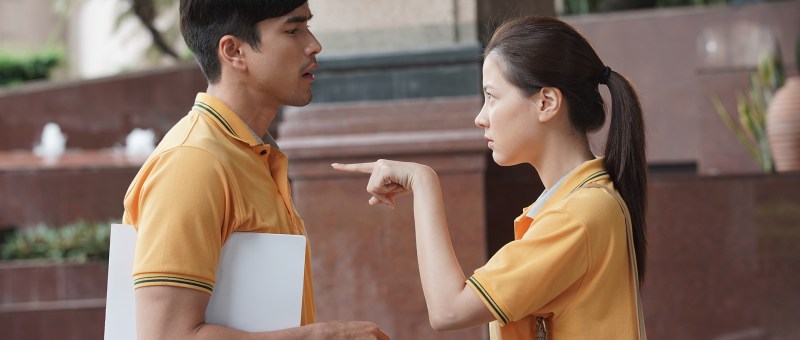
The Con-Heartist (อ้าย..คนหล่อลวง, Mez Tharatorn, 2020)

Is love the greatest swindle of all? In these strange times scams are on the rise as amoral fraudsters attempt to take advantage of our various anxieties, hoping we’ll be just distracted enough to fall for one of their tricks. The heroine of Mez Tharatorn’s heist caper rom-com The Con-Heartist (อ้าย..คนหล่อลวง), however, had her heart stolen out from under her well before the world began to wind down and other than stealing back what was stolen from you what better way of getting revenge is there than scamming a scammer out of their ill-gotten gains. 

25-year-old Ina (Pimchanok Luevisadpaibul) used to work in a bank but now has an unsatisfying job as a credit agent chasing bad debt, a minor irony because she’s in a significant amount herself as the post-it notes lining her wall detailing various repayment dates demonstrate. It seems that Ina has been unlucky in love, meeting the suave and handsome Petch (Thiti Mahayotaruk) through an app and falling head over heels for him. Thinking it was the real thing, she didn’t really question it when he kept asking her to lend him money, eventually taking out a sizeable loan to supposedly pay for his tuition using her mother’s farmland as security. Realising she’d been scammed, Ina tried to go to the police but as Petch claimed she gave him the money willingly there’s nothing they can do while he unceremoniously dumps her even as she humiliates herself clinging to him. That’s one reason why when she’s cold called by con-man Tower (Nadech Kugimiya) claiming to be from the tax office she nearly falls for his obvious scam despite being a former bank employee presumably familiar with official protocols. Finally catching on she decides to play Tower at his own game, recording their conversation as she uses her connections to unmask his “true” identity and then attempting to blackmail him before hatching on a new plan – getting him to scam Petch to get her money back (along with a little satisfaction not to mention revenge) and thereby save her mother’s farm. 

“No one dies from being conned out of money,” Ina later tearfully explains, “It just breaks your heart. It makes you want to run into an electric pole and die.” Perhaps people really do die of being conned out of money, but still there is a moral judgement being made between men like Tower doing small scale, one-off telephone scams and those like Petch, heartless gigolos leveraging the sincere feelings of perhaps vulnerable women for financial gain. After breaking up with Ina, Petch got onto a sure thing with an older woman who runs a travel agency and is apparently financially supporting him with gifts of expensive suits and fancy cars while he works at her company. 

Ina and Tower’s scam aims to take advantage of his weakness by convincing her old Chinese teacher Ms Nongnuch (Kathaleeya McIntosh), who is in a mountain of debt herself, to pose as the cougarish CEO of a Chinese beer company. Scamming a scammer is always a challenge, but the trio, later a quartet roping in Tower’s weird con-man brother Jone (Pongsatorn Jongwilak), hope they can unbalance Petch by poking at his weaknesses to undermine his natural cynicism. During the course of their scheming, Tower and Ina begin to draw closer but Tower is after all a conman, maybe he’s just playing an extra long con and Ina is about to get her heart broken all over again or on the other hand her earnestness may just reform him. Who is swindling who? It might be difficult to say. 

Shot with the customary slickness of a Thai heist move, Mez Tharatorn’s comedy caper throws in a series of twists and reversals while playing on the ironies of good scammers and bad as the gang determine to take down the “wolf” Petch to protect meek “sheep” like Ina while she perhaps begins to fall for Tower precisely because she already knows she can’t trust him. An epilogue a year on from the original action brings us up to the present day in which everyone is wearing visors and bumping buttons with their elbows, but in an odd way there has been a kind of healing as even scammers find themselves caught out by their greed in the midst of a deadly disease.


The Con-Heartist screened as part of the 2021 Osaka Asian Film Festival

International trailer (English subtitles)

Premika (เปรมิกาป่าราบ, Siwakorn Jarupongpa, 2017)

Premika posterHorror and comedy are often more compatible than it might seem, but despite the outward ridiculousness of Thai ghost story Premika (เปรมิกาป่าราบ, Premika-Parab) the issues at its heart are deadly serious. A selection of guests assembled as part of a PR launch for an isolated hotel resort soon find themselves plagued by the vengeful spirit of a murdered karaoke girl and forced to sing for their lives while across town a noble policeman tries to convince his less dedicated colleague that they still have a duty to find the person responsible for a gruesome murder even if the victim was likely “just another worker kid”. Xenophobia, homophobia, sexism, police corruption, people and organ trafficking, exploitation and a host of other social ills become fine fodder for a vengeful ghost but, perhaps, not so much for comedy.

A dismembered body is discovered in the forest. Honest policeman Lt. Poom (Todsapol Maisuk) is determined to investigate the crime-scene despite his sergeant’s attempt to order the rest of the men back to the station as soon as the commanding officer has left the area. Sgt. Ped (Kittipos Mangkang) writes the unfortunate girl’s name down as “Premika” – taken from the label on the cosplay sailor suit she is wearing and abandons the case.

Meanwhile, a number of guests including several celebrities, a film crew, and a couple of competition winners on a delayed honeymoon, assemble at a remote hotel as part of a soft launch PR exercise. The trouble starts when two vacuous Instagrammers power up an old karaoke box sitting in the reception area for decorative purposes. Unbeknownst to them, the box is a definite health hazard because it contains the rotting heart of a murdered girl jumped started into a vengeful fury as her ghost finds ample scope for revenge in these variously troubled souls.

To leave the ghost to one side, the guests begin to argue amongst themselves as they’re forced to spend time together in the otherwise isolated hotel, hardly noticing the strangeness of the goings on which include blood pouring from the taps and sudden blackouts. Once the karaoke loving ghost arrives she challenges each of them to sing for their lives – if they get the words wrong, go off key, or fail to get over 80 points on a song picked at random they will fall victim to her bloody axe of vengeance.

There is however a method to her madness – the ghost is looking for her own killer who happened to be completely tone deaf, leaving her with a deep seated hatred of those who hog the mic but can’t sing. Finally she gets the chance to sing her own sad song of vengeance in which she reveals the tragedy of her past – a poor farm girl sold into the big city red light district and then unable to escape because of the money she “owes” to her captors. Molested, beaten, raped, she finds herself exploited by men with no sign of escape and, as the news paper reports at the climactic moment record, she is far from alone. The police are themselves complicit in a vast ring of female exploitation and people trafficking. It’s no wonder Sgt. Ped wanted to forget the whole thing – after all “it’s just another worker kid, who cares”. Lt. Poom at least cares, reminding his sergeant that the victim had a mother too and deserves their respect in death even if they failed to protect her in life.

Prioritising the silly comedy over the serious issues, Premika fails to make the contrast hit home, allowing the humour to undermine the inherent critique of a misogynistic society while also indulging in some of the very ideas which support it to get a few cheap laughs. While there is a quiet lament for unrequited, unspoken same sex love, the androgynous photographer’s ambiguous gender is a constant source of comedy (even if the homophobic/anti-trans slurs directed in their direction eventually send a microphone right through the abusers chest) lending a slightly sour note to the proceedings as “Premika’s” axe continues to fall on the enablers of misogyny. 


Premika screens as part of the New York Asian Film Festival 2018 on 13th July at 8.15pm.

Original trailer (English subtitles)