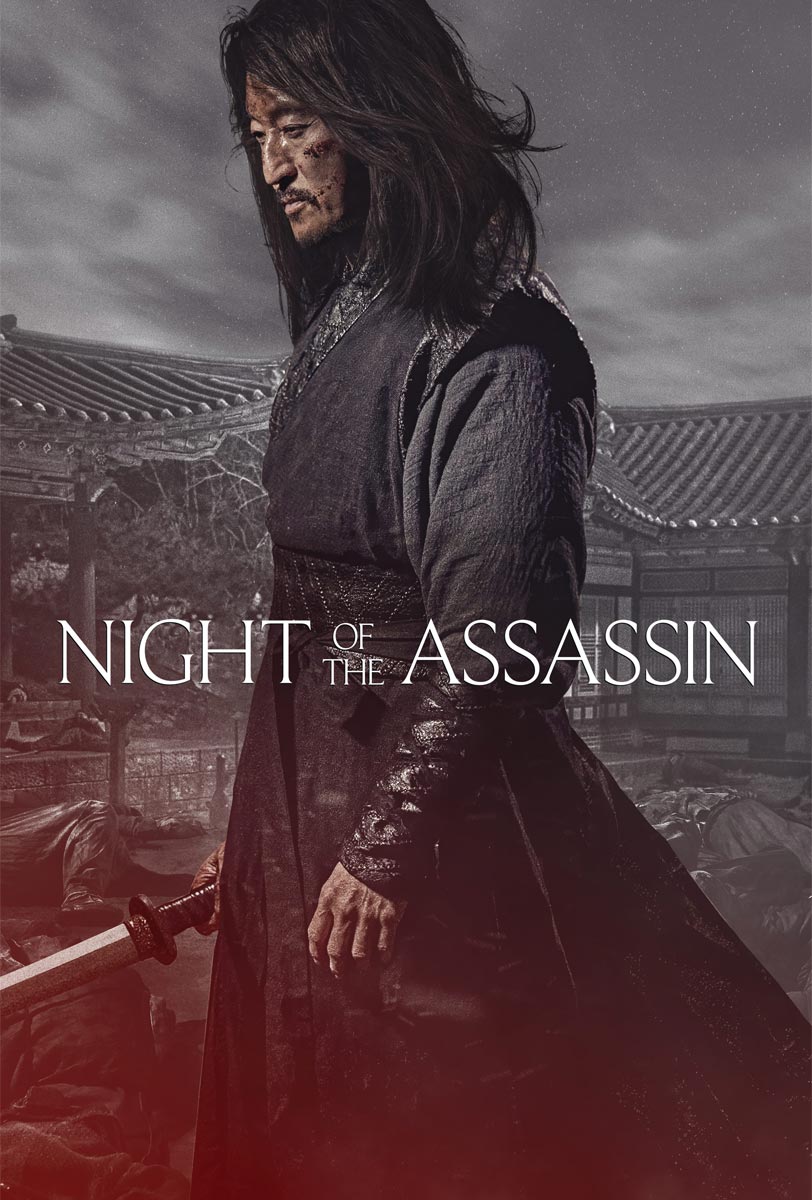
Night of the Assassin (살수, Kwak Jeong-deok, 2023)

The vagaries of the times take a toll on the heart of a killer for hire in Kwak Jeong-deok’s low budget historical drama, Night of the Assassin (살수, Salsu). Set in feudal Korea, the film takes place in a world in which “human lives have no meaning” and corrupt authorities fight amongst themselves while exploiting the suffering people for their own gain. As someone later says there is no end to a person’s greed in this constantly uncertain society. 

Inan (Shin Hyun-joon) is regarded as the best assassin in Joseon seeing as his targets always end up dead, but it seems the moral duplicities of his life as a sword for hire have begun to weigh on him and resulted in a heart that is in effect broken. His doctor warns him that his body can no longer support martial arts (or sleeping with women) while the only thing that might help him is a mythical herb, Mahwangcho, he isn’t really sure actually exists. Weakened as he is, knives are quickly out for Inan though somehow he manages to escape living a quiet life searching for the herb and reflecting on the dark deeds of his life. 

A year later he fetches up in a village where he’s taken in by a widow, Seon-hong (Kim Min-kyung), after making a non-violent intervention on seeing her bullied by local guards. Soon he becomes a waiter at her roadside restaurant and becomes a surrogate father figure to her young son, Chil-bok, who ironically enough wants to become an assassin when he grows up having become obsessed with a martial arts serial while determined to get revenge for his father who was killed by bandits while searching for a herb. 

The bandits are the reason Inan can’t just go and look for the Mahwangcho himself seeing as they pretty much own the mountain and are not so secretly in league with the guards where corrupt official and former gang boss Ibang (Lee Moon-sik) has made a bundle getting the local peasants hooked on opium so he can press them into debt and then take their land. Only, Ibang has had enough of working with bandit chief Baek Ga and figures he may as well use Inan, after learning his true identity, to take him out and put a weaker willed subordinate “in charge” while running things from behind the scenes. 

Inan is fighting a battle on several fronts, the first being his health and his reluctance to fight because of it which is also a symbolic manifestation of his moral conflict with his life as a hired killer. As he tells Chil-bok, they weren’t all bad guys even if he rationalises to himself that every one dies some day so today is as good tomorrow. Ibang justifies himself that he’s appeasing the bandits by containing them in the mountain while simultaneously peddling opium to the local population to make it even more difficult for them to resist him. Then again, Inan doesn’t rise up to free the villagers nor even to take out the bandits to get access to the mountain but only in defence of Seon-hong and her son when Ibang uses them to manipulate him into killing Baek Ga.

The film is framed as a kind of fable much like that in the serial Chil-bok is reading only related by an old friend of Inan’s who’s retired from the underworld and is attempting to live a quiet life in the country though as he points out real life doesn’t always have a neat ending. As such, the film works in a minor hook for a sequel in the mysterious identity of whoever it is sending assassins after Iban and the reasons why they want him dead though there may be a kind of explanation in the flashback scenes to his life as a young assassin. Likewise, the film has a kind of episodic structure in which Iban battles with a coldhearted mercenary much like himself and a female assassin with red eyes who seems to have some kind of hypnotic superpower. Though obviously constrained by budgetary limitations, Kwak’s attention to costuming and architecture help lend a potent sense of place to the feudal-era setting while the visceral quality of the action scenes reinforces Inan’s existentialist questioning in a land in which human life has little value.


Night of the Assassin is available to stream now in the US via Hi-YAH! and will be released on DVD & blu-ray Aug. 8 courtesy of Well Go USA.

International trailer (English subtitles)

Miss & Mrs. Cops (걸캅스, Jung Da-won, 2019)

When the Burning Sun scandal exploded in early 2019 it promised but perhaps did not deliver a reckoning with the generalised misogyny at the heart of a fiercely patriarchal society. Almost a year previously, 12,000 women had assembled at Hyehwa Station to protest the prevalence of “molka” or spy cam pornography in which footage captured of ordinary women through the use of hidden cameras in ladies’ bathrooms, changing areas, and fitting rooms had been uploaded to the internet without their knowledge or consent. Despite all of this, there has been relatively little progress. Miss & Mrs. Cops (걸캅스, Girl Cops), a lighthearted comedy dealing with the weighty issues of molka, date rape, and the indifference with which they are treated by an overwhelmingly male police force obsessed with targets and performance, was filmed before the Burning Sun story broke but drops neatly into the post-scandal society as two women discover that they’re on their own when it comes to taking down a vicious drug gang. 

Mi-young (Ra Mi-ran) was once an ace detective well known for her ice cool arrests, but after marrying a feckless man who repeatedly failed to pass the bar exam she was forced to leave active policing and take an admin job in the complaints department for higher pay. Her sister-in-law, Ji-hye (Lee Sung-kyung), has since joined the force as a rookie officer but has little support amongst her colleagues and is often in trouble for her worryingly aggressive policing which eventually gets her “demoted” to complaints where she ends up working with Mi-young. While they’re busy bickering, a young woman arrives looking lost and confused but is frightened off by a rowdy group of men before she can say anything. As she’s left her phone behind, Mi-young chases after her, but the woman immediately steps out into traffic and is hit by a car. Obviously extremely concerned, Mi-young and Ji-hye get their tech expert colleague to Jang-mi (Choi Soo-young) to help them crack the phone and discover a compromising photo of the young woman posted on an illicit web channel promising to release the full video when it reaches 30,000 likes. 

Talking to her friend, Mi-young and Ji-hye realise that the young woman has tried to take her own life out of shame because of what these men did to her. Yet their attempts to report the matter to the legitimate authorities fall on deaf ears. Ji-hye’s colleagues joke and complain about having to investigate “perverts” instead of doing “real” policing, as if it’s all just meaningless silliness. Back when Mi-young was on the force she was placed into a special woman’s squad dedicated to dealing with crimes against women. Ji-hye quite rightly points out that times have moved on and the woman’s squads were in their own way essentially sexist in that they were created because the male police force did not regard crimes against women as “serious”, nor did they regard female officers as “real” police, so they killed two birds with one stone to allow them to get on with more “important” matters. 

The women realise that they’ll have to deal with this on their own, but even once they do discover that the male officers are only too keen to take the credit for exposing a drug ring while leaving the “peeping toms” to the ladies as not worth their time. Ji-hye’s boss even lets his mask slip in irritatedly suggesting she’s being over emotional because she is a woman and should let the boys get on with their jobs, but it’s only when she has a moment of impassioned rage explaining to them that they’re consistently failing in their duty to protect the women of Korea that they are finally shamed into realising the consequences of their lack of concern. 

Meanwhile, each of the women has been in some way been deliberately obstructed in their career solely for being a woman. Mi-young was forced off the force and is now in danger of losing her complaints job because of budget cuts. An older woman doesn’t tick any boxes on the employment quotas and so they have no reason to keep her. Ji-hye, meanwhile, is ignored by most of her team and left without support, and even Jang-mi, we discover, had NIS training but quit in resentment after they put her on a pointless Twitter monitoring programme. Their much maligned boss was also a part of the woman’s squad and wanted to continue in the police after having children, but they put her in charge of complaints instead. 

Yet Mi-young says she isn’t on the case because of female solidarity but because it makes her so angry that most of the women this happens to, like the woman who stepped in front of a moving car, blame themselves. The woman’s friend blames herself too for getting her friend into a dangerous situation because she convinced her to come to a private party with guys in a club thinking “they seemed OK”. In that sense it’s a shame that the villain concerned turns out to be a drug-addled sociopath who apparently only does the date rape stuff “for fun” because the real reason for all those clicks is data collection, rather than a perfectly ordinary guy who is probably someone’s son, brother, or even husband, not to mention chaebol kid or Kpop star. Still even if a little flippant in presentation (including some extremely unfortunate racist “humour”), Miss & Mrs Cops maybe no Midnight Runners but has its moments as its determined heroines strike back against patriarchal indifference by refusing to give up on justice.


International trailer (English subtitles)

Memories of a Dead End (막다른 골목의 추억, Choi Hyun-young, 2018)

Memories of a dead end posterSometimes dead ends show up unexpectedly, as the heroine of Memories of a Dead End (막다른 골목의 추억, Makdareun Kolmokui Chueok) points out while ruminating on the abrupt revelation which has just rendered all her life’s hopes and dreams null and void. Adapted from the Banana Yoshimoto novella, Choi Hyun-young’s debut feature follows a young-ish Korean woman to Japan where she finds out something she probably knew already but didn’t quite want to accept and, thanks to the kindness of strangers, begins to see a way forward where she feared there might not be one.

Yumi (Sooyoung), a woman in her late 20s from a wealthy family, has been engaged to Tae-gyu (Ahn Bo-hyun) for the last few years but he has been working away in Japan supposedly preparing for their shared future. Unable to get in touch with him and worried he seems to be dodging her calls and refusing to return her texts, Yumi decides (against the advice of her steadfast sister) to go to Japan and confront him. Sadly, her family were right when they advised her that perhaps she should just forget her fiancé and move on. Tae-gyu has met someone else. On arriving at his apartment, Yumi is greeted by another woman who knows exactly who she is and why she’s come, but takes no pleasure in explaining that she and Tae-gyu plan to marry and were hoping Yumi would take the hint given a little more time.

Confused and heartbroken, Yumi checks into a hotel for the night planning to return to Korea the following day but a nagging phone call from her “I told you so / plenty of fish in the sea” mother (tipped off by her loudmouth sister) makes her think perhaps that’s not the best idea. Wandering around, she winds up at the End Point hotel and cafe where she cocoons herself away to think things through, trying to reconcile herself to the “dead end” she has just arrived at in the life path she had carved out for herself.

“End Point” is not perhaps an auspicious name for a hotel. A hotel is, after all, a deliberately transient space and not in itself a destination. The reason it might accidentally become one is perhaps on Yumi’s mind when she decides to check in, but despite the name the cafe is a warm, welcoming, and accepting place perfectly primed to offer the kind of gentle support someone like Yumi might need in order to rediscover themselves in the midst of intense confusion.

This is largely due to the cafe’s owner, Nishiyama (Shunsuke Tanaka), who, we later discover, was himself neglected as a child and almost adopted by the community who collectively took him under their wing and sheltered him from his childhood trauma. This same community still frequents the End Point cafe and is keen to extend the same helping hand to those in need, becoming a point of refuge for a series of lonely souls many of them travellers from abroad. Despite her desire for isolation, Yumi is finally tempted out of her room by the gentle attentions of the cafe’s regulars who make sure to include her in all their gatherings, reawakening something of her faith in humanity in the process.

In introducing her to the cafe, Nishiyama remarks that though it is literally in a dead end, many begin their forward journeys from here. A dead end does not, after all, have to be an “end point” but can become an opportunity to turn around and start again without necessarily having to go back the way you came. Yumi likes the End Point so much she briefly considers staying, but it would, in a sense, be a betrayal of its spirit. Nishiyama, becoming a staunch friend and ally, finally comes to the conclusion that her former fiancé was not a bad man even if he was a weak one, but that in all the time he knew her he never discovered the “treasure” of her heart as he seems to have done despite knowing her only a few days. Yumi takes this new knowledge with her on her forward journey as she abandons her much commented on practicality for warmhearted connection as a path towards fulfilment, learning to treasure her “dead end” memories not as time wasted but as a pleasant diversion which led her to exactly the place she needed to be in order to discover the treasure in her own heart and the willingness to find it in others.


Memories of a Dead End screens as part of the eighth season of Chicago’s Asian Pop-Up Cinema on April 17, 7pm, at AMC River East 21.

International trailer (English subtitles)