
Tiger Stripes (Amanda Nell Eu, 2023)

There’s a moment in Amanda Nell Eu’s Tiger Stripes in which a teacher writes a sentence in English on the board for the students to fill in the blanks. “The father ___ to work,” one reads. Another, “The mother ___ at home.” It’s within these blanks that the girls live their lives, contained by rigidly held patriarchal norms supported by a religious environment that turns resistance into heresy, something demonic and evil that must be rooted out so the afflicted individual can be returned to society without their parents being ostracised.

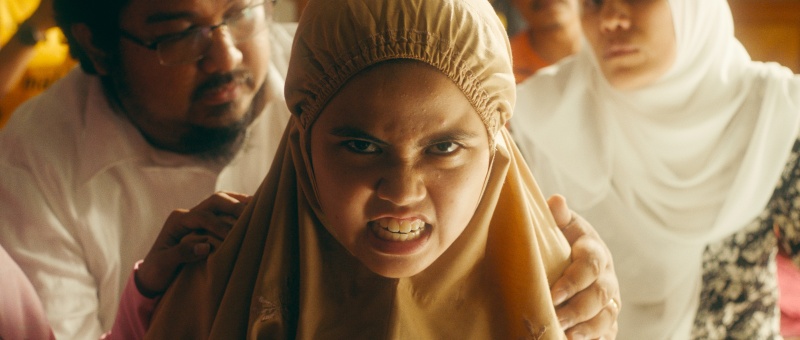
A bright and talented student, Zaffan (Zafreen Zairizal) is shown to flaunt these rules by wearing a bra and commandeering the toilets to record tiktok dance videos with the help of her friends Mariam (Piqa) and the more conservative Farah (Deena Ezral). Perhaps the most transgressive thing about them is that she’s removed her hijab and in fact much of her clothing, defiantly assuring herself with a cheekiness that seems almost naive. After getting her school uniform wet in a local pond, she cheerfully runs home hair exposed in only her smalls. Her father barely bats an eyelid, but her mother is incensed. Somewhat counter productively, she drags her outside and shouts at her in front of all the neighbours about bringing shame on their family. 

Time and again, it’s other women that cause Zaffan the most trouble. After her classmates discover that she’s got her period and is therefore a woman, they beat her up and call her names suggesting that she’s unclean and no longer wanting to associate with her. It doesn’t help that her new status is known to all because girls on their period cannot participate in some of the religious practices at the school which similarly reinforce the idea that menstruation is a pollutant and womanhood itself is toxic. It’s indeed womanhood which been activated in Zaffan along with a natural desire to resist her oppression and be who she is. She begins to undergo a transformation that even she barely understands, snapping and snarling those who challenge her while otherwise catching and eating wild animals which she tears apart with her teeth. 

The girls tell each other a story of a woman, Ina, who apparently went feral and escaped to live in the forest. They tell it as a cautionary tale, but Zaffan begins to see and identify with Ina who has found a kind of natural freedom outside of the oppressive patriarchal social codes of the contemporary society. Yet it’s precisely this freedom that must tempered ad women kept in their place. The school later calls in some kind of spiritualist, Dr. Rahim (Shaheizy Sam ), who pedals snake oil treatments and claims to be able to exorcise the young women who have similarly come down with shakes and shivers in the wake of Zaffan’s metamorphosis. Earlier on, Zaffan had seen a wild tiger filmed by a man who walked slowly behind it, menacing but unwilling to engage. Her friends tell her they probably mean to kill it, but there’s also an ineffectuality in this male timidity that is essentially afraid of an independent woman. Having transformed herself into a tigress, Zaffan too is followed by a crowd of men but all they do is stare at her back.

Meanwhile, in the background her teachers make ironic comics that the students won’t amount to anything while the Malay pupils seemingly trail behind their Chinese classmates. Zaffan becomes the embodiment of monstrous femininity, a dangerous and transgressive womanhood that rejects all of the constraints placed upon it. Though she does not understand what is happening to her and is hurt that her former friends, still on the other side of adolescence, now view her as something other and unpleasant, Zaffan longs for the freedom of the forest and to dance to her heart’s content no longer willing to submit herself to the strictures of the patriarchal society. Her rebellion earns its followers among girls of her age, themselves longing for freedom but too afraid to ask for it. Tinged with supernatural dread, the film nevertheless presents Zaffan’s progress as a gradual liberation found in the natural world, nature red in tooth and claw but alive and unconstrained as free as a tigress in a world without man.


Tiger Stripes is in UK cinemas now courtesy of Modern Films.

UK trailer (English subtitles)

Evil Does Not Exist (悪は存在しない, Ryusuke Hamaguchi, 2023)

Whatever happens upstream affects those further down according to the headman of a small village faced with incursion from city dwellers hoping to turn their peaceful idyll into a tourist hotspot in Ryusuke Hamaguchi’s eco drama Evil Does Not Exist (悪は存在しない, Aku wa Sonzai Shinai). He reminds them that those at the top have a responsibility to those below, and it’s only because of this sense of mutual consideration that life is possible here. It’s an obvious metaphor for the contemporary society in which those with money and power have largely forgotten about those without, but then the film’s title also asks us a question. What is “evil”, does it exist or not, or is it merely in inextricable part of nature human and otherwise that balances out the good?

After a long tracking shot along the trees shot from below, Hamaguchi focuses on the figure of Takumi, a man at home in nature patiently sawing and cutting logs. He teams up with another man, Kazuo, to harvest water from a local stream we later realise is being used by an udon restaurant for a superior taste. Takumi shows him wild wasabi and explains how the locals use it, suggesting that Kazuo consider adding some to his dishes. Like him, Takumi’s daughter also seems to be at home in the forest, wandering off to walk home alone when Takumi inevitably forgets to pick her up from school.

Takumi describes himself as a “jack of all trades” or more to the point a local odd job man, but seems in many ways he’s one who keeps the balance. The problem they have now, is that a company from Tokyo has bought some land and is intent on stetting up a “glamping” resort in the village. A pair of agents turn up from the city to give a kind of question and answer session, but as one of the attendees later suggests it’s mainly to make themselves look good. Unable to answer most of the villagers’ quite reasonable questions all they can do is state they’ll take their opinions into account while offering flawed promises of financial gain and insistence that people from Tokyo will visit as if that were some kind of honour. It doesn’t seem to occur to them that the villagers maybe happy as they are and aren’t interested in further material gain while understandably wary of the effects of the resort on the local area from increased traffic and pollution. The agents encounter unexpected resistance centring on the septic tank which has been penciled in for an area which would lead to the contamination of wells and groundwater while it’s also clear that the company are determined to cost cut with the agents blithely telling them that a little bit of sewage in your drinking water never harmed anyone and in any case it’s within the permitted amount. 

Others ask questions about fire risk and understaffing with the agents later asking Takumi to become the resort’s caretaker, insulting him with the implication that he’s some kind of layabout easily bought with a fat paycheque. He corrects them that he has a job and doesn’t need the money, though they persist with asking him to be a kind of advisor. Takahashi, a jaded manager, is soon captivated by the area and in particular Takumi’s manliness in his log splitting and mysterious demeanour but there’s something inevitably harsh and unforgiving about nature even if it’s man that has corrupted it. Gunshots are heard over the horizon, men hunting deer. Takumi and Hana walk past the carcass of one who bled out from a bullet wound and was presumably just left there dying for no real reason. Takumi tells the agents that their site is on a deer path, so they’d need high fences which might put the customers off but reflecting that wild deer aren’t usually “dangerous” unless they’re sick or have been shot. Takumi asks where the deer are supposed to go but gets only a shrug of the shoulders and “somewhere else” from Takahashi, but there are only so many other places, what if this is the last one? If you continue to displace things, there won’t be anywhere left for anyone.

Still, as Takumi says it’s not that villagers have already decided to resist the glamping project, only that they want their fair complaints to be addressed and are willing to engage with the process if only the agents would treat them with a little more respect. But that’s something thin on the ground from the execs in Tokyo who think they’re all a load of bumpkins easily bought off with promises of a better economic future. To Takumi it is really a matter of balance, something that should be maintained for one’s protection as much as anything else. The ominous score which frequently cuts out abruptly adds to an edge of unease and supernatural dread in the ancientness of the natural world even if as Takumi points out this isn’t their ancestral land. It’s a new village that originated in the immediate post-war era when returning soldiers were given land to farm. They are all to some degree outsiders, as perhaps are humans in this inhuman place, but also ones who’ve found a way to live in it that’s as much about respect for the land and others as it is about survival.


Evil Does Not Exist opens in UK cinemas of 5th April courtesy of Modern Films.

UK trailer (English subtitles)