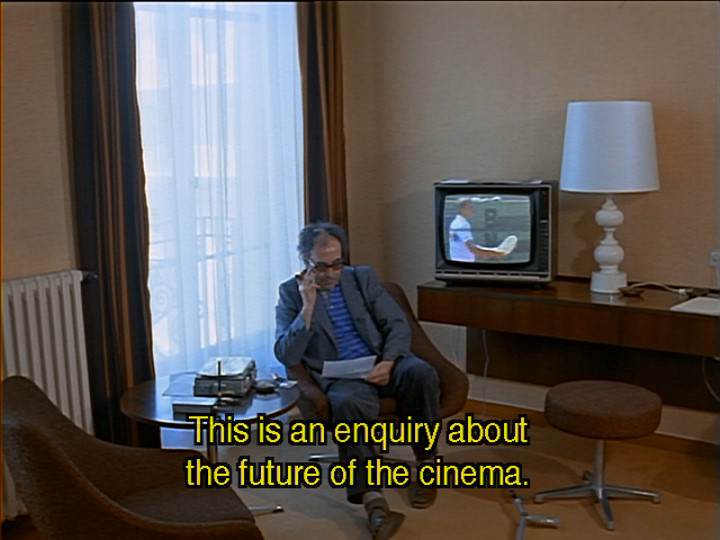
If you’re Wim Wenders and you’re bored at the 1982 Cannes Film Festival, you could amuse yourself by getting a bunch of your director friends to answer a series of pre-set questions about the future of cinema whilst sitting alone (aside from the ever present TV) in front of a static rolling camera in a fairly anonymous hotel room. Luckily, you have a lot of director friends making all sorts of films from all over the world who apparently won’t get that weirded out by sitting alone in an empty room pontificating about the death of cinema as an art form.
This is 1982, the year I was born (though I was born in the winter and Cannes is in the spring so I’m probably on my way somewhere but haven’t quite arrived yet), and this ‘future of cinema’ they’re envisioning is the present in which we now live. It’s depressing how many of the arguments the class of 1982 come up with are the exact same arguments we’re having now – that cinema as an art form has migrated to television and the cinematic output has been reduced to a vague amalgam of the the things Hollywood (in particular) wants it to be. More than one American director, when questioned about his own cinematic habits, admits he rarely watches films himself – he prefers television. In a telling and prophetic fashion, he videotapes films off the TV but then never bothers to watch them. Another recounts the story of friend who’s terrified of this ‘brave new world’ where you’ll be able to buy things through a video camera or, heaven forbid, order a meal from a computer screen! Some are more positive like Werner Herzog who believes the cinema has its own aesthetic which will save it or Antonioni who looks forward to a new age of HD video which is only now coming to pass.
However, aside from the futuristic visions of thirty years ago, it’s almost even more interesting to note how each director chooses to behave inside this strange “diary room”, left all alone except for the silently glaring camera. Jean-Luc Godard is first up – sitting directly facing the camera, smoking in a relaxed fashion and lamenting that his position isn’t the best for seeing the tennis on the TV just beside him. He gets the longest unbroken lecture in which he talks at length about various quite unrelated things until he gets bored and leaves in true Godard fashion – we wouldn’t have him any other way but it’s difficult to tell how seriously he’s taking this. Some directors sit nervously on the edge of the seat, thinking hard about their answers where as others bluster through as though they were at a Hollywood pool party a la Spielberg who laments the weak dollar and the rising cost of filmmaking which he fears will lead to a decline in artistry (which seems kind of ironic). Werner Herzog wins all the prizes for his entrance in which he makes a point of removing his shoes as ‘these aren’t the sort of questions that should be answered with your shoes on’ and being the only director to realise he can turn off the TV behind him! Antonioni gets up and roams around the room as if giving a lecture whereas Rainer Werner Fassbinder (in a late career appearance – he would sadly pass away of a drugs overdose only a few weeks later) gives his answer concisely and leaves almost straight away.
So there we have it, cinema apparently died sometime prior to 1982 and has been subsisting in some kind of bloated zombie state ever since. Art forms are always dying, books died a century ago and yet new ones keep being born which we take to our hearts and minds, nurturing them even though we keep being told there is no hope. The theatre is dead, pop music is dead, classical music and opera? fossilised, perhaps? The presence of the TV set in background is the most ironic use of a TV screen in any movie, just as the directors talk about the threat of television the viewer is constantly distracted by whatever happens to be playing (which includes some kind of Battle of the Planets type thing and Planet of the Apes!) and good old Werner is the only one who thinks to turn it off so we can focus all of our attention on what he has to say. Perhaps the most pressing segment is the one where the director isn’t even present as he’s the subject of an extradition order by the Turkish government but has been able to tape record his contribution prompting Director Wim Wenders to step in front of the camera to explain. This segment highlights how the cinematic art form is still held as a threat and that the true artistic spirit it can exhibit is often suppressed or oppressed by bodies governmental or otherwise. Sadly, this is a problem that has not gone away, nor is it likely to (and unfortunately applies to all art forms equally not just cinema which necessitates higher visibility). Where is the cinema in 2014 then, still trapped like Shrodinger’s cat inside an opaque box where we can’t be certain if it lives or dies? Maybe, it’s making noises every now and then though perhaps it doesn’t sound quite like it used to. The real question though is who wants to save it, and why? Are there people willing to stand up and fight for their art and what exactly is the ‘cinema’ that they want to save?
Watched on Mubi 12th June 2014 (its expiry date). Also available from Anchor Bay in the UK or legal streaming from The Paris Review (among other places).
 Windows on Worlds