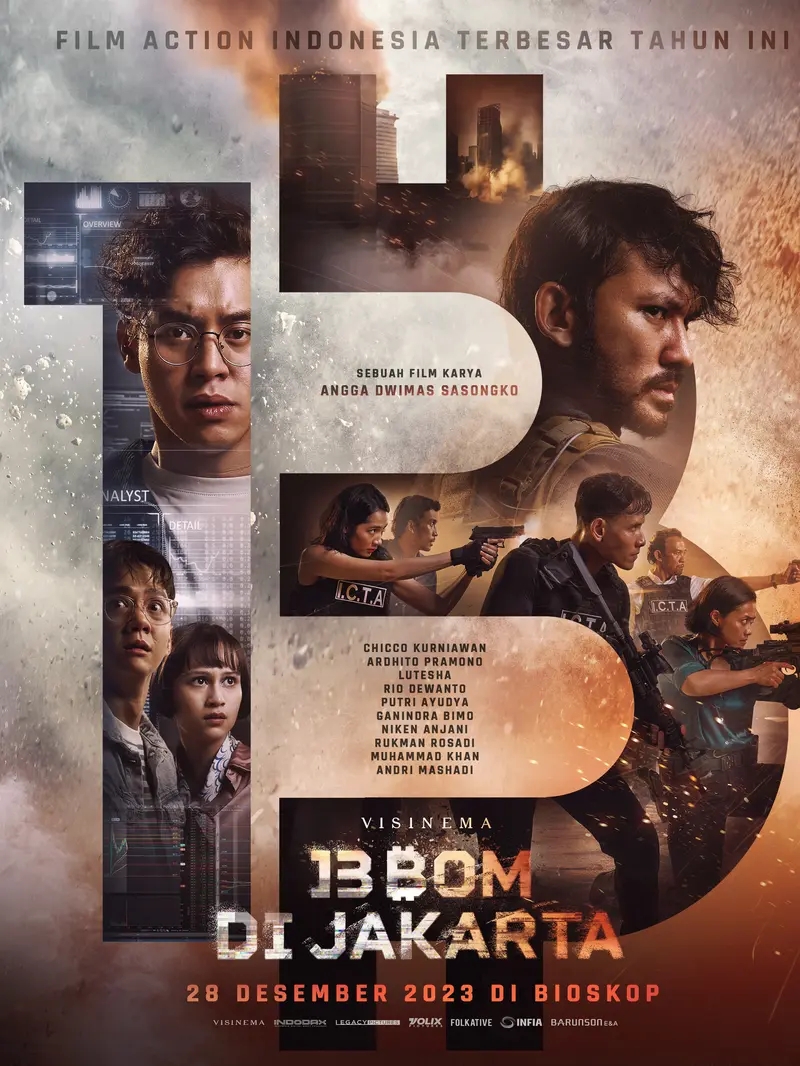
13 Bombs (13 Bom di Jakarta, Angga Dwimas Sasongko, 2023)

There’s an interesting juxtaposition in opening scenes of Angga Dwimas Sasongko’s action thriller 13 Bombs (13 Bom di Jakarta). A security guard in a cash van listens with exasperation to a radio broadcast voicing the nation’s economic decline before remarking that his mortgage keeps going up but his pay stays the same. Meanwhile, across town, two youngsters celebrate after receiving a huge payout from the cryptocurrency exchange app startup they’ve been running, drinking and partying oblivious to the poverty that surrounds them. Yet it’s the two youngsters that have unwittingly spurred a desperate man towards revolution, giving him the false idea of a utopia uncorrupted by money.

The interesting thing about the terrorists is that after attacking the cash van they blow the doors open and then leave without the money, allowing the people to pick it up instead. The explosion was apparently one of several more to come as the gang have placed 13 bombs around the city which they are holding to ransom, demanding to be paid in bitcoin solely through the boys’ exchange. The level of the crypto kids’ complicity is hard to discern, but it soon becomes clear they weren’t up for loss of life even if there’s a large payout at the end of it though they don’t really trust the police either. 

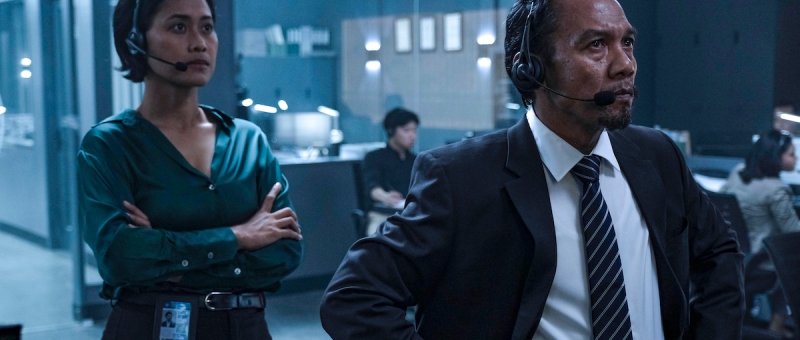
The police, or more precisely, the Counter Terrorism team, don’t come out of this very well. They’re originally quite reluctant to view the incidents as “terrorism” because that will make everything very “complicated” and also worsen the already precarious financial situation. They also seem to be fairly blindsided, arguing amongst themselves about the proper course of action with the sensible and reliable Karin (Putri Ayudya) often shouted down for relying too much on gut instinct as in her decision to trust bitcoin boys William (Ardhito Pramono) and Oscar (Chicco Kurniawan) only for them to immediately run away hoping to find the gang’s hideout for themselves after being disturbed by a strange message from the gang branding them as their allies.

Bitcoin seems like a strange thing for the revolutionaries to pin their hopes on, though it later seems they hope to do away “money” in its entirety, though it’s true enough that all of them have suffered because of the evils of contemporary capitalism. Many were victims of the same pyramid scheme, one man losing everything after his mother invested the family fortune and died soon after, and another scarred by the suicide of his wife and later death of his child. You can’t say that they don’t have a point when the press the authorities on their failure to protect the poor along with their uncomfortable cosiness with wealth and power. As their leader says, people starve to death every day because of poverty or die earlier than they would have because of a lack of access to healthcare yet the authorities don’t seem to be doing much at all to combat those sorts of “crimes”.

Nevertheless, there’s tension in the group with some opposing leader Arok’s (Rio Dewanto) increasingly cavalier attitude to human life and worrying tendency to suddenly change their well designed plans. The battle is essentially on two fronts, the police stalking them with traditional firepower and Arok fighting back with technology, harnessing the power of the internet to disguise his location while hacking police systems and public broadcasting alike to propagate his message of resistance against corrupt capitalism and oppressive poverty. Counter Terrorism does not appear to be very well equipped to deal with his new threat, but can seemingly call on vast reserves of armed troops even if in the end it’s mostly down to maverick officer Karin to raid the villains’ base largely on her own trying to rescue the boys after realising they are trying to help her after all.

These action sequences are dynamic and extremely well choreographed even if some of the narrative progressions lean towards the predictable and the final gambit somewhat far fetched in its implications. Then again, it’s also surprising that Counter Terrorism doesn’t seem to have much security and should perhaps have considered paying a little more for bulletproof glass in the control room. The subversive irony of the seeing the words “New Hope” and “deactivated” on the final screens cannot be overstated even as a kind of order is eventually restored in an otherwise unjust city.


13 Bombs screened as part of this year’s Osaka Asian Film Festival.

Original trailer (English subtitles)
Yuni (Kamila Andini, 2021)

“Marriage is a blessing”, according to a wise old grandma, “we shouldn’t refuse a blessing, no?” expressing a commonly held belief in the traditional small town where the titular Yuni (Arawinda Kirana) resides in Kamila Andini’s melancholy social drama. Yuni meanwhile isn’t so sure, if marriage is a blessing then why does it feel like a trap and how can you call something a blessing if as it seems to have been for some of her friends it only results in violence and misery? 

At 17 Yuni is a talented student, her progressive female teacher urging her to consider going to college while offering various pamphlets about applying for scholarships which Yuni feels might make it easier for her parents to accept. Yet in addition to the academic criteria, the rules are clear that married women are not eligible which is a problem because Yuni has just received her first marriage proposal from a man recently relocated to the village who is handsome enough and thought a catch because he has a good job in a local factory. 

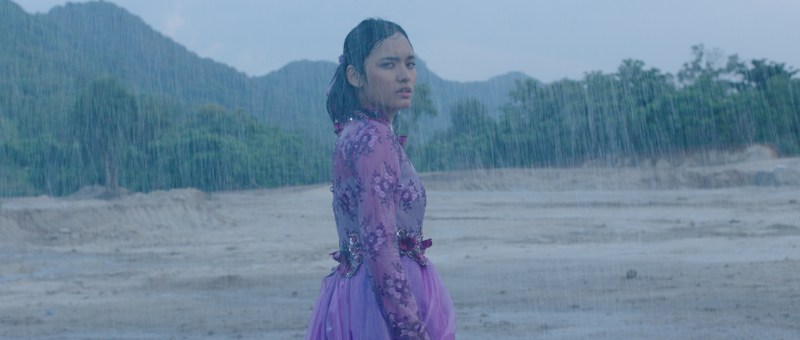
While everything in Yuni screams no, she finds it difficult to articulate her resistance constantly second guessing herself wondering if she’s doing the right thing or if as some of the other girls suggest she is lucky to have received such a generous offer and ought to accept it. Her obsession with the colour purple, the colour both of a wedding dress and according to another girl widow’s weeds, which causes her to steal any purple item she sees is an expression of her alienation yearning for colour and vibrancy in a culture which seems to deny her both. Dressing in purple under her green school uniform, she rejects the idea of marriage and wants to continue her education, spending time with an older woman who takes her to clubs to dance enjoying the illicit freedom of a modern society which has otherwise been kept from her. 

Even at school, her freedom begins to shrink. The Islamic Club seems to dominate everything, planning to introduce virginity tests for the female students to prevent the inconvenience and shame of teenage pregnancy though it does not seem as if the boys are given the same talk. The girls are all convinced that one of their classmates is pregnant because she wears a baggy jacket and has become withdrawn, but later wonder if she may have been raped no one seemingly very interested in helping her. Later after embarking on an escapist romance with diffident and sensitive classmate Yoga (Kevin Ardillova), Yuni is also asked if was raped when confessing that she is no longer a virgin in order to escape a second marriage proposal to become the second wife of a wealthy old man who not so subtly tries to buy her from her grandmother while implying that she might be considered damaged goods as a woman who’s already rejected a suitor. 

Yuni is warned that turning down a second proposal is bad luck and struggles with herself in her decision, her internal confusion ironically interfering with her studying making it harder for her to escape through education. Meanwhile she hears of a woman who married young but experienced domestic violence after her husband blamed her for a series of miscarriages only to be disowned by her family following a divorce they again telling her she ought to have counted herself lucky that her husband still put up with her despite her “condition”. Another friend’s husband has abandoned her with a young son and she isn’t sure if she should divorce him and look for someone else, while one of Yuni’s classmates ends up having to marry a teenage boyfriend when a gang of blackmailers threatens to ruin their reputations after discovering them taking photos at a well known hookup spot. 

With most of the other women largely complicit, Yuni feels she has no one to talk to or turn to for advice eventually pouring her heart out to the sensitive Yoga who offers to run away with her knowing that nothing will change as long as she stays in the conservative environment of their hometown. Even the teacher whom she’d once admired, Mr. Damar (Dimas Aditya), proves no ally attempting to use her to escape his own sense of impossibility after she catches him trying on women’s clothes at a local department store. Mr. Damar’s own desperation causes him to act in the most insidious of ways, in effect barring Yuni’s path out of her repressive life in inappropriately wielding his power as a teacher against her. Having lost all confidence, Yuni no longer knows what she wants out of life and is growing weary of fighting the same battles in attempting to struggle free of the constraints of traditional patriarchy but is left with little choice once all her dreams are shattered. A tragedy of modern day Indonesia, Yuni sees its heroine’s spirit gradually crushed by the world in which she lives in which she has only the choice of lonely exile or resigned misery. 


Yuni screened as part of this year’s Glasgow Film Festival and is available to stream in the UK until 8th March.

International trailer (English subtitles)

Memories of My Body (Kucumbu Tubuh Indahku, Garin Nugroho, 2018)

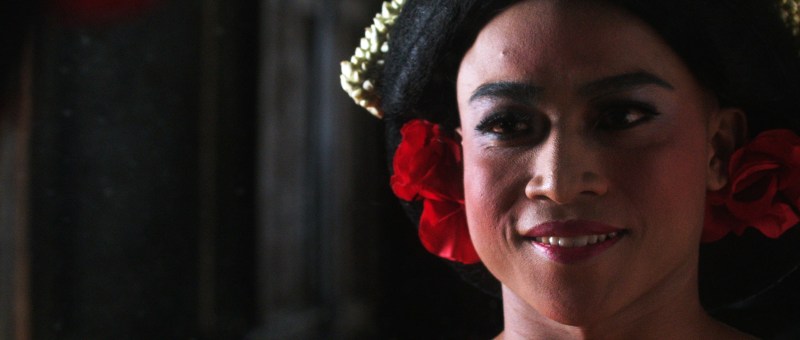
Memories of My Body posterYou view life through a tiny hole, as the narrator of Garin Nugroho’s Memories of My Body (Kucumbu Tubuh Indahku) so often observes. Loosely based on the life of Lengger Lanang dancer and choreographer Lianto, Nugroho’s 19th film examines the physicality of history as bodies become maps of trauma and dislocation while its itinerant hero is pushed from pillar to post through a series of abandonments and upheavals that leave him at the mercy of a society permanently on the brink of eruption.

We begin with the older Juno who narrates his story to us as if it were a piece of ritual theatre. The camera pans left and we meet Juno (Raditya Evandra) as a child – or more precisely, the child of the older Juno’s memory. Abandoned by his father, the boy begins hanging around a troupe of Lengger dancers for whom sensuality is all. Though Juno was originally attracted to the show for this very reason, peeping at the ladies through another “tiny hole” in the wall, he eventually becomes disillusioned with the dancers when he sees the group’s leader viciously beat an underling for having sex with his assistant at her instigation.

Sex, violence, and dancing continue to define the young Juno’s life even after he is taken in by an aunt when it becomes clear his father will never return. Following a brief obsession with chickens, Juno is then sent on to live with an uncle who trains him as a tailor where he develops a friendship with an ultra macho, soon-to-be-married boxer (Randy Pangalila) who too longs to be free of his bodily constraints but has become indebted to gangsters. Before long he finds himself in motion again before coming full circle as a costuming assistant with a troupe of travelling dancers where he becomes a favourite of the “Warok” (Whani Darmawan) but also the object of unattainable affection for the local military representative (Teuku Rifnu Wikana) of a corrupt regime whose insoluble jealousy seems set to burn the world around him.

As Juno’s uncle later tells him, bodies can go anywhere but they take their traumas with them. Even so, you have to love your body or all is lost. His uncle goes on to add that this family is particularly burdened, explaining the reason for his brother’s coldness to his son which turns out to lie in a rational distrust of family born of seeing his own massacred in a river, a sight he couldn’t seem to forget and eventually decided to erase by leaving his home and family far behind for the anonymous vistas of an unfamiliar island. Juno’s own traumas, as he seems to remember them, imprint themselves on his physicality and give weight to his dance as he tells his own story, filled with abandonments, rejections, transformations and rebirths in the intensely repressive atmosphere of a nation trapped in perpetual revolutions.

Juno’s own, slow path towards delight in his own body takes place against a series of external reformations obliquely referenced in a red terror threat to have the dancers denounced as communists, while primacy of religion remains paramount – the local military officer running for office, or more particularly his eminently practical but perhaps also compromised wife, is panicked by a photo in which he unwisely took Juno’s hand in public. Merely grasping a hand becomes suspect in an atmosphere of intense suspicion and any hint of impropriety potentially enough to destabilise an already volatile situation.

Illicit romantic jealously spurs on a greater tragedy, and Juno is soon on the road again. As Juno says, you see life only through a tiny hole – in this case through the rhythmic history of an itinerant dancer whose stage is perpetually ripped away from him as external freedoms shrink and all that remains is the unification of the contradictory elements of one’s own soul and the authenticity of touch and movement. Poetically told and boasting a wonderful selection of classic Indonesian pop music, Memories of My Body is a beautiful exploration of “muscle memory” as lived history and the tangible effects of a life lived in turbulent times.


Memories of My Body screens as part of the eighth season of Chicago’s Asian Pop-Up Cinema on April 23, at Joffrey Ballet Tower Studio A, 10 East Randolph Street, 7pm.

Original trailer (English subtitles)