I Go Gaga, Welcome Home Mom (ぼけますから、よろしくお願いします。~おかえりお母さん~, Naoko Nobutomo, 2022)

Naoko Nobutomo’s documentary feature debut I Go Gaga, My Dear proved an unexpected hit on its 2018 release striking a chord with many middle-aged and younger people facing similar issues to the director while preoccupied about how best to care for their ageing relatives. Her 2022 followup I Go Gaga, Welcome Home Mom (ぼけますから、よろしくお願いします。~おかえりお母さん~, Bokemasukara Yoroshiku Onegaishimasu -Okaeri Okasan-) once again follows her parents though this time witnessing her mother’s gradual decline and eventual hospitalisation along with her equally ageing father left alone at home. 

Nobutomo does retread some of the same ground reusing footage from the previous documentary to fill in gaps in her mother’s story giving a brief overview of life and marriage before the first signs of the Alzheimer’s with which she would later be diagnosed would appear. It is however also rawer, including several scenes of Fumiko in extreme distress calling out for a knife in order to end her life in a moment of frightening lucidity or walking around the house asking “what’s wrong with me?” 

The couple had hoped to stay in their home taking care of each other but as Fumiko’s condition declines that becomes increasingly impossible until she finally suffers a stroke and is hospitalised. Naoko frequently talks to her father Yoshinori about returning home to help him care for her but her offer is always refused. They tell her not to worry about them and to do the things she wants to do while she can but Naoko continues to worry. Explaining that her parents had married at a late age by the standards of the time and never expected to have any children, she recounts that she was raised in an extremely loving home and that sense of love and devotion is still very much evident between the elderly couple who continue to love and care for each other deeply. 

But then Yoshinori is also ageing, approaching his 100th birthday, and taking care of his wife takes an obvious physical toll. After Fumiko is hospitalised, he walks for an hour everyday to visit her while even carrying the shopping home from the local store is far from easy. Meanwhile he too undergoes physical therapy hoping to build up his strength for when Fumiko eventually returns home. Though in generally good health, at times he too struggles suffering a nasty fall during heavy rain on his way home from the dentist and later hospitalised with a hernia. His daily visits to Fumiko seem to keep him going, but even these come to an end during the COVID-19 pandemic during which hospital visits are restricted leaving Fumiko, bedridden having suffered a second stroke, all alone with nothing to do. 

The presence of COVD-19 is also reflected in the funeral, an incredibly small affair populated by people wearing masks. Fumiko’s condition caused her to worry about her quality of life while a poignant visit to her home reduces her to tears before she’s transferred to hospital for longterm care. In her voice over Naoko explains that she’s been spending more time in Kure with her father, but evidently does not wish to intrude on his independence as far as she can help it while he becomes an accidental local celebrity given the documentary’s success. Fumiko too had been looking forward to seeing it, a treasured pamphlet lying next to her bed, but was ultimately unable to because of her ill health. 

Like its predecessor, I Go Gaga: Welcome Home, Mom tells a heartwarming study of an elderly couple doing their best to care for each other though later turns in a poignant direction as Naoko and her father begin to process the possibility that Fumiko will not return home something very painful for Yoshinori who is evidently suffering himself extremely worried about the thought of losing his wife. Yet life in a sense goes on, Yoshinori edging his way to his 100th birthday and pledging to live until 120 before heading to a diner for the hamburger steak he’d been craving. He even gets an award from the local mayor in celebration of his centenary. Ending on a poignant note, Nobutomo switches back to older footage of happier days in which her parents go about their ordinary lives filled with precious memories never to return. 


I Go Gaga, Welcome Home Mom streamed as part of this year’s Nippon Connection.

Original trailer (no subtitles)

I Go Gaga, My Dear (ぼけますから、よろしくお願いします。, Naoko Nobutomo, 2018)

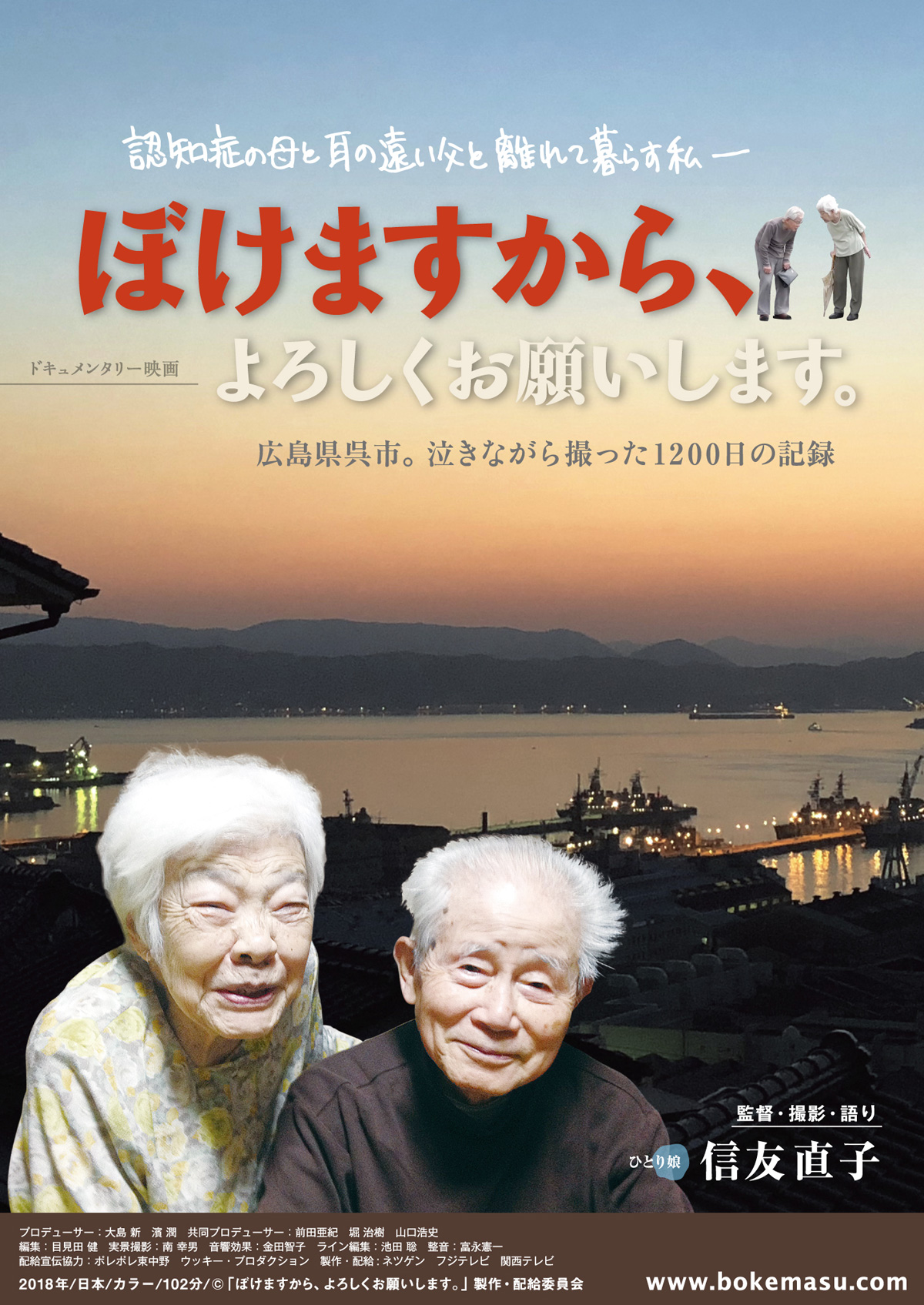
I go gaga posterWith the population ageing at unprecedented levels, Japanese society is facing a series of interconnected social issues as it contemplates the best way of caring for large numbers of elderly people often living away from family members who, in the past, might have been expected to bear responsibility. What sometimes gets forgotten, however, is the human dimension as older people go on living their everyday lives sometimes surrounded by family and sometimes not. Veteran TV director Naoko Nobutomo’s first feature I Go Gaga, My Dear (ぼけますから、よろしくお願いします。, Bokemasukara, Yoroshiku Onegaishimasu) follows her ageing parents from her own perspective as their daughter as they continue supporting each other into old age.

Nobutomo begins her story on New Year’s Day 2014 as she begins to notice a change in her sprightly, independent mother Fumiko and decides to take her to a doctor where they discover she is in the early stages of Alzheimer’s. Over the next three years, Fumiko’s condition intensifies while her husband of 60 years, Yoshinori, does his best to care for her though he himself is already over 90.

Flashing back to home video taken in earlier years, Nobutomo recalls her difficulty dealing with breast cancer at 45 throughout which her mother had been there to look after her. Having looked after her family for all of her life, there is an especial irony that now it’s Fumiko who needs looking after and it is perhaps these small moments of change that force her to acknowledge a gradual decline in her living standards even if she cannot clearly process them. Though Yoshinori bravely starts taking more domestic responsibility at 95, losing the ability to cook for herself is an obvious blow to Fumiko who nevertheless determines to keep her kitchen spotlessly clean.

Luckily, Fumiko and Yoshinori have a generous health insurance policy which entitles them to assistance in the home though that is something they obviously feel ambivalent about accessing. Fumiko, in particular, remains confused about the presence and role of their new helper, believing she is something to do with the insurance company, and is a little resentful of her offer to help with physically difficult housework such as cleaning the bath and emptying the washing machine. Likewise, she is originally reluctant to attend the daycare centre but noticeably perks up after being given a valuable opportunity to socialise rather than staying home all day with relatively little stimulation.

Seeing that her parents are struggling to manage on their own, Nobutomo wonders if she should give up her job in Tokyo and come home to Kure to look after them but is assured by her father that they’d prefer her to go on living her own life. Yoshinori, born in 1920, wanted to study literature at university but the war got in the way. Perhaps for this reason, he was determined that his daughter follow her dreams and is profoundly happy that she’s been able to make a career doing something she loves in the big city. Fumiko too, marrying at the comparatively late age of 30, had been a career woman, graduating from a woman’s school and working as an accountant before her marriage. A notably progressive pair, perhaps usually for the times in which they lived, they were content to let their daughter live the life she wanted to live and never placed any particular pressure on her to conform by getting married and having children.

Married for over 60 years, Fumiko and Yoshinori are determined to go on living independently and managing on their own as best they can. Fumiko, however, has brief painful moments of anxiety in which she is acutely aware of her declining condition and implications for her future. Some days she refuses to get out of bed, either resigned to the fact that “life isn’t always happy”, or lamenting that her life “miserable”. Neither of them want to be a “burden”, but find it increasingly difficult to continue managing on their own as much as they prefer to be as independent as possible. Nevertheless, they go on supporting each other much as they always have living together in hope and happiness while Nobutomo watches warmly from the sidelines supporting them in the same way they supported her, gently and with compassionate understanding.


I Go Gaga, My Dear was screened as part of Japan Cuts 2019.

Original trailer (English subtitles)