
Love, Life and Goldfish (すくってごらん, Yukinori Makabe, 2021)

An emotionally repressed salaryman discovers that it really is all about connection in Yukinori Makabe’s absurdist musical, Love, Life, and Goldfish (すくってごらん, Sukutte Goran). Adapted from the manga by Noriko Otani, the Japanese title is itself a minor pun in that it could be translated either as “please try to save me”, or “please have a go at scooping” as in goldfish which is a popular activity at Japanese summer festivals. A fish out of water, former top banker Makoto (Matsuya Onoe) is in a sense saving himself, biding his time until he’s scooped back up again, but discovers his true purpose may be to save someone else in this strange, goldfish-obsessed tranquil country town. 

Defiantly aloof, Makoto arrives a wounded man resentful that one mistake could have derailed his career to the extent that he’s gone from a cushy job in the Tokyo head office to a regular clerk in a rural branch of a nationwide bank. Viewing himself as an elite, infinitely better than all these country bumpkins with their weird goldfish obsession, Makoto is scrupulously polite but abruptly deflects the attempts of his new colleagues to make him feel welcome. He does however, develop a fascination for a melancholy young woman dressed in kimono, Yoshino (Kanako Momota), whom he firstly mistakes for a geisha running a house of ill-repute only to realise that her establishment caters to a different clientele in that she runs a goldfish scooping emporium. Meanwhile, he also becomes an object of fascination for Asuka (Nicole Ishida), a young woman running a bar with her brother. 

Makoto is fond of saying that “numbers don’t lie”, devoting himself entirely to work and insisting that he has no need of things like love or friendship but is in fact deeply lonely and trying to fill the void with industry. Though we never see much of his previous life, it’s easy to assume that he has at some point been deeply hurt and has affected this impervious persona as a means of self defence. Nevertheless, bottling up his emotions is apparently what caused his career to implode leading him to break with salaryman protocol and tell his boss what he actually thought in a less than polite manner. In a repeated motif, Makoto is no longer sure if and when his interior monologue has become exterior with the unwanted consequence that some of his less than charitable thoughts and inner insecurities accidentally leak into the outside world. 

More self aware than he seems, Makoto is moved to tears on hearing a heartfelt song from Asuka who, like him, is a Tokyo “reject” having come back after failing to achieve her dreams of becoming an actress. Overwhelmed by the sight of someone expressing their emotions without embarrassment he can’t help crying but continues to struggle with his feelings for Yoshino who is herself perhaps also feeling something similar. Once a promising pianist, she now only plays alone too afraid of judgement or rejection to risk playing for others. 

Tellingly Makoto’s Tokyo outburst had been over a business plan for an AI robot massage parlour which his boss dismissed on the grounds that it’s human warmth and kindness which are essential for healing. Of course Makoto didn’t want to hear that because he wants to live in a cold world of order ruled by the unassailable logic of numbers, but through gradually bonding with the townspeople comes to accept that it’s human connection that’s most important after all. “Sometimes you have to face reality even if it’s painful”, he remarks eventually realising that “you can’t save anyone if you obsess over numbers” after failing to scoop an arbitrary number of goldfish with a broken paddle. 

Realising life’s not a numbers game gives Makoto the courage to sing with his heart no longer quite so repressed as he prepares to escape this strange holding tank for the oceans of the metropolis. An old-fashioned integrated musical, the whimsical score skips through several genres from j-pop to rap though it’s true enough that some of the melodies stray uncomfortably close to popular hits from recent musical theatre and family animation. Nevertheless, the quirky production design and absurdist direction make Love, Life, and Goldfish difficult to resist as the repressed salaryman its centre learns to open his heart while swimming in a different river to realise that it really is all about feeling after all. 


Love, Life and Goldfish screened as part of this year’s Glasgow Film Festival.

Original trailer (no subtitles)
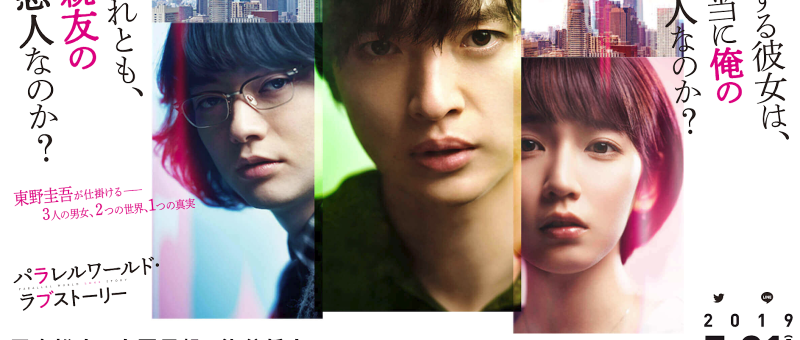
Parallel World Love Story (パラレルワールド・ラブストーリー, Yoshitaka Mori, 2019)

Have you ever had the feeling that you’re going out of your mind? Something just doesn’t feel right, your sense of perception and memory of the past don’t match the “reality” you’re currently experiencing but you have no way of knowing what’s at fault, you or the world. The hero of Parallel World Love Story (パラレルワールド・ラブストーリー) finds himself in just this situation as he begins to experience two very different states of being, one in which he’s living happily with the love of his life, and another where she’s dating his childhood friend. Is he a love crazed fool, or is someone messing with his head?

Travelling the same train into college every day, Takashi (Yuta Tamamori) fell in deep silent love with a young woman whose train crossed his every Tuesday morning. On his very last Tuesday, he decided he’d switch trains and try to find her, but she did exactly the same thing and so they missed each other, leaving Takashi feeling as if his fated romance was matter for another universe. He is then shocked when an old friend from middle school, Tomohiko (Shota Sometani), introduces that same young woman, Mayuko (Riho Yoshioka), as his girlfriend some time later. A little resentful at this twist of fate, Takashi tries his best to keep his feelings hidden. Meanwhile we see him “wake up” in his own apartment where Mayuko, who lives with him, is lovingly making him breakfast. He has a vague recollection of Tomohiko turning up in his dream, but can’t seem to remember what it is he’s doing these days. In this “reality”, Tomohiko introduced Mayuko to Takashi, and has abruptly moved to LA without even saying a proper goodbye, apparently working on a top secret research operation which keeps him entirely out of contact. 

Both men are involved with the research of perception and memory. Talking to another friend before “meeting” Mayuko, Takashi points out that it’s your brain which constructs the current reality from your sense perception. He grasps her hand and her brain tells her she feels it, but she’d feel the same thing if he isolated and activated the relevant sectors of her brain which tell her her hand is being grasped. Tomohiko, meanwhile, has gone one step further. He’s discovered that it’s neural networks rather than the brain which store memories and that, by stimulating those neural receptors in a particular way, memory can be rewritten or fake memories introduced. He proves this by illegally experimenting on a friend, making him think he’s from Tokyo when he’s really from Hiroshima, and reconstructing the image of an old teacher so that she’s now a pretty young woman and not a portly old man. 

The gap between what you want to be true and the “reality” is shrinking. It turns out that it’s easy enough to trick yourself into thinking something is true when it isn’t when you really want it to be. According to Tomohiko, once your brain has decided to approve the “fake” reality, cognitive dissonance is overcome by everything else being forced to fit into your new conception of the world. Takashi, however, is struggling to integrate his two parallel lives, one bleeding inconveniently into the other leaving him wondering which one is the “reality” and which the “dream”. 

Takashi’s less palatable qualities, however, exist firmly in the recent past of reality A in which romantic jealousy appears to have driven him half out of his mind, causing him to semi-stalk the innocent Mayuko and consider betraying his childhood friend by stealing the woman he loves. Takashi’s sole justification for his behaviour is the unspoken romantic connection which brought them together on the train, a connection he is “certain” she remembers without being given any particular encouragement from her side. Reality B Takashi, who lives with Mayuko, similarly becomes obsessed with the idea that Mayuko in some way belongs to Tomohiko, awakening an unpleasant sense of misogyny in his desire to prove that Mayuko is his because he saw her first on the train. 

Meanwhile back in Reality A, he starts to suspect that Tomohiko is up to no good pursuing unethical research practices and working towards a sinister goal. It’s unfortunate that Tomohiko also has a prominent limp from a lame leg, playing into the unpleasant association of villainy and disability. Even Takashi, having turned dark, accuses Mayuko of dating him out of pity, while Tomohiko describes him as a “hero” for having rescued him from childhood bullies. Takashi starts to suspect him, not only of being a mad scientist, but perhaps actively hostile and plotting revenge against him for stealing Mayuko. In a particularly Higashino-esque touch, Tomohiko’s motives turn out to be kinder than they might at first seem even if they’re a little on the extreme side, leaving Takashi pushed to make a similarly extreme yet strangely counterproductive move by his infinitely shady boss who is also exploiting the increasingly conflicted Mayuko. Yet, aside from all the philosophical musings on the nature of reality, the interplay of desire and memory, and the ethics of manipulating the perception of others, this is in essence a love story between two people who gazed at each other from passing trains. If you find each other once, you can find each other twice, and, in love, reality might not be so important.


Original trailer (hit subtitle button for English subs)