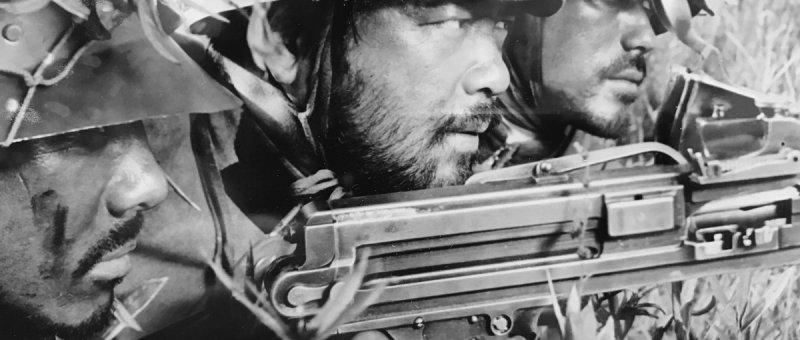
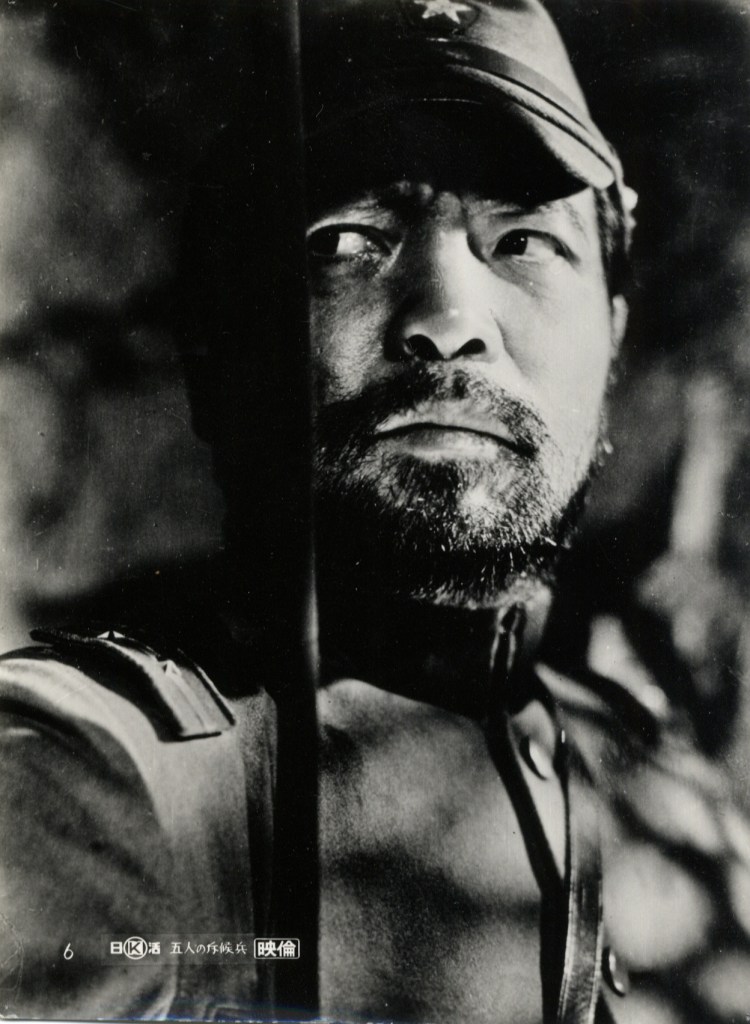
 War, in Japanese cinema, had been largely relegated to the samurai era until militarism took hold and the nation embarked on wide scale warfare mixed with European-style empire building in the mid-1930s. Tomotaka Tasaka’s Five Scouts (五人の斥候兵, Gonin no Sekkohei) is often thought to be the first true Japanese war film, shot on location in Manchuria and trying to put a patriotic spin on its not entirely inspiring central narrative. Like many directors of the era, Tasaka is effectively directing a propaganda film but he neatly sidesteps bold declarations of the glory of war for a less controversial praise of the nobility of the Japanese soldier who longs to die bravely for the Emperor and lives only to defend his friends.
The film opens with an exciting action sequence playing behind the titles featuring impressive scenes of battle with mortar shells exploding while soldiers run over trenches before entrenching themselves with a light machine gun. Eventually the day is won – after a fashion. Having lost 120 men, the 80 surviving of the 200 strong company settle-in to a fortified position awaiting further orders.
The excitement of the battlefield soon gives way to behind the lines boredom. Danger lurks around every corner, but there is work to be done. The men dig trenches, clean their weapons, draw water, cook and eat but they also try to live, chatting or enjoying the “spoils of war” which in this case amount to stolen watermelons and captured ducks. In quiet moments they dream of sukiyaki and of home, but are content in each other’s company and as cheerful as it’s possible to be given the seriousness of their circumstances.
When two enemy soldiers are detected on the perimeter, a squad of five scouts is sent out to investigate but find themselves lost in the confusing Chinese terrain and eventually come under heavy fire. Worryingly enough, only one of the soldiers makes it back in good time with the others remaining unaccounted for until they eventually arrive save one who no one can remember seeing since the beginning of the attack and whose helmet has been found in an abandoned trench.
Tasaka refuses to glorify the business of war. What the men experience is rain and mud and sorrow, not an exultation in male virility and the politics of strength. He does however fulfil his propaganda requirements in demonstrating the army’s dedication to the Emperor. The commanding officer’s final rousing speech reminds his troops that now is the time they are expected to “repay the benevolence of the Emperor” whilst also emphasising that the hopes and dreams of the Japanese people are invested in them and, even if their families at home are worried for their safety, they are also proud of their sons fighting proudly for their homeland so far away from home.
The men too display the appropriate level of patriotic fervour, breaking off to wave at a Japanese plane before dragging out a giant banner to show their support and each remaining committed to serving even when physically compromised. One soldier with a bullet lodged in his arm, violently rejects the idea of going to a field hospital even though there is a strong chance that his arm will need to be amputated if they do not remove the bullet in due time. The soldier pleads to be allowed to stay on the front line, claiming that he does not mind losing an arm if it means he gets to stay and help his comrades. His comrades, touched by his dedication, nevertheless urge him to get his arm seen to by subtly suggesting that his desire to remain on the frontline is a kind of vanity when his effectiveness is compromised. His arm, technically speaking, does belong to the army and the Emperor after all. Another soldier, not so lucky, exclaims he can see Japan as he lays dying, singing the first verse of the national anthem before finally giving up the ghost.
As the men march off towards the final battle following the rousing speech from their commander who warns that many will die, they do so melancholically rather than with eagerness to sacrifice themselves on an imperial altar. Tasaka stages the battle scenes with impressive realism, drawing inspiration from news reel footage to capture the immediacy and energy of the live battlefield, filming on location behind the lines in Manchuria for added effect. The behind the lines sequences are intentionally less dynamic and conventionally captured, allowing the tedium and the anxiety of a soldier’s life of waiting to take centre-stage. Tasaka’s film may seem naive and perhaps lacks the initial impact of the shock of seeing such visceral action scenes portrayed on screen for the first time, but it is also mildly subversive in its subtle rejection of the militarist lust for glory even whilst heaping praise on the ideal soldier’s love of Emperor, comradeship, and strong sense of duty and honour.
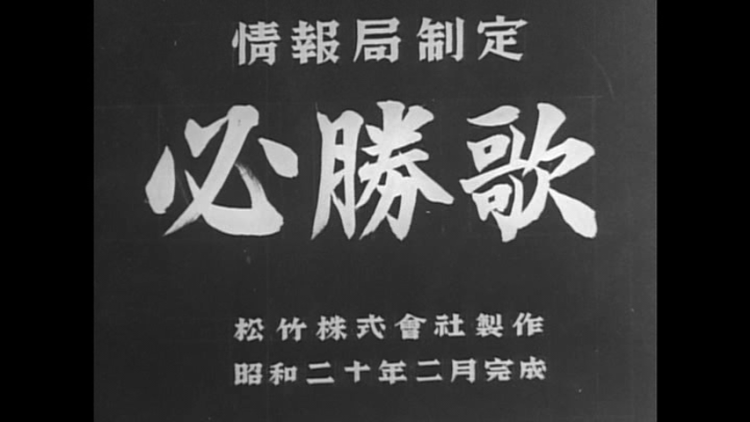 Completed in 1945, Victory Song (必勝歌, Hisshoka) is a strangely optimistic title for this full on propaganda effort intended to show how ordinary people were still working hard for the Emperor and refusing to read the writing on the wall. Like all propaganda films it is supposed to reinforce the views of the ruling regime, encourage conformity, and raise morale yet there are also tiny background hints of ongoing suffering which must be endured. Composed of 13 parts, Victory Song pictures the lives of ordinary people from all walks of life though all, of course, in some way connected with the military or the war effort more generally. Seven directors worked on the film – Masahiro Makino, Kenji Mizoguchi, Hiroshi Shimizu, Tomotaka Tasaka, Tatsuo Osone, Koichi Takagi, and Tetsuo Ichikawa, and it appears to have been a speedy production, made for little money though starring some of the studio’s biggest stars in smallish roles.
 Windows on Worlds