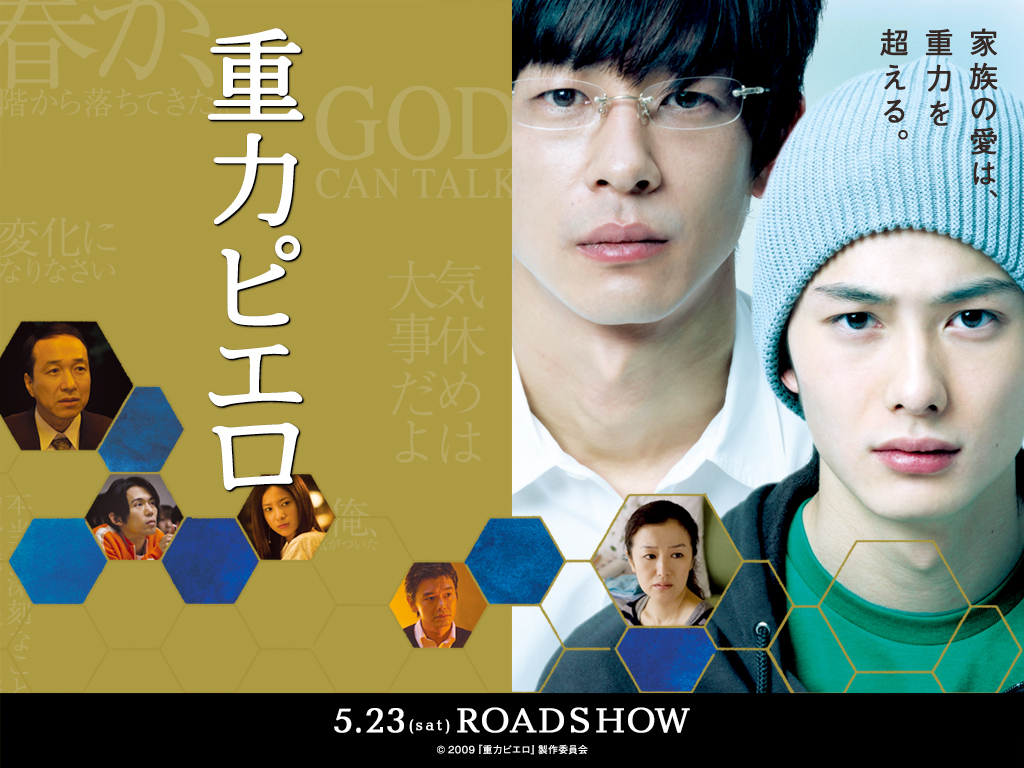
Gravity’s Clowns (重力ピエロ, AKA A Pierrot, Junichi Mori, 2009)

wp03_1024-768

Based on a novel by Kotaro Isaka (Fish Story; The Foreign Duck, the Native Duck and God in a Coin Locker), Gravity’s Clowns is the story of two very different brothers who discover a dark family secret following the death of their mother. Part mystery story part character drama, Gravity’s Clowns takes a look at the themes of nature vs nurture as well as the importance of familial love and acceptance.

Returning home for the first anniversary of his mother’s death, Izumi (Ryo Kase) and his younger brother Haru (Masaki Okada) spend some time with their father Tadashi (Fumiyo Kohinata) reminiscing about the past. Watching a local news broadcast, Haru realises the site of a recent arson attack is not far from where he’s been working. Noticing a pattern in the location of the attacks, Haru decides to investigate and ropes his brother in for the ride. However, the mystery Izumi finds himself embroiled in ends up being far different than the one he imagined.

It’s revealed fairly early on in the movie, but the fact of the matter is that Izumi and Haru may only be half brothers as their mother became pregnant with Haru shortly after being brutally assaulted in her own home by a serial rapist operating in the area. Having decided to have the baby and raise the child together whatever his true parentage, Haru’s parents did their best to give him a normal, loving upbringing alongside his older brother. Though there was some gossip in the town thanks to the incident’s notoriety, neither Haru nor Izumi were aware of their mother’s ordeal until after her death. After discovering the truth, both brothers react in different, though ultimately similar ways.

As a mystery, Gravity’s Clowns tries to pack in a fair few twists and turns though ultimately they are all quite obvious and frequent viewers of crime thrillers or psychological dramas will have guessed the entire plot in the first ten minutes. However, the mystery is definitely of secondary importance to the character drama that is being played out in front of it. The real key to the film is in the relationship between the two brothers, and to a larger extent the family as a whole. What’s important is that the brothers support and and love each other no matter what and as their father told them, their family is the strongest family there is. No matter what past traumas or biological facts may interfere, these guys will always come through for each other.

Having said that, the narrative does meander somewhat and in particular the “comedy stalker” subplot feels a little out of place and under developed. Despite playing a crucial plot role, and providing quite an amusing joke early on in the film and at its end, Yuriko Yoshitaka’s “Natsuko” (this is just a nickname and a fairly amusing pun as Haru’s name means “spring” and she always follows him around so they called her “Natsuko” which means “summer’s child” , she doesn’t even get a proper name) doesn’t have a tremendous amount to do. Likewise, the small but important role played by the boys’ father feels as if it bounces around a little in terms of weight as does that of their mother who is only seen in flashback. Ultimately Gravity’s Clowns over reaches itself as it tries to tackle some more weighty themes like nature vs nurture and the ethics of certain kinds of crimes which are only addressed in a very superficial way, and in fact concluded fairly ambiguously.

A flawed, if pleasant enough character drama, Gravity’s Clowns is generally entertaining but ends up feeling a little insubstantial. High quality and committed performances from the cast and especially from Ryo Kase and Masaki Okada as the two central brothers help to elevate the material but somehow it never quite takes off. Heart warming and actually quite funny at times, Gravity’s Clowns is a noble effort but one that ultimately fails to strike home.

Poetry


Last year’s winner of the Cannes award for screenwriting, Lee Chang-dong’s Poetry is the story of one women’s yearning to see the beauty of life and finding that often it’s only to be found in its blackest tragedies. Mija (Yun Jung-Hee), a sixty-five year old woman, is caring for her grandson in a tiny apartment of the edges of a city when simple aches and pains lead to the discovery of a serious health problem. Having seen a poster for a local adult education class in poetry writing, and recalling a teacher once predicted she’d one day become a poet she decides to enroll. In the midst of this she also discovers that her grandson has done something unthinkable, and that the reactions of others to these events ranges from the nonchalant to the wildly self interested. Bewildered by the conspiracy of these conflicting crises, Mija must reach an understanding of what must happen now and learn to see the beauty of life in all its ugliness so that she can finally write her own poem.

Although it has a gentle melancholy, Poetry is not quite as depressing as it sounds and is in the end deeply beautiful. Yun Jung-Hee’s performance is breathtaking, never straying too far into melodrama she keeps a film that might have become overwrought firmly rooted whilst allowing the audience to totally empathise with her character. It’s no wonder that this won the screen writing prize at Cannes last year as it’s incredibly well written and hugely literate.

Poetry is a beautiful film that everyone would benefit from seeing. It’s a real shame that this is the first of Lee Chang-Dong’s films to be released in the UK, hopefully it won’t be the last!

Pitfall

Pitfall, Teshigahara’s 1962 ‘documentary fantasy’ is a difficult film to describe. It begins with the story of a poor migrant worker and his son, skipping out on an ill paying prospect the worker travels to another mine but discovers he doesn’t  have the necessary papers. Despite this he is offered another job, however this turns out not to be the stroke of luck he hopes it might be. A strange man wearing a white suit and gloves begins to follow him and around and eventually spreads confusion throughout this strangely desolate landscape.

The film is deliberately vague and offers no answers to the problems it poses. Though its political intentions are quite clear through the use of actual documentary footage of mining accidents and malnourished children the more surreal aspects remain unexplained. Exactly who is the white suited man, and who (if anyone) has given him his instructions? In this ghost town that is both literal and figurative, where identities are confused and long for events always arrive too late is there something strange and unnatural going on, or is it just the surreality of everyday life? The figure of the boy is also problematic, why does he only react to the death of the man who resembles his father but isn’t? Though perhaps if he’s the type of boy to pull the skin of frogs and watch a rape impassively through a small hole in a wooden wall the answer to this may be self evident. As he runs off alone down the winding road at the end of the film, what or whom is he running from or to. Is it his childish passivity that’s saved him, for the moment at least, from from the adult’s internecine warfare or is it just blind dumb luck that might just be leading him deeper into hell.

The Skin I Live In – Summer Screen at Somerset House

Wednesday night saw the opening of the Film4 Summer Screen at Somerset House which launched with the UK premiere of Pedro Almodóvar’s latest film The Skin I Live In (La piel que habito). This marks the first reunion of Almodóvar and Banderas since 1990’s Tie Me Up, Tie Me Down!. It’s also the first time Almodóvar has stepped into the horror genre, so expectations were running fairly high.

They were not disappointed.  This is quite simply a brilliant film, dark, disturbing, but also displaying that trademark Almodóvar humour. Unfortunately it’s almost impossible to review as it’s best to know absolutely nothing at all about the plot before going in. It’s a real return to form for Almodóvar after the slightly disappointing Broken Embraces, this is a film with plenty to say that’s also wickedly entertaining. Highly recommended, do not miss this!