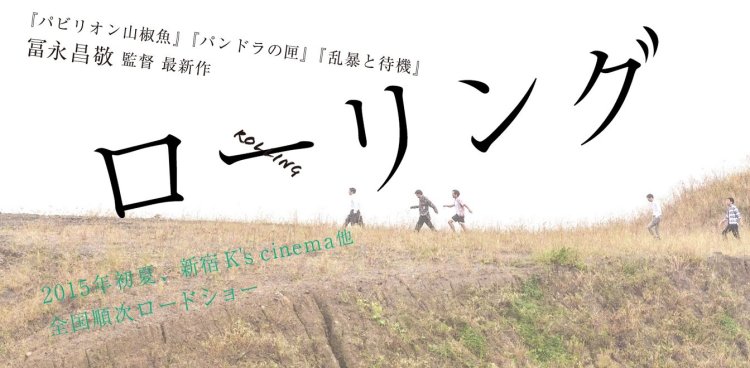
Rolling (ローリング, Masanori Tominaga, 2015)

384f90_4054bb8ba5554cc186f2bce4c6beb853“Weird teacher” is almost becoming a genre now. Even so, the teacher at the center of Masanori Tominaga’s Rolling may give them all a run for their money (well, for about five yards before having somekind of bizarre accident, anyway). Gondo is a feckless middle aged man who was fired from his teaching position ten years previously after having been caught secretly filming the girls’ changing rooms. Now he’s back in his old stalking ground after having pulled off an improbable white knight routine by rescuing the young and pretty Mihara from a bad boyfriend in Tokyo. However, his former students have not forgotten him or his pervy ways! It’s not long before the entire town of twenty somethings are on Gondo’s case hoping for a little vengeance for their teenage betrayal.

However, Gondo’s fortunes improve slightly when it’s discovered that some of his secret recordings feature some rather salacious goings on starring a former classmate whose TV career is just about to kick off. Smelling money in the air, Gondo is suddenly everyone’s best friend again. Gondo is…still Gondo though so as you may expect this state of affairs will not last. He’s even lost Mihara to a former student of his, one he even quite likes too…

Despite his failings and protestations to the contrary, what Gondo ultimately remains is a teacher. Yes he’s made some mistakes (understatement of the century), and he’s actually quite unpleasant in a lot of ways but somehow he still wants to protect this ragtag bag of not quite young people that he previously harmed. Coming to the realisation that his actions not only resulted in revulsion and violation of trust but also had a disruptive effect on the educational progress of his students simply resulting from his abrupt dismissal, Gondo does at least want to make amends (in his own way).

However, Gondo’s just the kind of guy things never work out for. “All my students are idiots” he proclaims at one point and he’s not altogether wrong. Attempting to hatch a blackmail plot with a very strange group of a idol managers-cum-gangsters and an ex-policeman, the gang get themselves into a whole world of trouble which is only exacerbated when the almost famous subject of the video comes forward and makes a very surprising request of her old flame and Gondo’s kindly love rival Kanichi.

Darkly comic, Rolling has the air of a film noir B movie with its ever present voice over and thriller trappings including secret video taping, a blackmail plot and trio of business-like gangsters. It is though, also firmly grounded in the now despite its often surreal humour. Also branded an “erotic comedy” Rolling is fairly high on sexual content adding to its generally sleazy feeling. It may well go down as a cult hit simply for the phrase “I’m going to make a milkshake out of your filthy boob juice” which gives you some indication as to the tone.

Far from perfect but oddly touching if sometimes baffling too, Rolling is another strange and surreal adventure from Tominaga. Its slightly vulgar tone may put off some but by and large it gets away with it through sheer cheekiness and absurd humour. Gondo is a dreadful person almost all of the time, selfish and needy yet he also seems to have this yearning for redemption which makes him seem not so bad really, as does the fact that most of his former students have not turned out all that well – even the “hero” Kanichi has his problems. For those that can accept its oddly surreal tone and decidedly old fashioned gender politics, Rolling is a rewarding and delightfully absurd film that does also manage to pack in a decent (if subtle) amount of social commentary.


Reviewed at Raindance 2015.

Review of Masanori Tominaga’s Rolling (ローリング) – first published by UK Anime Network.

Like Someone in Love (UK Anime Network Review)

Like_someone_in_love_quad_v5_HRFirst published on UK Anime Network in June 2013.


Like Someone In Love is only Iranian director Abbas Kiarostami’s second international venture after 2010’s Certified Copy but this time sees his familiar preoccupations with ambiguities and poetic imagery transported to modern day Tokyo. Although in this case all the characters are quite clearly drawn and presented somewhat unambiguously, the reasoning behind the decisions they make and the way they behave, however, remains oblique. The title implies someone is acting ‘like someone in love’ if not exactly ‘in love’ themselves but who is it, who or what are they (‘almost’?) in love with, and what exactly would that mean – these are all the gentle ambiguities that Kiarostami wishes us to think about in this perfectly excised cross section of modern life.

As the film opens we are placed statically looking onto a scene which appears to be some sort of bar, a woman’s voice can be heard speaking to someone – not us, this clearly isn’t a voice over, there is obviously someone else involved in this dialogue that we cannot hear. We search the screen for the owner of the voice and even though we can see that nobody else is speaking somehow the thought that the woman is off camera hasn’t quite occurred to us. Eventually we find a young woman has been talking on the phone, presumably to her boyfriend – ‘I’m not lying’ she says, though we know she is. The boyfriend suspects her and makes her go to the bathroom to count the number of tiles so he can come there later and compare to see if she’s telling the truth.

Shortly afterwards, an older man (Denden) starts talking to her and encourages her to break up with said jealous boyfriend ‘not just for business reasons’ but as fatherly advice. He wants her to visit ‘a very important man’, she doesn’t want to because she’s tired after cramming all night for an exam and anyway her grandmother is in town and she’d like to see her. The man makes it very clear he isn’t forcing her, but he leaves her no room to refuse and she goes anyway even though she doesn’t want to. He puts her in a taxi for an hour’s drive across the city – on the way she gets a message from her grandmother that she’ll be waiting outside the station until her train so Akiko (Rin Takanashi) asks the driver to pass the station twice just so she can catch a glimpse of her.

Fast asleep in the car she arrives at a rather nondescript little address behind a ramen shop where a retired sociology professor (now sometime translator), Watanabe (Tadashi Okuno), lives. As soon as they enter the phone rings and Akiko takes the opportunity to poke around – she finds some pictures of an older and a younger woman – a wife and daughter perhaps? Strangely they look a little like her, as does the woman trying to teach a parrot to speak in the famous print on one wall.  ‘I always thought the parrot was teaching the woman’ Akiko says and the professor laughs. Still tired she makes straight for the bedroom, undresses and gets into the bed. This wasn’t what the old man had in mind though – he’s cooked a full dinner and bought wine, soft music ‘Like Someone in Love’ is playing in the background. After trying to convince her to eat and failing the professor gives up and turns the light out to let her sleep.

The next morning he drives her to school only to witness an altercation with the jealous boyfriend, Noriaki (Ryo Kase) who’s been lurking in wait after not being able to get through on Akiko’s phone. It’s clear he’s angry, he grabs at her then sulks after she goes inside before trying to talk to the professor, mistakenly thinking he’s her grandfather. He of course keeps up the pretense simply by not (directly) correcting the mistake. It’s clear though that something is coming to head and the meeting of these three people is going to produce a fundamental change in one or all of their lives.

Like Someone in Love might be one of those films where the reaction to it says much more about the viewer than it does about the film. It’s so much more about what isn’t said, the things that one infers from brief snippets of possible backstory than it is about what is actually seen on the screen. We don’t know exactly why Akiko got into this line of work or why she does it or even how she really feels about it. It’s plain in the first scene that she doesn’t want to go, at least tonight, and that she’s refused to go before but when she arrives at Watabe’s house she’s anything but coy and seems every inch the seasoned pro ready to get down to business. She’s a cipher, the clearest thing you can say about her is that she’s defined by her own passivity. She says she won’t go and then bows to pressure and goes, she obviously wants to break up with her awful boyfriend but doesn’t, she wants to see her grandmother but obeys her pimp(?) instead. She seems to spend her entire life bowing to the whims of other people rather than making any sort of decision for herself.

The two men by contrast appear as virtual mirror images of each other. The elderly scholar Watanabe, contemplative and introspective and the violent, obsessively jealous high school dropout garage owning Noriaki. What is Watanabe’s interest in Akiko? Is this something he’s done often? it seems maybe not, perhaps this is a gift from his former student now Akiko’s ‘boss’. At any rate it seems he’s after some kind of romantic evening rather than a torrid few moments in bed with a girl young enough to be his granddaughter. He’s arranged things for her comfort – cooking her local dish, lighting candles, setting the dinner table etc just as someone in love might do. Perhaps he’s just lonely (though his phone is always ringing and he never answers it) and wants to relive fondly remembered memories of his wife. Noriaki by contrast seems much more territorial – he wants to own Akiko, he’s decided she’s useless on her own and needs his protection but he’s obviously terrified someone’s going to steal her out from under him. He’s also hugely over sensitive about the phone box card which looks like Akiko (because we know it is) maybe because he’s got a Madonna-whore conception of women to begin with.

The film ends as abruptly as it started which is inevitably going to be a problem for many viewers. This is not the end, but it is an end – perhaps the beginning of something new rather than the end of something old. An internal world is penetrated – like the intrusion of falling in love into an otherwise dull life, old securities prove inadequate and perhaps it’s harder to protect the things that are precious to you than you might hope (especially if you are old and your aggressor is not). In many ways we are like the old curtain twitcher whose sole entertainment is her window onto Watanabe’s doorstep – we can’t know what happened before our one and only window was opened, nor can we know what will happen once it’s closed but still we can’t help but wonder.


Available now in the UK from New Wave Films.