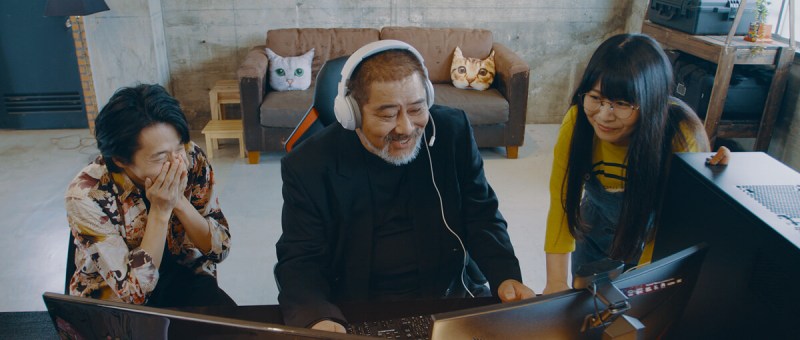
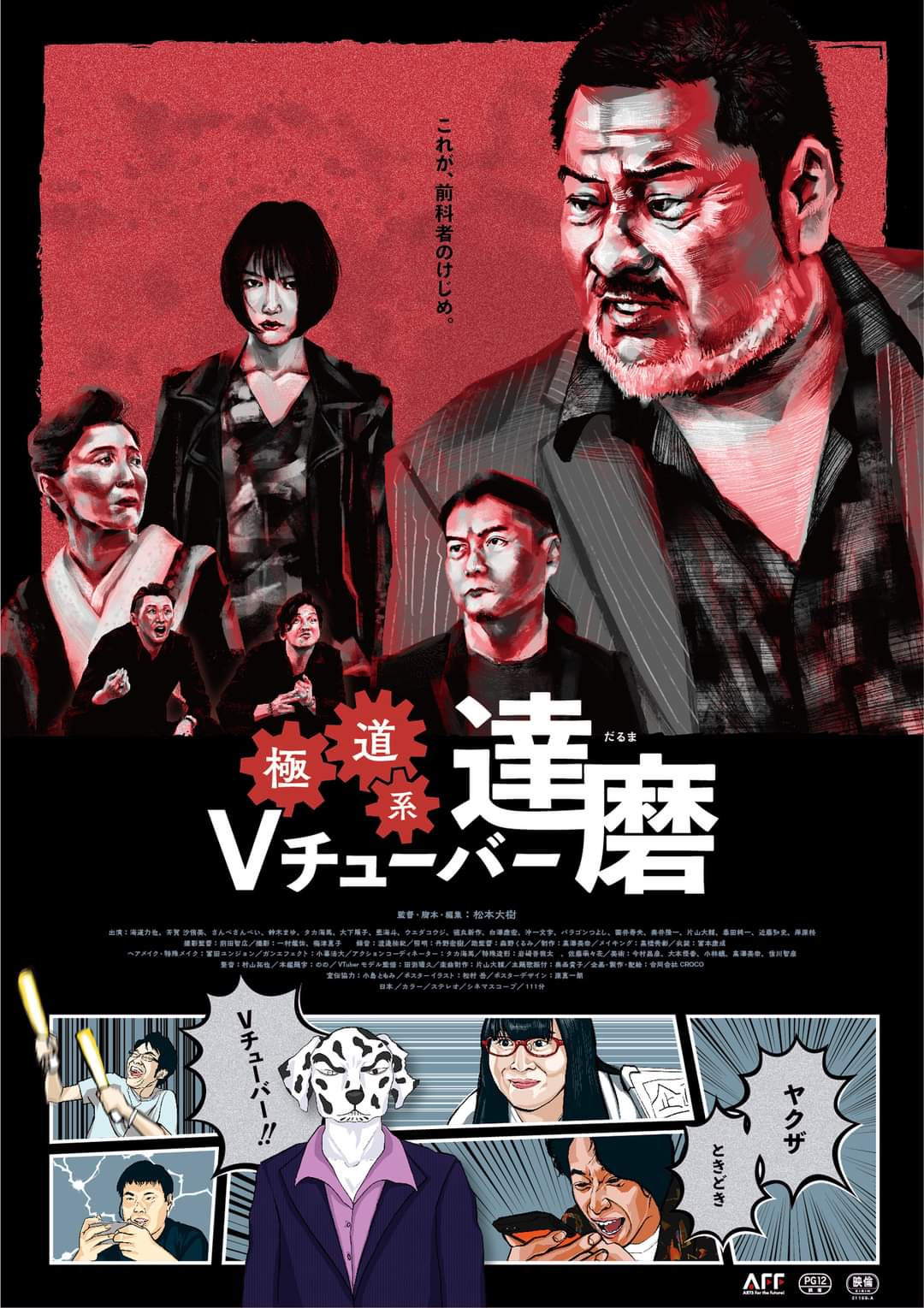
Times are hard for yakuza. The footsoldier who comes out of prison and discovers everything has changed (and from his point of view not for the better) while he’s been inside is a stock character of the post-war gangster movie but the yakuza has been in decline for decades so you’d think there might not be so much of a culture shock on emerging into the world of 2022 after 15 years away. The hero of Daiki Matsumoto’s Daruma (極道系Vチューバー達磨, Gokudokei VTuber Daruma) is however plunged straight into the deep end when his late boss’ wife (Junko Ohshita) who now heads the operation puts him in charge of a moribund film studio currently being used by the previous owner’s daughter, Shoko (Sayumi Haga), to livestream as a VTuber.
Daruma (Rikiya Kaido) hasn’t even heard of YouTube so it’s a quite a learning curve for him when the assistant he’s given, IT nerd Sampei (Sanpesanpei), explains that a VTuber is a live streamer who appears as an animated avatar, in this case a cute high school girl. When a miscommunication about dates causes Shoko to miss an important stream, Daruma has no choice but to step in himself but though some viewers respond positively to the obvious incongruity of a grizzled old man’s voice coming out of a cute high school girl’s animated mouth others are soon flooding the comments section with anti-yakuza sentiment. Nevertheless, he eventually finds an audience after leaving his mic on accidentally while sharing prison anecdotes with Shoko and Sampei.
There’s no question that Daruma is intended as an example of good old school yakuza while the young guys who surround the lady boss are definitely of the new generation who no longer care about things like honour or humanity. Avuncular in nature, he may be intimidating when needed but is generally cheerful and pleasant to be around which makes it difficult to accept that he was in prison for 15 years for stabbing a man to death on the orders of his gang. Even so, after after getting out, he’s quick to spring into action to help out some of his old buddies most of whom now run legitimate businesses which are suffering under the constraints of the pandemic-era economy. It’s clear the yakuza game has changed even while he’s been away, Daruma noticing one of their guys riding a delivery bike and asking if even yakuza need a side hustle these days (though as it turns out he may have been working his main job after all). As he arrives at HQ, the youngsters are busy trying to teach a veteran how to run an “ore ore” scam which he can’t seem to manage because he can’t drop his classic yakuza speech to sound like a teenager in trouble to con money out of vulnerable old people.
Daruma’s crisis comes when he realises that the gang has shifted into lines of work prohibited by their old moral code including the manufacture and trafficking of drugs which is not something Daruma can condone. While he leaves to start his own “gang” with Sampei and Shoko, factional tensions arise between the old school veterans and the amoral youngsters with Daruma’s protege Nishimura (Kaiba Taka) caught in the middle. Meanwhile, he’s left wondering if and when he’ll have to deal with reprisals for the killing of 15 years ago as he reflects on his new found happiness as an improbable VTuber surrounded by people who love and respect him as if he really were a member of their family.
A daruma is a round, red, figure with a rounded bottom so that it can not fall over and just like his namesake Daruma does try to keep going trying to rebuild his life in the new yakuza environment while taking care of friends and family and genuinely moved by the support of his new internet community. In the film’s gory finale he even takes on the form of a daruma, covered in red and rolling around but finally getting back up again to carry on with the help of his friends as if to symbolise his resilience and rebirth as a yakuza VTuber offering strange stories from his life of violence along with acting as a kind of agony uncle. Matsumoto frequently references classic cinema in giving Daruma the surname Mifune and having him belong to the Kurosawa clan, while Sampei claims he became a yakuza after seeing Battles without Honour and Humanity and the films of Takeshi Kitano even suggesting their lady boss reminds him of Shima Iwashita in a series of films about yakuza wives directed by Hideo Gosha in the 1980s. His gently humorous tale of yakuza redemption, found family, and unexpected new beginnings eventually comes full circle in its surprisingly bloody climax, in some ways quite literally, allowing Daruma to put the past to rest and then get back up again to rejoin his new family.
Daruma screened as part of the 2022 Yubari International Fantastic Film Festival.
Original trailer (English subtitles)

 Windows on Worlds