
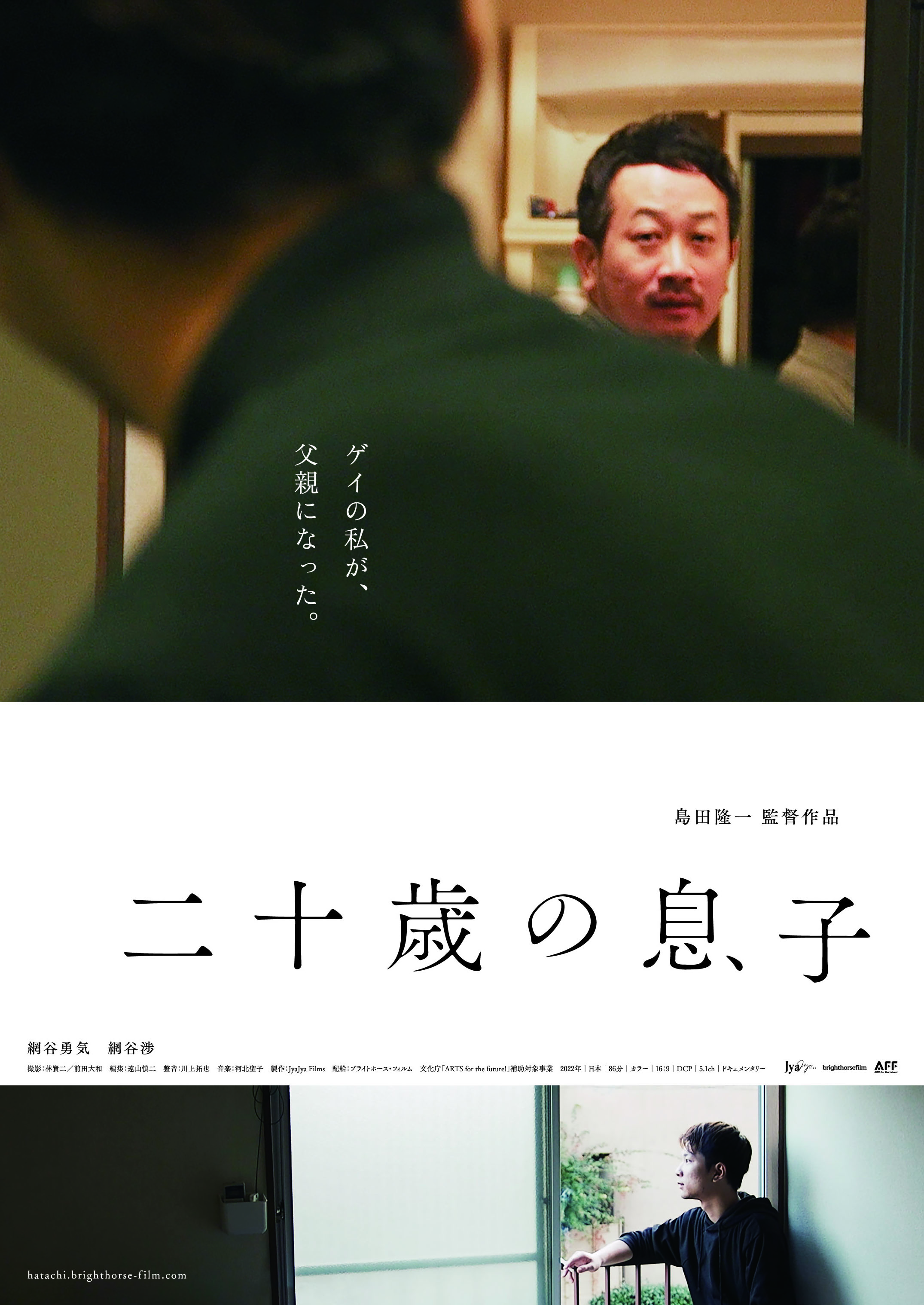
“It is simply how it should be” the father of the protagonist of Ryuichi Shimada’s documentary A Son (二十歳の息子, Hatachi no Musuko) remarks, explaining a concept of unconditional love to the 20-year-old man his own son has just adopted. The documentary never quite answers the question of exactly why Yuki made the decision to legally adopt Wataru aside from perhaps suggesting it’s a way of rejecting his own indifference to injustice, but otherwise attempts to draw comparison between the prejudice faced by members of the LGBTQ+ community and that towards children who grew up in the care system.
As Yuki later says, both LGBTQ+ people and foster children develop a habit of scanning people’s faces and watching out for any offhand remark they may make that would tip them off to the fact they are not a safe person to be open with. As he later relates, Wataru never knew his birth parents and suffered abuse in the care system. Looking for a place to belong, he ended up joining a biker gang, getting involved in petty crime, and being placed in juvenile detention which has left him with a criminal record. Even so, Yuki seems to have unshakeable faith in Wataru and is determined to provide him with a safe space and sense of permanency he hopes will allow him to feel a greater sense of confidence and security.
In an outreach session, Yuki reveals that he knew he was gay from around 14 years old struggled to accept his sexuality after seeing the word “abnormal” listed under the dictionary definition of homosexuality. He too became violent and considered taking his own life which might explain why he empathises so strongly with Wataru, only he chose to come out to his parents instead who didn’t care at all and continued supporting him just the same. As his father later says, that’s just the way it should be. Yuki didn’t suddenly stop being their son just because he told them he was gay and all they ever wanted was his happiness. As parents, they support their children in whatever they want to so so if Yuki believes in Wataru then they’ll believe in him too immediately welcoming him to the family as their grandson much to Wataru’s mystification. He admits he’s not sure he could be so universally accepting should he one day have children of his own.
Later in questioning his relationship with Wataru, Yuki explains that he’s also trying to teach him how to be a father in case he eventually becomes a parent but obviously struggles with the difficulties involved in becoming a father figure to man who is already a legal adult who may have ideas of his own and not always want to listen. Wataru can’t quite give a clear answer of why he accepted the adoption either aside from suggesting he wants to escape the social prejudice of being a man without a family, but perhaps also hints that family is what he’s been looking for or at least a place to belong that he can anchor himself to and go for help whenever he might need it. Yuki seems to think that by offering him a literal bed that it will help him turn his life around knowing that he will always have a safety net to fall back on.
One of Yuki’s relatives nevertheless suggests she thinks Wataru’s optimism is merely “naive” as he pins all his hopes on a showbiz career, doing modelling gigs while working part-time in a cafe. He claims he wants to make something of himself by buckling down and working hard, insisting that his painful past can become a strength in lending him a unique profile rather than remaining something that will always drag him down. Yuki’s desire to become a father figure might also be branded as naive by some while he struggles with trying to find the right approach to allow Wataru to find his own way safe and secure that he’ll always have a home to go to. The documentary ends before it’s really possible to know how well the arrangement has worked out for either party and sometimes struggles to unify its twin themes of the abuses of the care system and a more generalised take on social prejudice towards minorities such as the LGBTQ+ community and orphans but nevertheless presents a broadly inspirational tale of intergenerational solidarity and the power of unconditional parental love.
A Son screened as part of this year’s Nippon Connection.
Original trailer (English subtitles)
 Windows on Worlds