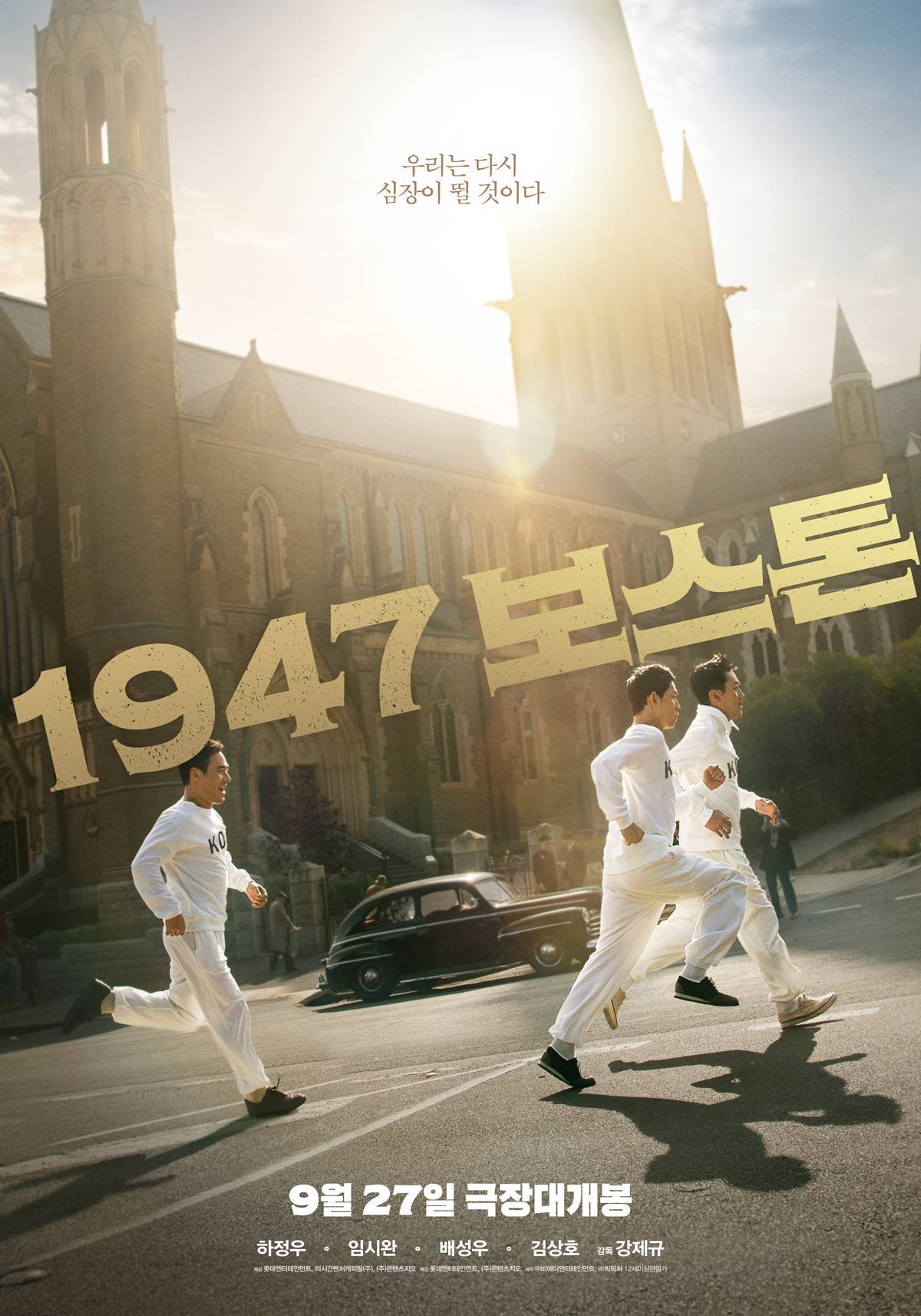
Road to Boston (1947 보스톤, Kang Je-kyu, 2023)

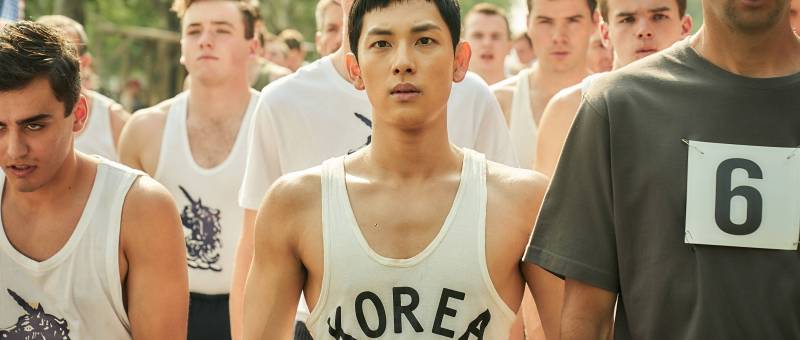
The right to participate in a foreign marathon becomes a victory for the Korean in people in Kang Je-kyu’s sporting period drama, The Road to Boston (1947 보스톤, 1947 Boston). Skewing towards the nationalistic, the film finds two brands of exceptionalism colliding while hinting at the sense of destabilisation in a nation which has not only been divided but rather than the promised liberation only re-colonised by an entirely different military regime who insist that Korea is not a real country merely a protectorate. 

In 1936, Sohn Kee-chung (Ha Jung-woo) won a gold medal for marathon running in the Berlin Olympics but when he stood on the podium they played the Japanese anthem and flew the Japanese flag. They announced his name pronounced the Japanese way, and when Kee-chung covered the Japanese emblem on his uniform he was banned from sports and put under police surveillance. Japan had annexed Korea in 1910, and the victories were accredited to the Japanese Empire. The country had been liberated from Japanese rule at the end of the war, but the nation was divided in two with the Americans occupying the South and the Soviets the North. 

Part of Kee-chung’s bitterness is that his family are trapped over the border and he’s been unable to bring them South, but it’s also that he was not able to run “freely” under the flag of his nation or in his true name. Yet now that they’ve been liberated, it’s as if only the names have changed. Loutish American GIs make trouble in the streets bullying the locals much as the Japanese had while the nation in general remains poor. There’s a chance that Korea could compete in the 1948 Olympics in London, but they’ve been told they don’t qualify because Korea doesn’t really exist and even in the way it does it’s only for a couple of years so they have no track record of international competition, all their previous successes are still attributed to Japan. To qualify, they decide to enter the Boston Marathon, but are told there are additional hurdles because Korea is a “refugee country” and the authorities are worried they might just stay there. 

When they do actually arrive in the US, they get a similar attitude told that winning the Boston Marathon might help them gain US citizenship as if that were some ultimate prize they must be secretly longing for when all they want is to be recognised as Koreans. Because the Military government signed off on their participation, the shirts prepared for them carry American flags, but Kee-chung does not want his protege Yun-bok (Im Si-wan) to suffer the same fate as him and compete under a flag that is not his own as he outlines in a powerful speech to the person in charge of the marathon while cheered on by outraged Asian Americans who also suffer racism and discrimination in the so-called land of the free.

At the press conference, reporters ask offensive and embarrassing questions such as whether Korea has universities, newspapers, or even electricity. The US guarantor Nam-hyeon (Kim Sang-ho) also states that even when he says he’s Korean, people ask him if he’s from China or Japan while Yun-bok receives racial slurs from a runner representing America. America is also presented as the land of immoral capitalism in which the only thing that matters is money in direct contrast to Kee-chung’s claims that runners aren’t in it for the cash. He originally rejects Yun-bok for his “arrogance” and lack of interest in anything that isn’t about money but later changes his mind on realising his crushing poverty and desire to help his ailing mother. 

On the other hand, the runners are constantly reminded how different the US (and elsewhere) is from Korea, asked if they know how to sleep on a Western-style bed or use a shower while reminded that everything in the mini bar you’ll be charged for. Yun-bok comically washes his face in the toilet seeing only a basin of water little knowing what taps are or how to use them. On his first taste of Coca Cola, a symbol of American capitalism, he is captivated and wonders if they should just accept the American flag for the right to run and a quiet life while Kee-chung will not be put through that humiliation again. The right to participate in the marathon under the Korean flag becomes a victory for the Korean people as a whole who had chipped in to crowdfund it in the face of resistance from the US military government. A big wig who made his money in dubious ways might have a point when he asks if it’s right to spend so much on a marathon when people are starving in the streets, but then what Kee-chung is trying to reclaim is national pride which to some at least is worth the price. In any case, the historical victory becomes a crowning moment of Korean independence, no longer a refugee state but (symbolically at least) a sovereign nation and finally free to run just as far as it can go.


Road to Boston screened as part of this year’s London East Asia Film Festival.

International trailer (English subtitles)

Juror 8 (배심원들, Hong Seung-wan, 2019)

Juror 8 poster 1What is the role of the law in a free and democratic society? In an effort to democratise justice, Korea held its first jury trial in 2008 giving “the people” a voice in the courts. As might be expected the judiciary had its doubts. Where judges and lawyers are best placed to assess the evidence and draw their conclusions, might not ordinary citizens be swayed by emotion or argument? Then again, compassion might be a force sorely lacking in a legal process some might feel to have become too efficient in its keenness to see justice is done speedily, losing all important scrutiny and allowing corruption and complacency to sneak their way in.

Juror 8 (배심원들, Baesimwondeul), a courtroom comedy drama, subtly puts the nation on trial as it asks what the point of the law is if it’s wielded like a blunt object. The case in hand concerns a middle-aged man, Kang Du-sik (Seo Hyun-woo), accused of hitting his elderly mother (Lee Yong-yi) on the head with a hammer and then throwing her off the balcony to disguise the crime. Though the defendant made a confession to police shortly after the incident, he did so vaguely from a hospital bed after being knocked out and now claims he can’t remember the events in question. This presents a problem for the judiciary who had chosen this case for the first jury trial precisely because it seemed so open and shut, all the jury was supposed to do was consider sentencing. Now they’re being asked to consider guilt or innocence and asking lots of awkward questions in what was supposed to be a token effort on behalf of law enforcement to demonstrate that it is listening.

Everything might have gone to plan if it hadn’t been for problematic “Juror 8” Nam-woo (Park Hyung-sik ) who, despite giving some worryingly conservative answers in his interview, instantly sympathises with the suspect and worries that there are too many unanswered questions in the evidence presented. His conviction only strengthens when he wanders off trying to get to the patent office to file sample of a self-defence device he was trying to launch as a business and accidentally meets Kang who seems despondent and frightened, worried he really might be guilty but fundamentally unable to remember.

More cynical minds might ask if Kang’s memory lapse is merely convenient and he hopes to exploit the jury trial to win acquittal through sympathy. Having noticed that Kang has no fingers, Nam-woo insists on a test to see if he is able to swing a hammer only for others to point out that there is no real way to know if he is not physically able to do it or chooses not to to aid his case. Meanwhile, Kang sits sullenly like a defeated ball of pent-up rage, eventually exploding when the jury is handed a letter he claims he was forced to write expressing frustration with his mother’s refusal to sign a legal separation form so that he would be eligible to receive welfare payments.

As his lawyer later puts it, the real villain here is poverty. Kang was raised by a single-mother, something still frowned upon, who had to leave him alone to go out to work. She locked the door from the outside to keep him safe, but that also meant he was unable to escape a house fire and was badly burned at only five years old sustaining prominent facial scarring and the loss of the fingers on both hands which means he is unable to work and cannot easily write. According to the testimony, Kang and his mother argued constantly over money, especially since her job washing dishes at a restaurant came to an end. As her son and dependent, he was unable to claim benefits and wanted, the prosecution claims, to legally sever ties. When his mother refused, they allege that he lost his temper, killed her, and tried to make it look like an accident.

Nam-woo is unconvinced as is another juror whose 30 years as an embalmer tell him that the head wound was unlikely to have been caused by a hammer. Juror 6 is dismissed for speaking out in court, his exuberance held up as an example of teething problems in the jury system, but his words strike a chord with some of the other jurors who wonder if the smug expression on the forensic scientist is there to mask the fact that he didn’t really bother to investigate because there had already been a confession and all he needed to do was “confirm” the police’s findings. Time and again, the jurors accidentally uncover the failings of justice in a system geared towards efficiency. Kang was pushed to confess by police keen to meet their targets, the confession then became basis for deprioritising his case. Or as some of the legal minds put it, they got “sloppy” because there was no sense in devoting time and energy to a matter already closed.

The same thing happens in the jury room. The jurors are ordinary people. They have lives waiting for them. Nam-woo wants to file his paperwork for the business loan, another juror has a child to get back to, one is a salaryman with an angry boss on the phone. Everyone has a vested interest in getting this over with as quickly as possible so they can all go home, but they also take their responsibilities seriously – much more seriously than they were intended to. Korea is a conservative society in which it is natural to follow the guidance of the authorities and the collective will, and so it seems natural to everyone that you simply rubber-stamp whatever the judge says. Nam-woo is a bit different, he notices details and he asks awkward questions. “Just go with the flow” the other jurors urge him, “when in doubt follow their lead”, but he wants to do what feels right. The exasperated businessman orders him to fall in with the boss, in this case the judge, but crumbles when another juror asks for his own opinion. He doesn’t have one, because he’s corporate drone and he’s been conditioned to do whatever the boss says without really thinking about it.

In any case, the jury system itself is a bit of a sham. The jury’s opinion is not legally binding, the judge only has to take it under advisement and can overrule. Sympathetic judge Kim (Moon So-ri), defended in her appointment as “strong and resolute like a man”, is fighting her own battles in a male-dominated arena, hoping for a long overdue promotion following the successful handling of this high profile case she only got through lottery. She begins to notice things she might not have when it was just a formality of sentencing a man who had confessed, but she is under pressure to maintain control and authority while demonstrating the magnanimity of the state. The jurors’ deliberations expose their pettiness and snobbery, some taking against Kang just because he lives in the poor part of town, but also their keenness to ensure the law is fair and exists to protect and not to oppress. Genial and humorous, Juror 8 addresses a serious subject with a lightness of touch and a subtlety that gently exposes the shortcomings of its society while placing its faith in “the people” to make a compassionate choice in the face of a fierce pressure to conform.


Juror 8 screens in Chicago on Sept. 12 as part of Asian Pop-Up Cinema season 9 where director Hong Seung-wan will be in attendance for an introduction and Q&A moderated by Korean cinema expert Darcy Paquet.

Original trailer (English subtitles)