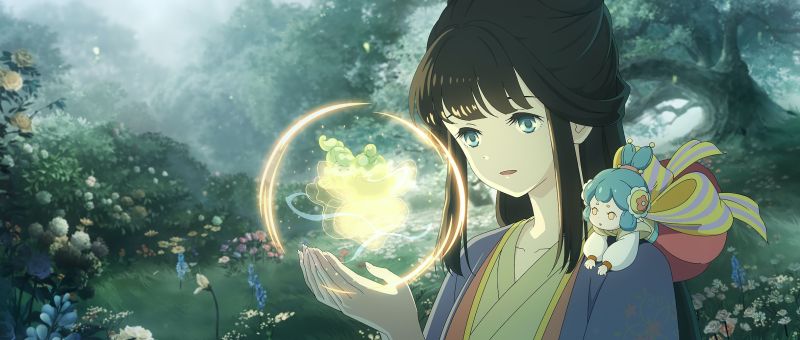

Should you be bound by the past or try to forge your own destiny? It might be an odd question seeing as the central thesis of Shen Jie’s gorgeously detailed animation The Umbrella Fairy (伞少女, sǎn shàonǚ) is that every object has a soul which has developed over its lifetime and often bound to whoever originally owned it. Though what these fairies, perhaps subversively, learn is that they have will of their and should not be bound by the desires of their former masters but are free to decide their destinies for themselves.
In typical folktale fashion, a block of black jade is split in two and used to create an umbrella, which implies protection, and sword which is itself somewhat cursed wreaking death and destruction where it is found. In our world, it seems that peace has prevailed but the princess has had to abdicate her kingdom meaning that she no longer feels fit to carry her most treasured possession, The Imperial Umbrella, and places it in a repository for relics along with the Sword. There a heartbroken Qingdai tries to get used to her new life among the similarly discarded fairies while fulfilling her former mistress’ orders that she should try to look after her sister Wanggui, spirit of the Black Sword. But Wanggui is hurt and vengeful. She resents the death of her former owner and vows revenge, threatening to plunge the nation back into chaos.
Of course, the point of the sword and the umbrella is balance and the idea is they should work in work in harmony with neither in the ascendent. The vision of the outside world we get when Qingdai ventures off in search of the escaped Wanggui is of a wounded nation still trying to repair itself in much the same way as craftsmen Mo Yang attempts to repair the objects in the archive not so much restoring them to their former glory as adapting them for a new life. Yet we can see that objects are also a way for the living to mediate their sense of loss while embracing something that is permanent but not perhaps unchanging. Thus Qingdai and Mo Yang find themselves repairing a damaged flute the sound of which only brought pain to the Governor for it belonged to a musician who, again a little subversively, seems like he may have been more than a friend and gave his life in service of the Governor at the end of the war. Once repaired the flute has a different yet familiar sound and is passed on to a new owner to make with it what they will while accepting its legacy.
In many ways it’s about taking the past with you, but also learning to let it go. The fairies think that they’re powerless. They can’t touch any solid objects and humans, even the ones they care so much about, cannot see them. But they do in fact have power and there are things they can do to shift the world, Qingdai’s unusual strength not withstanding. Under the guidance of Mo Yang, who becomes not quite a love interest but a kindred spirit, she begins to realise that she does have agency and is free to make her own decisions rathe than remain slavishly devoted to the desires of her former mistress. Wanggui perhaps learns something similar, rediscovering and redefining her purpose to determine to fight for something rather than flailing around in hurt and anger sowing the seeds of chaos wherever she goes.
The again, the mystery villain is a cursed mirror who has centuries of pain in ironically being forever unseen for when people look into it they only wish to see themselves. Yet as Wanggui later says, there is something powerful in Qingdai’s surrounding herself with love while protecting all with her umbrella even if some in the outside world would be content to strip it for parts. Beautifully animated, the character design and aesthetic leans closer to Japanese anime than many recent Chinese animations which otherwise rooted themselves in cultural traditions such as ink painting and established mythology but otherwise spins a tale of learning to find oneself again in the wake of loss as a free spirit free from petty tyrannies and wider oppressions forever on your own journey fixing things as you go.
The Umbrella Fairy screened as part of this year’s Fantasia International Film Festival.
Original trailer (no subtitles)
 Windows on Worlds