A Bullet Hole Underground (地下街の弾痕, Kazuo Mori, 1949)

Produced by Daiei Kyoto under the guidance of the Osaka Police, Bullet Hole Underground (地下街の弾痕, Chikagai no Dankon) is keen on selling a vision of order in a new Japan in which the police force employs all the latest technology to solve crimes calmly and methodically. We see them approach the crime scene forensically and conduct a series of scientific tests with microscopes and gadgets such as lie detector machines and code breaking equipment as they proceed towards the truth while earnest policeman Minagawa (Hiroshi Nihonyanagi) battles the ghosts of his past on realising that the dead man’s wife is his own lost love.

In any case, the film opens with a noirish scene at Umeda Station, Osaka, which then turns strangely comic. A man stumbles toward the exit and we assume that he is probably drunk but another man soon comes up behind him and pushes a pistol into his back. The second man pulls the trigger, then again to make sure, before calmly walking up the steps and leaving the station. A little while later, another drunk man arrives and has a little banter with the body before covering it with a signboard which is one reason it isn’t spotted until the shoeshine boys turn up in the morning. 

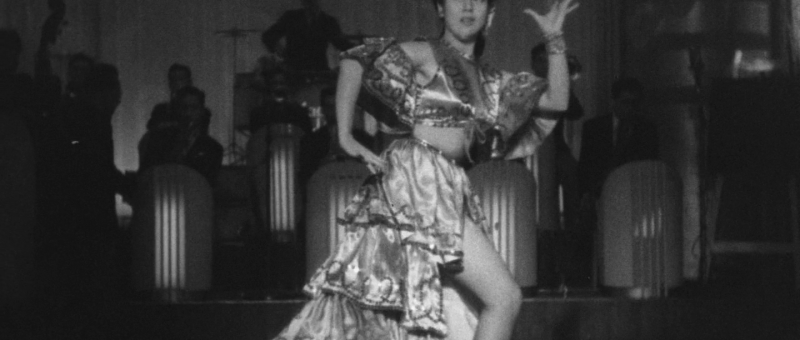
This sudden influx of children at rush hour is another symbol of the destabilisation of the post-war society in which the war orphans try to support themselves amid the still difficult economic environment. The lack of economic opportunities is also posited as a reason that the deceased, later identified as Kaneko, may have turned to crime by getting involved with a criminal gang smuggling drugs and money to destabilise the society even further. Yet the rot may have set in a little earlier than that. Before the war, Minagawa had wanted to marry Michiko (Machiko Kyo), the sister of his friend Sekiguchi (Toshiaki Konoe), but she later threw him over to marry the wealthy son of a family running a pharmacy. She admits she married him for the money, but after the war he lost everything. Unable to find work, Kaneko became a wastrel while Michiko gained employment at a cabaret bar as a dancer. He told her that he’d found a job at a company, but this turned out to be a lie and chief investigator Fujimoto (Takashi Shimura) assumes he must have been working for the gang. 

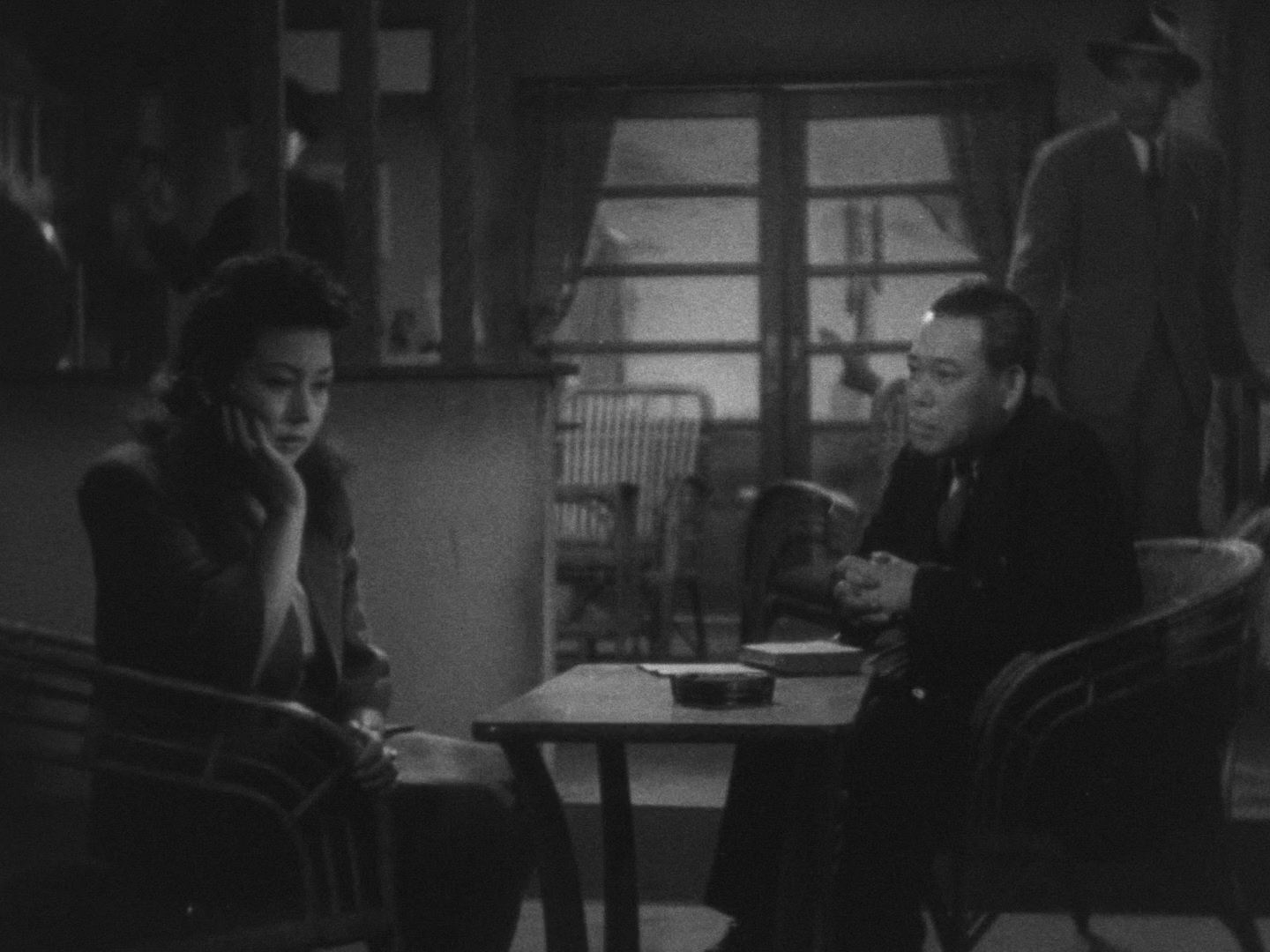
Still, to begin with it seems like it may have been a case of mistaken identity. Kaneko’s clothes turned out to belong to other people, a fact easily explained by Michiko that they were second hand, but also suggesting that someone may have set him up to take their fall. The gang needed the skills he learned in the navy but maybe they didn’t need him anymore. The root of the evil is located, ironically enough, in a jewellery store presenting a front of affluence and elegance but in reality founded on crime and misery when so many are still struggling to rebuild their lives. Michiko too seems to have turned cynical. She snarls and pushes Minagawa away, but privately cries and appears to regret her youthful decision to reject love for material comfort.

Perhaps because of its genesis as a film designed to promote the local police force, it has a much more upbeat conclusion and particularly for Michiko who is, unusually, allowed to redeem herself and gain a second chance to make a better decision by reuniting with Minagawa who does not and never has held her past against her. The pair of them look out over the fracturing city and remark at how it just carries on as if nothing had happened which feels like advice intended for the post-war society that it should do the same and try to leave the past behind to start a new life in this new era. Meanwhile, huge numbers of policemen swarm the harbour to crack down on the smuggling gang sending the not altogether comforting message that this city is well protected against all kinds of crime and the police force is a well-trained, modern institution that has the latest technology at its disposal along with astute and compassionate officers. There may be sleazy clubs, duplicitous men and heartless gangsters, black markets and smuggled dangers, but there are, the closing scenes with their wide-open vistas in which scorched trees stand behind the burgeoning city imply, better days to come.


The Song Lantern (歌行燈, Mikio Naruse, 1943)

Mikio Naruse famously denounced his wartime films, dissatisfied with himself largely for personal rather than political reasons though among those which survive it is possible to detect a degree of subversion even in his most “national policy” pieces. 1943’s The Song Lantern (歌行燈, Uta-andon) opens with a title card reminding the audience to “support the honour of family and people” and is in part a filial morality tale in which the hero is disowned by his father for his thoughtless haughtiness, though also one which largely manages to skirt its way around the censorship regulations through its historical setting and emphasis on traditional noh theatre. 

As the film opens, a troupe of noh players is moving on to its next destination when they are recognised by a man on the train who liked their performance but also claims to have seen better and if they want to account themselves true artists they need to pay a visit to Master Sozan (Masao Murata) who lives in the area they are heading to. Onchi Genzaburo (Ichijiro Oya), the troupe’s leader, takes this with good grace but his son and heir Kitahachi (Shotaro Hanayagi) is extremely offended. Genzaburo had just been talking with his brother about how good Kitahachi’s performance had been and how glad they are that he will be succeeding them, but were careful not to be overheard because they already think Kitahachi is a little full of himself. Still resentful, Kitahachi does indeed decide to pay Sozan a visit without telling his father or revealing his identity having heard from the maid at the inn that Sozan is a blind masseur who also runs a restaurant but she dislikes him because he has three mistresses, something which leaves Kitahachi mildly scandalised. 

Kitahachi gets him to sing his signature song but remains unimpressed, eventually slapping his thigh to beat out what is, in his view, the proper rhythm leaving the old man breathless and unable to continue singing. Sozan concludes that his guest must also be a great noh master and begs to hear him sing, but Kitahachi cruelly refuses and leaves in huff, rudely rebuffing Sozan’s daughter Osode (Isuzu Yamada) on the way out in the mistaken belief that she is one of the mistresses. The next morning, however, he is accosted by his father who wants to know if he saw Sozan the night before. He admits that he did but goes no further until he is informed that his stunt left the old man feeling so embarrassed that he took his own life. A group of reporters is outside wanting a statement. Encouraged by an audience who reveal that actually everyone hated Sozan and they’re glad he’s dead so Kitahachi need not fear offending them, he tells all but is disowned by his father who forbids him from singing noh ever again. 

So begins Kitahachi’s wandering. The troupe suffers without him, but Genzaburo is unwilling to forgive his son viewing it as bad luck to share a stage with someone who shortened another’s life. As his uncle points out, Kitahachi was raised to be a noh performer and if he can’t perform he has no other way of living. What he resorts to is becoming a street singer, strumming a shamisen and singing popular material. His new occupation provokes another humbling when he’s given a dressing down by a man whose career he has just ruined by shifting into his territory. After hearing him play, Jirozo (Eijiro Yanagi) relents, recognising Kitahachi’s technique as superior and therefore unable to resent him for undercutting his business. Jirozo too is in a similar position, “disowned” by his sister after losing his job as a cook and attempting to earn enough money to go back to his hometown to live right once again. 

Kitahachi is incapable of going back because he is still haunted, almost literally, by the figure of Sozan whose ghost he sees during sake-fuelled nightmares. He’s thinking of paying a visit to the old man’s grave to apologise, but gets another idea when Jirozo advises him to try helping Sozan’s daughter whom he, quite coincidentally, met while doing odd jobs and subsequently rescued from being pelted with eggs after being sold off by her wicked stepmother. Learning that Osode was a daughter not a mistress, Kitahachi feels even more guilty, but realises there is something he can do after Jirozo tells him that she is now working at his sister’s geisha house but is entirely incapable of mastering the shamisen. For some reason, however, he doesn’t teach her how to play an instrument, but gives her a crash course in traditional noh dance in only seven days which is not actually all that useful for an aspiring geisha but might at least help her with her determination never to become someone’s mistress. 

Kitahachi undergoes several humblings and then finally manages to atone only through becoming a teacher, passing on his art to an amateur. It’s Osode’s skill in learning the dance which eventually paves the way for his forgiveness and a possible return to his previous life while Genzaburo also decides to “adopt” her as a daughter, ensuring she won’t ever have to be a mistress (and will most likely become Kitahachi’s wife). Forgiven by everyone but himself, Kitahachi comes “home”, completing the cycle in regaining his position within the family and the theatre troupe in healing the rifts caused not only by his filial failures but his disrespect of the art in his selfish misuse of it to humiliate a man more like himself than he cared to admit.