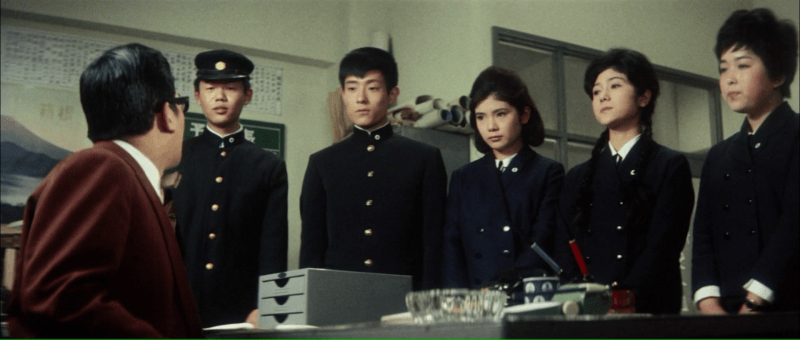
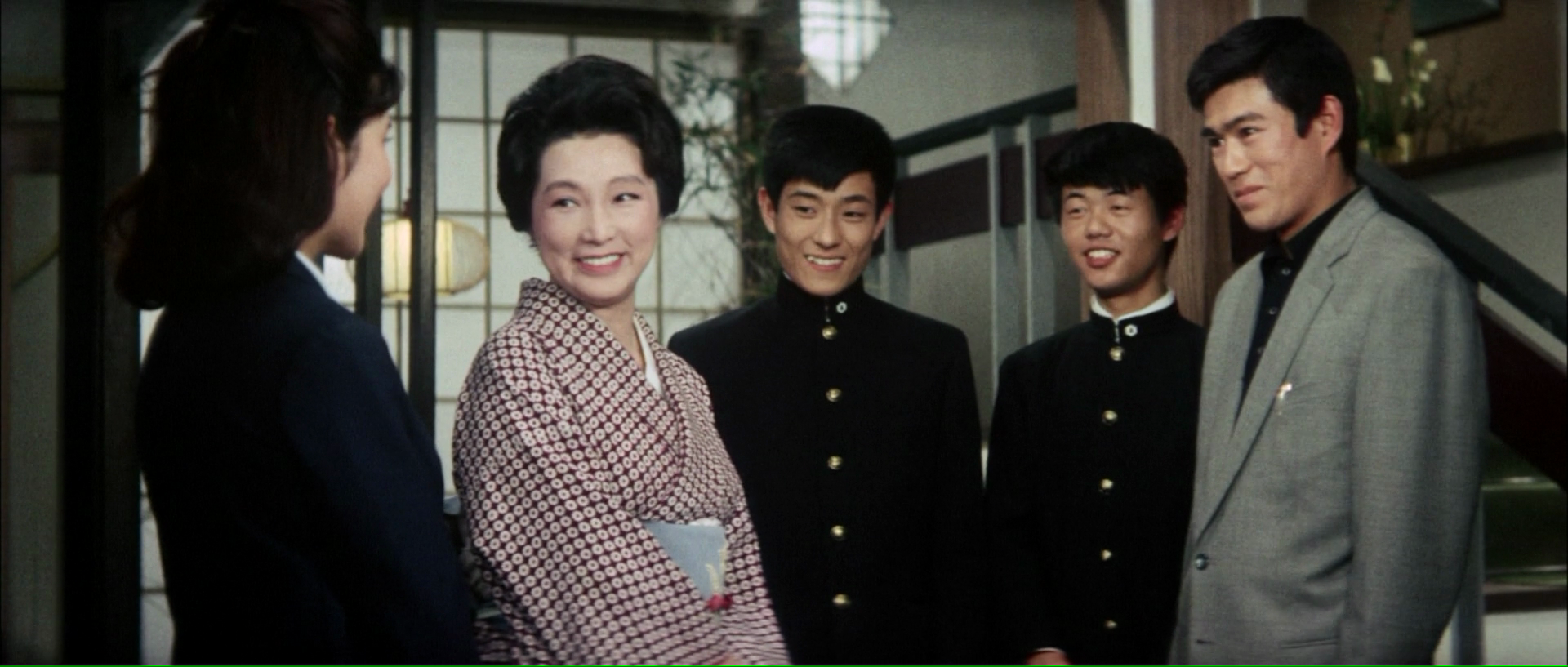
Here Because of You (君たちがいて僕がいた, Ryuichi Takamori, 1964)

“The strength of our modern generation is that we never let anything get us down, and we’ll go after what we want without a moment’s hesitation.” The heroine of Ryuichi Takamori’s cheerful teen comedy Here Because of You (君たちがいて僕がいた, Kimitachi ga Ite Boku ga Ita) encapsulates a sense of post-war youth while trying to convince a sullen friend to join her in standing up to injustice when their teacher is smeared in the press, but he for his own reasons remains indignant and defeatist certain that nothing they do will make any difference. 

Essentially a vehicle for Toei teen stars Chiyoko Honma and Kazuo Funaki, the film is like many similarly themed youth movies of the time a progressive appeal to a new generation intent on rebelling against the social conservatism of their parents along with the injustice and inequality that accompanied it. The villain of the piece is the father of one of the students, Akira (Masaaki Sakai), who has become wealthy and is intent on throwing his weight around. Tanaka (Ken Sudo) wants his son to go to the best university in Japan and does not take kindly to the advice of his teacher, Mr. Yamabuki (Sonny Chiba), that Akira is just not up to it academically and putting so much pressure on him to achieve something which is almost certainly beyond him will only make the boy suffer. 

Akira is one of those kids with his head in the clouds who isn’t particularly good at anything. School is in general a torture for him and he himself knows that Tokyo University is not a possibility though he’s prepared to do his best if only his father would lower his expectations and let him apply to a college that is more within his capabilities. Both Tanaka and Mr. Yamabuki are however partially at fault when Akira is injured during a PE lesson that he was supposed to be excused from, Tanaka having told him not to participate in sports but to spend the lesson doing extra study instead. Mr. Yamabuki had thought that Akira had just not been applying himself, but a combination of a lack of physical agility due to being kept off PE and being encouraged to push himself further than he should lead to him falling from some climbing bars and spraining his ankle.

As might be expected, Tanaka is not happy and even asks for a second opinion on his son’s minor leg injury while deepening his grudge against Yamabuki. Tanaka also has a minor grudge against fellow student Hiroshi (Kazuo Funaki) who threw a bucket of frogs at him (to which he is allergic) for reasons Hiroshi doesn’t fully understand after hearing him kick off about Akira’s college prospects. It’s Hiroshi who fulfils the role of rebellious youth in the angry impulsivity that he often cannot explain. He’s been saying he doesn’t want to go to college but it’s because his older sister was forced to leave education during in middle school because of the family’s poverty and has become a geisha in order to pay for his tuition. Yamabuki and Hiroshi’s sister Yukiko (Junko Miyazono) develop a fondness for each other while discussing Hiroshi’s education, and it’s this suggestion of there being some impropriety in a schoolteacher dating a geisha that Tanaka takes to papers in effort to get Yamabuki fired. 

Meanwhile, Hiroshi’s cheerful classmate Chieko (Chiyoko Honma) has also developed a crush of Yamabuki. Claiming that she intends to marry him, she goes so far as to turn up at his house and insist on doing his laundry but he quite reasonably tells her that as an adult man his wife would have to be an adult woman. Surprisingly, she gets over it quite quickly and realises that Hiroshi is a much better match for her instead, but nevertheless springs into action when Yamabuki is unfairly smeared in the press. Even she is originally scandalised by the suggestion that her long widowed mother (Mieko Takamine) may have feelings for a local doctor (Shuji Sano), but soon comes round to the idea that there’s nothing wrong with it if she has just as there’s no problem with a teacher dating a geisha. She claims she would be more offended if each of them were forced to deny their feelings for each other because of social propriety and is intensely annoyed by the network of local corruption she uncovers in investigating the origins of the false news report which also suggests Yamabuki may have been inappropriately carrying on with a student, presumably herself. 

As chairman of the parent teacher association, Tanaka tries to railroad the headmaster into firing Yamabuki by holding a kangaroo court at which Yamabuki is prevented from speaking in his own defence all while his character is assassinated. But the kids, who previously witnessed a drunken Tanaka harassing Yukiko, aren’t having any of it and abandon their lessons to surround the meeting vowing that they’ll go on hunger strike if they aren’t listened to which won’t look very good in the national papers. What they bring about is a kind of democratic revolution in which the corrupt authority of Tanaka is deposed in favour of the more evenhanded chairpersonship of Chieko’s grandmother who turns out to be the oldest person in the room at 63. The children will not be ordered around or told what to think and will stand up to injustice where they find it, which is very bad news for those like Tanaka who are used to getting their way because of their privilege and social status. It’s all very wholesome and innocent, perfectly in keeping with the zeitgeist while remaining cheerful and upbeat even with Hiroshi’s continued brooding until Chieko finally manages to win him over. A charming teen musical adventure with a handful of songs performed by its idol stars, the film’s infectious energy is difficult to beat.

A Fugitive from the Past (飢餓海峡, Tomu Uchida, 1965)

Fugitive from the past“There’s no way back” intones a spirit medium in the throws of a possession early on Tomu’s Uchida’s three-hour police procedural, A Fugitive from the Past (飢餓海峡, Kiga kaikyo, AKA Straits of Hunger). Her message will be repeated frequently throughout the journeys of our three protagonists – a guilty man seeking escape from himself, the hooker with a heart of gold who thinks of him as a “kind person”, and the obsessive policeman whose quest to find him threatens to destroy his own family and chance of ongoing happiness. Beginning in 1947, Uchida’s adaptation of the novel by Tsutomu Minakami is a cutting indictment of post-war inequalities but is also keen to remind us that the war was merely a symptom and intensifier of problems which existed long before and are likely to survive long after.

In 1947, three men in military uniforms attempt to escape from Hokkaido after committing a crime while the island is subject to a typhoon warning. Using a ferry disaster in which hundreds of people have been killed as cover, the men steal a boat and try their luck on the stormy seas. Only one of them makes it. Once all the bodies from the ferry are accounted for, two more are discovered and later identified as recent parolees from Abashiri prison. The dead convicts are then linked to a local robbery, murder, and arson case in which a large amount of money was stolen leaving the third man, described by witnesses as bearded, tall and imposing, the prime suspect in the deaths of the two prisoners as well as the original robbery.

Calling himself “Inugai” (Rentaro Mikuni), the “third man” takes off with all the money and ends up forging an unexpectedly genuine connection with a cheerful prostitute just on the way back from her mother’s funeral. Yae (Sachiko Hidari), claiming to have seen through to Inugai’s kindly soul, seems to reawaken something within him but the next morning he moves on leaving only a vast a mount of money and some nail clippings behind him. Meanwhile, Yumisaka (Junzaburo Ban), the dogged policeman who discovered the convicts’ bodies, tracks him at every turn.

The world of 1947 is a hellish one in which perpetual hunger is the norm and crushing impossibility all but a given. Inugai is starving. With rationing in place the black market is flourishing while the unscrupulous profiteer off the back of other people’s desperation. This is a land of defeat where to survive at all is both shame and victory, yet somehow you have to go on living. Inugai, like many a hero of golden age Japanese cinema, is engaged in an internal war to erase the dark past, drawing a veil over what it took to move from post-war privation to economic prosperity. He does however take his unseeing further than most in adopting a new, more respectable persona, remaking himself as self-made man and wealthy philanthropist keen to “pay back” the society which has been so supportive of his “success”.

Thus when Yae, whose attempt to remake herself in the capital has fared far less well, spots Inugai’s photo in the papers and decides she just must track him down, it’s not that Inugai fears blackmail or even really that she poses a threat but that she shatters the integrity of his carefully crafted post-war persona and reminds him who he really is. A climactic storm mirroring that which illuminated their first meeting also graces their last as “Inugai” finally resurfaces, committing an impulsive act of animal violence which tugs at the strings of his new life and sets the whole thing unravelling.

Yae used Inugai’s money to pay off her debts and get out of the brothel, but even if the Tokyo of 1947 was warmer than that of Hokkaido it was no more kind and her attempt to lead an “honest” life was quickly derailed by underworld crime and unforgiving law enforcement. Realising there’s nowhere left for her to go she resigns herself to life in the red light district but does at least manage to find a “nicer” establishment run by a kindly older couple where the girls are like one big family. Her meeting with Inugai has come to take on mythical proportions in her mind – she even worships a tiny relic of him in the form of one of his nail clippings. Hoping to repay his kindness she commits herself to hard work and barely spends any of her money on herself, dreaming of the day she will one day see him again.

Yumisaka, however, mirrors Yae’s devotion in his all encompassing “hate” for Inugai as his obsession consumes him, costs him his job, and threatens to ruin his family. Alerted by two more bodies washing up out of the sea, a young detective (Ken Takakura) puts two and two together and gives Yumisaka a chance to vindicate his long held convictions but what they discover through the shifting sands of invented truths and corrupted memories is a legacy of suffering and resentment which runs far further back than the recent wartime past. As Yumisaka later puts it, those who’ve never been poor or miserable cannot understand the desperation felt by those who have in the presence of money. Inugai, poor and trapped by circumstance, longed to escape the drudgery of Hokkaido life but couldn’t live with what he did to do it and so conjured up another history for himself.

Still, the truth will out and there really is “no way back”, not for Inugai or for his nation which seems determined to continue unseeing the darkness of the previous 30 years as it begins to find a degree of comfort once again. Incorporating strong spiritual overtones from the sutras Yumisaka is so strangely adept at reciting to the gloomy intoning of the spirit medium, Uchida imbues all with a heavy sense of dread as a man attempts to outrun his fate by running from himself only to be tripped up by sudden moment of panic born of a lack of faith in his only true believer. A chronicle of the post-war era, A Fugitive From the Past makes poverty its ultimate villain but attempts to paper over spiritual corruption with the pretty trappings of conventional success will only end in ruin as the unresolved past eats away at the foundations of a brave new world.


Original trailer (no subtitles)

https://www.youtube.com/watch?v=jHgeiDgxb6E