
Phoenix (Christian Petzold, 2014)

phoenixIn late June of 1945, one woman is escorting another through a US checkpoint in Berlin. The young American soldier is somewhat cocky and feigns an officious sort of suspicion that causes him to demand the bandaged woman reveal her face – just to be sure. The obvious agony she feels just beginning to unwind the various layers which hide her identity is enough to convince him that he’s made a cruel mistake and he lets the pair pass.

Finally Lene (Nina Kunzendorf) delivers the wounded Nelly (Nina Hoss) to a specialist hospital. A survivor of Auschwitz, Nelly was at some point shot in the head and left for dead. Though she miraculously survived, her face is ruined – missing nose, shattered cheekbones etc. She will need extensive reconstructive surgery. “Who would you like to be?” her doctor asks her, but Nelly only wants to be herself – exactly as she was. The doctor advises against it – it can never be exactly the same and the uncanniness is something not everyone can get over plus it can be an advantage to be given the opportunity to start all over again with a new face, a new identity newly shed of all the scars of a traumatic past. Nelly, however, is insistent.

Returning to the city with Lene, she learns that her entire family and many of their mutual friends have been killed though others turned out to have been nazi sympathisers. Nelly repeatedly asks about her husband, Johnny (Ronald Zehrfeld), but Lene is reluctant to talk about him. Roaming the streets alone at night she tracks him down to a seedy cabaret club, Pheonix, in the American sector where he now clears tables rather than playing the piano. When she calls him by his former name he barely reacts and fails to recognise her. Later he tracks Nelly down and makes her a very odd proposition – pretend to be his deceased wife to claim the inheritance then split the proceeds.

“I no longer exist” exclaims Nelly at one point. Robbed of everything apart from her breath, Nelly has been erased and replaced by something with no clear history. She wants to go back, to reclaim the life she led before exactly how it was but her home no longer exists – her city is in rubble, most of her friends are dead and the husband that she’s made the anchor of her survival may have been the very one who betrayed her.

Meeting Johnny (now “Johannes”) again and moving into his back room she studies for the role of a lifetime – once again inhabiting her former self, stepping into the shoes of a soulless ghost. Nelly pleads with him silently to remember – recall her from the abyss, recognise her living form as the woman who was taken away in October 1944. Johnny, however, cannot bear to think about the past. He’s convinced himself his wife is dead and is only interested in claiming her money to make a new life in the post-war world. No matter how the coincidences mount up as “Esther” not only looks like “Nelly” but also has her handwriting, voice and movement, Johnny refuses to recognise her or acknowledge their shared tragedy.

Operating like an inverted Vertigo, Phoenix is an extremely rich character drama which not only deals with one woman rebuilding herself from the ashes but also with her nation’s sense of guilt as it resolutely refuses to look the victims of its crime in the eye. Nelly needs to remember and have her existence acknowledged in order to reclaim her identity, but Johnny cannot bear to look, his guilt is so great that it would shatter his sense of self irrevocably. They dance around each other caught between past and future but both trapped, their passage blocked by the symbolic checkpoints that exist all around them in their now ruined city.

Just as the doctor told her, it can never be exactly the same. At the end of the film, Nelly’s transformation is complete, her selfhood restored though somehow different from before. Lene wanted to run away to Palestine, create a new world for her people free from fear and persecution, Johnny wanted to forget and Nelly needed to remember (and be remembered) in order to become herself again but in the end nobody gets quite what they wanted. Only Nelly by meeting her former self head on is able to evolve, finally pulling away from us, out of focus.

Petzold serves us ghosts of several varieties including those of our cinematic pasts by imbuing his melodrama with the gloomy allure of the film noir mixed with the uncomfortable psychology of the Hitchcockian thriller and the uncanny horror of Eyes Without a Face. Probing questions of identity which extend from the individual to the national it asks us to consider a post-war world of guilt and recrimination in which everyone is engaged in rebuilding an idea of selfhood which can take account of wounds suffered or inflicted. Difficult and complex yet beautiful too, Phoenix is anchored by the extremely accomplished performance of its star Nina Hoss and proves a hauntingly melancholy exploration of all it means to be alive.


Phoenix is currently available in the UK on blu-ray, DVD and VOD courtesy of SODA Pictures and is available in the US as part of the Criterion Collection.
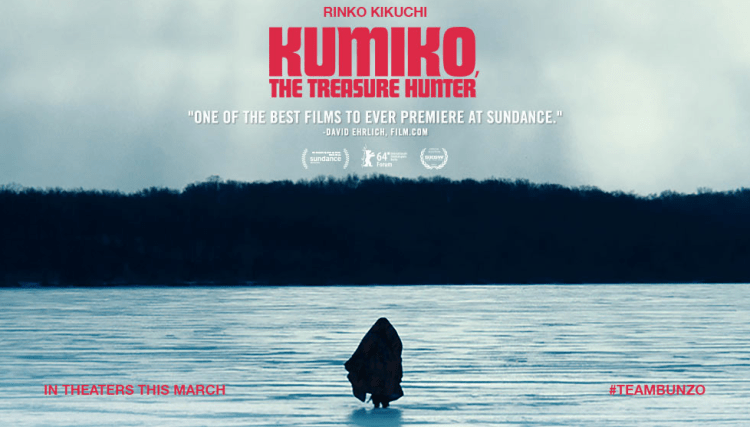
Kumiko the Treasure Hunter (UK Anime Network Review)

Screen-Shot-2014-12-29-at-10.49.38I wrote this getting on for a year ago when the film was screened at Sundance London (which is apparently dead now) but seeing as it’s getting a proper release by Soda Pictures from 20th February here it is again! Hit the jump to read my review over at UK Anime Network.


Famously, the Coen Brothers’ 1996 film Fargo begins with a black screen and a caption telling us that everything we’re about to see is based on real events that took place in Minnesota in 1987. What is perhaps less well known is that this is an out and out lie – a manifestation of the Coens’ strange sense of humour that’s just really there as a sort of in joke to mess with the viewer’s head. When a Japanese woman was found wandering around a wintery Minnesota, underdressed for the cold weather and pointing to a hand drawn map of tree next to a road, it wasn’t long before someone connected her actions to the famous movie. When she was found dead in the woods some days later, an urban myth was born about a crazy Japanese lady who froze to death looking for Steve Buscemi’s buried suitcase. As it so often does, the truth turned out to be much sadder and more ordinary than the legend suggests and that this poor woman became the butt of a global joke seems cruel and unfair. Now the original myth has spawned another story of its own – of Kumiko, who sees herself like a Spanish Conquistador who alone has learned of vast riches hidden deep in the new world.

Kumiko is a 29 year old office lady from Tokyo who lives alone in a tiny apartment aside from her pet rabbit Bunzo. As she goes about her everyday life she looks worn out, like someone who’s been carrying a heavy burden for a long time. She barley speaks to anyone and resents her boss so much she almost spits in his tea before thinking better of it. As it turns out one of the reasons she looks so tired is that she spends every night sat in front of her ancient TV scouring an old VHS of the movie Fargo (which she found in a cave buried under a pile of rocks at the end of a previous treasure hunt) for clues as to where Steve Buscemi buried his money. When her boss calls her in one day to ask why it is she always looks so miserable and points out, in a nice avuncular way, that 29 is really far too old for an office lady things have come to a crisis point. Using his company card she’s booked herself on a flight to Minneapolis armed only with her hand embroidered map and unshaken faith that her treasure exists and is hers alone to find.

Of course, her delusion is ridiculous for a multitude of reasons: to begin with, it’s obviously a constructed film – not a documentary so even if the events were real how would you know they recreated the exact burial spot in their movie version. Secondly, why would they have done that and then left the actual money where it was. Thirdly, the money was supposedly buried in 1987 – surely someone else would have come up with a similar idea in the intervening fifteen years and found the money already, wouldn’t they? Fourthly, he only buried it in the snow. Snow melts. How could anyone believe this? The film opens with Kumiko following another of her intricately made hand embroidered maps that results in her finding the fateful tape as if she alone had been handed some kind of divine revelation. Accordingly she pours all of her energy into divining its holy secrets. Hers is a literal leap of faith – she simply believes in it even though we ‘know’ it’s absurd.

What would make someone cling on to this kind of bizarre idea as their only true hope of salvation? We’re never given very much backstory, but it seems that somewhere along the way Kumiko’s life diverged from the one she wanted to live and ever since then she’s been treading water. Her mother rings her periodically to try and convince her to move back home ‘until she gets married’ whilst asking all sorts of questions about her love life and career that Kumiko would rather not answer. At work she’s the odd one out in the office as generally young women either decide to leave and get married or pursue a more demanding career long before Kumiko’s almost ancient 29. She keeps herself apart from her colleagues and barely speaks to them which is fine because they think of her as a creepy old lady anyway. She does eventually agree to meet an old school friend for coffee but bolts once left alone in a cafe with her friend’s five year old daughter. It’s almost as if Kumiko herself feels she’s failed and is too ashamed to interact with other people. Faced with her friend’s successful home life with a healthy young daughter compared to Kumiko’s own dreary, lonely existence it’s not difficult to see how loneliness and frustrated desperation could lead to a state of psychosis. If she can just prove it, show everyone she has a destiny – something she alone is supposed to do then they’d all see.

Once she reaches America things begin to take a darker turn. Dressed only in her usual blue dress and little red hoodie, she’s like Red Riding Hood stepping off alone into the woods. She hasn’t brought winter clothes, cash or even made a proper plan of how to actually get to Fargo. She meets some nice people along the way – a lonely old lady who means well has almost kidnapped the poor girl and keeps trying to thrust James Clavell’s Shogun at her, and a truly decent policeman who can see there’s something wrong but is prevented from helping by the impenetrable language barrier. Every time it seems as if there might be a better way out of this the door is cruelly slammed in Kumiko’s face and left entirely alone in a strange land there really is nothing else for her to do than trudge on in hope of finding her treasure. Kumiko could so easily have been a series of crazy lady tics and quirks but thanks to Kikuchi’s extremely nuanced performance the infinite sadness of her story is completely laid bare. All this happened, more or less – mostly less in this case, but there is truth in this story. The world is full of lonely people whose minds have turned in on themselves through having nowhere left to run. Kumiko the Treasure Hunter is an existential tragedy that nevertheless is shot through with enough charm and whimsy to make its often unpalatable message easy to digest. A strange fairytale for adults, Kumiko’s story is heartbreakingly bleak but it’s also immensely beautiful.