
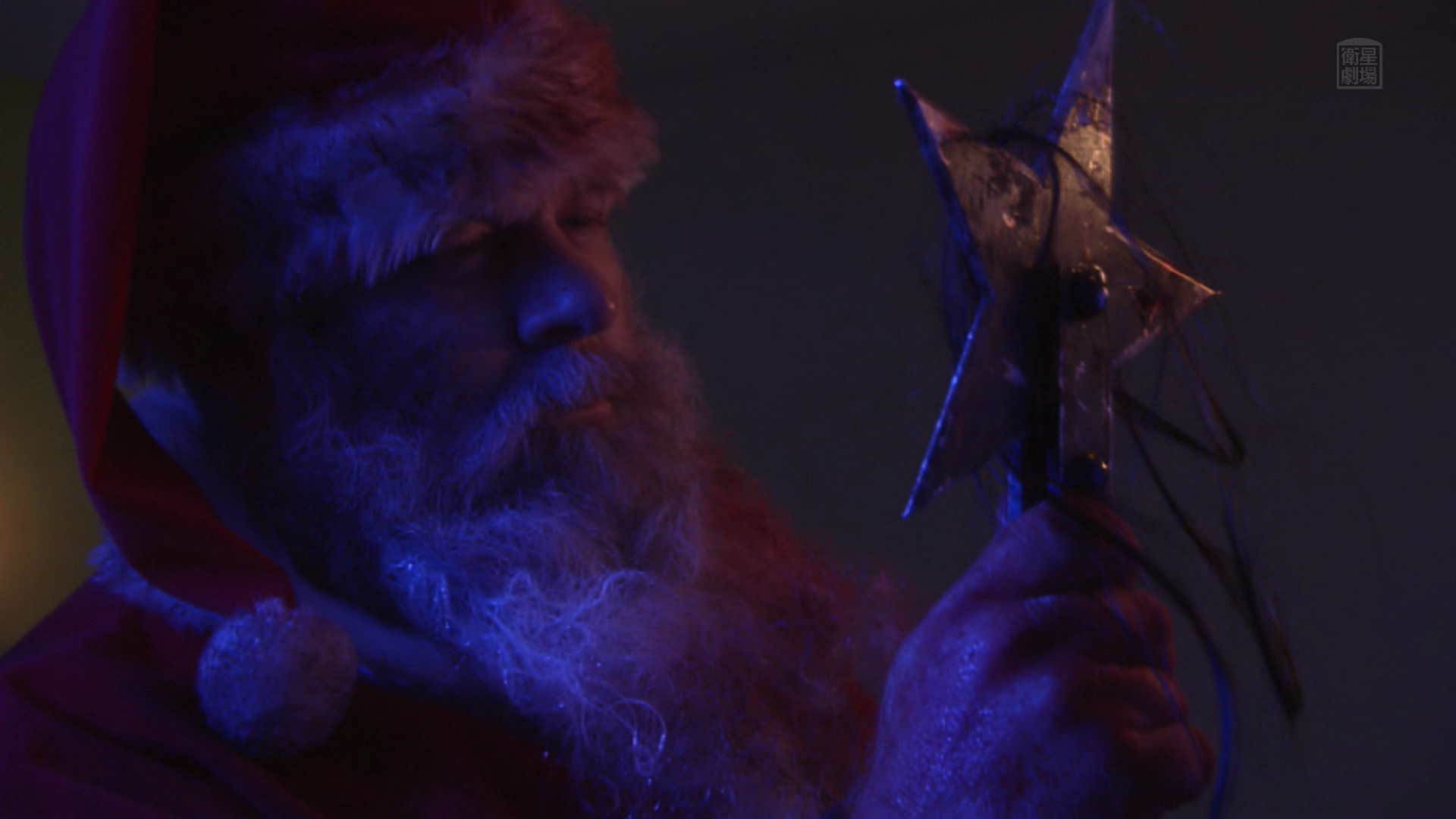
Generally speaking, Santa is quite a benevolent figure. Even the children who are naughty usually just get left out or else awarded a single piece of coal or some other worthy yet dull gift that lets them know how badly they’ve behaved. Not so in the world of Kazuo Umezu, however. You don’t want to get on the wrong side of this Santa, though in other ways it’s less “Santa” that is haunting these youngsters than the disappointed spectres of the children they once were.
As a small child, Yuko (Seiko Iwaido) had a funny dream, though her parents reassured her that Santa would come to save her. However, if she did anything wrong, he’d come after her too. Years later, when Yuko is a student, she writes a Christmas card to a boy she likes and goes to spend the night at a hotel with her friends. But the hotel looks weirdly like her doll’s house from when she was little, and other things from her childhood bedroom seem to turn up here and there. In case that wasn’t weird enough, the reception desk is manned by a creepy Santa, while the atmosphere inside couldn’t really be called “jolly” so much as mildly depressing.
Meanwhile, it almost seems as if Yuko is being bullied by her female friends and has been set up in some way as a figure of fun, though it turns out that Ryosuke (Takamasa Suga) seems to like her too. Only, that’s largely because she seems “pure” in comparison to her friends, which is a bit of a red flag. In any case, though this is a slasher film, it doesn’t really seem to be the case that Yuko is a “bad” girl for getting it on with Ryosuke but for some other transgression. As one of the kids says, they’re all apparently guilty of “desecrating” Christmas, which is what has annoyed Santa to the extent that he’s decided to take back all the gifts he previously gave them. What he actually takes, however, is most of their limbs and internal organs which he feeds to his reindeer.
How they “desecrated” this non-religious event isn’t really clear, but on the other hand it’s true that they don’t make much of an attempt to save each other apart from Ryosuke who is protective of Yuko suggesting that he did actually have feelings for her and wasn’t just looking for a bit of festive nookie. Yuko, by contrast, is revealed to be not quite all she seems and there are other reasons someone, like Santa, might judge her to have been “bad” not least in her rather callous disregard for her parents who were looking forward to seeing her over Christmas. The contrast with her younger self couldn’t be starker, while in her dream, the young Yuko believes herself to have beaten “the evil one” by pulling out her rotten brain which is either a fantastically grim paradox and metaphor about the various ways we disappoint our younger selves, or a kind of course correction in which the young Yuko “became Santa” and removed all the “rotten” parts of her future self’s mind so she won’t end up turning out like that.
The fact that everyone sees a different version of Santa also lends weight to the idea that they’re coming out of their own psyches and Santa is really a manifestation of their own fears and anxieties, though Yuko’s is a fairly conventional take based on what her mother told her Santa looked like. Her mother also attributes young Yuko’s rather gory dream to watching too many splatter films and reflects that perhaps she shouldn’t be letting her do that. “Who on earth would make such films?” she ironically asks in a meta moment while Yuko cheerfully plays “hide and seek” with her new stuffed toys of Santa and Rudolph smiling sweetly while her mother adds that she’s sure Yuko will grow up to be as gentle a woman as she is a child. Meatball Machine director Yudai Yamaguchi, however, indulges in some surreal Christmas gore as Santa goes on his killing spree utilising festive items to hack off the kids’ limbs before stuffing them in his sack and retreating to his decidedly unjolly grotto with his psychotic reindeer. The Christmas spirit is it seems alive and well.
 Windows on Worlds