In Our Prime (이상한 나라의 수학자, Park Dong-hun, 2022)

Education is supposed to be the great leveller, a true meritocracy in which a combination of hard work and innate ability can enable anyone to follow their chosen path as far as it will go. The reality is however far less idealistic. Park Dong-hun’s In Our Prime (이상한 나라의 수학자, Isanghan Naraeui Suhakja) is the latest in a series of Korean films taking aim at corruption within the educational system along with a persistent classism that ensures only the “right” kind of people are allowed to prosper. 

Han Ji-woo (Kim Dong-hwi) knows he’s not the “right” kind of person and feels out of place at the elite boarding school where he is bullied by teachers and students alike for being a scholarship boy amid the children of mostly wealthy families. Though he won the place though being a top student at his previous school, now his grades are merely average and he’s bottom of the class in maths. Ji-woo’s odious, elitist teacher coldly tells him that his case is hopeless and he’ll never get into a top league university with these kinds of grades at this kind of school. He pressures Ji-woo into applying to transfer out which he is reluctant to do because he knows how much his attending such a prestigious school means to his widowed single mother. In any case as we later discover, the teacher merely has it in for him openly complaining with other members of staff about having to fuss with paperwork for kids on scholarships and bursaries who in his opinion don’t really belong in a place like this which is clearly geared towards perpetuating the privilege of the children of the elite at the expense of those like Ji-woo. 

When Ji-woo is caught smuggling in pork and soju at the behest of his exploitative roommates he refuses to dob them in, making the unlikely claim that he intended to consume all four meals himself. The teacher first praises his idealistic stance but then calls him an idiot because the other boys wouldn’t do the same for him nor are they coming forward themselves to take responsibility. Perfectly happy to let the scholarship boy take the blame one of them even crassly slips Ji-woo some money afterwards, genuinely confused when Ji-woo tries to turn it down claiming such things are unnecessary between friends. Nevertheless, the incident brings him the attention of the “commie officer”, a North Korean defector (Choi Min-sik) working as the nightwatchman who easily solves Ji-woo’s impossible maths problems. The officer eventually agrees to teach him maths but only on the premise that he doesn’t care about tests or grades but solely on the art of learning. 

What he teaches Ji-woo is a valuable lesson that cuts straight to the quick of the issues within the educational system in which children are being taught to blindly answer standardised questions without developing critical thinking skills. The first problem he shows him has a deliberate error in it, but Ji-woo is so focussed on giving the correct answer he doesn’t stop to consider the question itself may be wrong and as the officer is fond of saying there can be no correct answer to an incorrect question. Yet this new philosophy of maths in particular being a purely rational science in which there is only one true answer brings Ji-woo back into conflict with his teacher who complacently teaches to test and humiliates him when he points out one of the test questions is badly formulated. The teacher tells them the correctness of their answer is irrelevant for they must answer in accordance with the textbook and willingly say that black is white if the textbook says it’s so. Meanwhile it also becomes apparent that he has been taking kickbacks from parents getting wealthy students into an elite tutoring group where he leaks the questions on upcoming exams.

This discovery prompts a minor rebellion by rich kid Bo-ram (Jo Yun-seo) who becomes disgusted with her elitist mother after being unwittingly enrolled in the cheating cabal while already resenting her for having made her give up playing the piano. For the officer, music is a mathematical language and merely an expression of the beauty of numbers which can used to explain everything there is in the world, yet as we discover he left North Korea after finding out that his research was used in weapons production only to become disillusioned with the South on realising that here people merely use it as a tool for advancement towards dull and conventional lives in the service of capitalism. When Ji-woo admits that he supposes he wants good grades to get into a good uni and then get a good job to be set for life, the officer decides to broaden his horizons encouraging the better instincts the elites at the school had rejected and showing him how to think for himself rather than blindly follow what he’s being taught. 

All that might seem quite ironic for a man from North Korea pointing out the unhelpful brainwashing of a rote learning system along with the unpleasant complacency of Ji-woo’s teacher not to mention his unethical hypocrisy. Nevertheless, the officer has his own tragic past which suddenly rears its head just as the two begin to form a paternal bond and Ji-woo finds himself at a moment of crisis once again pushed towards a transfer. Though the system is stacked against them, Ji-woo and Bo-ram eventually find their way through it in their shared resistance bolstered by the officer’s teaching as they gain the strength to fight back with honesty and integrity. It may be a slightly rosy conclusion implying the system has been corrected as if Ji-woo’s teacher were the only problem rather than the product of its corruption but does at least make the case that integrity is the one thing that pays but can’t be bought.


International trailer (English subtitles)
Hommage (오마주, Shin Su-won, 2021)

A struggling female filmmaker finds herself haunted by a ghost of the silver screen in Shin Su-won’s strangely moving ode to cinema, Hommage (오마주). As much about the difficulties faced by women in the predominantly male film industry as those faced by women in general in the still patriarchal society, Shin’s drama looks back to a cinematic golden age and the pale shadows of those history has seen fit to forget. “You will vanish one day like I did” according an ominous note discovered in a never finished screenplay, but through a gentle process of restoration the forgotten figures of the past can perhaps be resurrected as the frustrated director begins to find new hope in a departed kindred spirit. 

Dressed very much like Shin herself, struggling director Ji-wan (Lee Jung-eun) has hit a creative rut. Her third film, Ghost Man, has recently been released but is not exactly setting the box office on fire while the latest tentpole blockbuster continues to pack them in. With her confidence at rock bottom and financial worries hovering on the horizon, Ji-wan is offered an unusual job which although it might not pay much will be very worthwhile in helping to restore Hong Eun-won’s 1962 melodrama A Woman Judge starring the great Moon Jeong-seok to its former glory. Unfortunately like many films of its era the negative is in poor condition with sound missing from several scenes which Ji-wan is supposed to re-dub only she’s not much to go on beginning by tracking down the director’s daughter in the hope of retrieving a script before embarking on a kind of scavenger hunt in the search for Hong herself. 

As the film opens and indeed closes, Ji-wan is in the middle of a swimming lesson quite literally attempting to keep herself afloat mimicking the despair she is beginning to feel in her personal life as regards her career. She identifies strongly with Hong who, in the film’s slightly fictionalised history, was forced to give up filmmaking after her third film, as Ji-wan herself fears she may have to do, having toiled away for 10 years just waiting for the opportunity while Ji-wan is also approaching the 10th anniversary of her decision to pivot into filmmaking as a married wife and mother. Though she had taken the job only reluctantly, the desire to restore the film is partly born of her need to rebuild her confidence as a filmmaker but also to honour Hong’s legacy and restore her rightful place in Korean film history. 

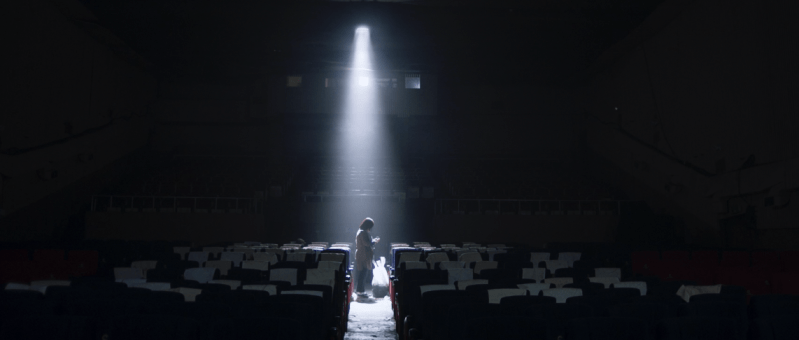
Playing out like a ghost story, Ji-wan is almost literally haunted by Hong’s silhouette in her elegant trench coat and hat, at several moments hearing someone shout “let me out” as if pleading with her to release Hong’s spirit from within the sealed film cans of her almost forgotten feature. Meanwhile she’s spiritually haunted by the discovery of a woman’s body in a car parked outside her apartment building which had not been discovered for some months, a pretty photo of a young woman sitting on her dashboard perhaps of the woman herself or of a daughter, sister, friend but either way a poignant reminder of a life extinguished which Ji-won worries may have been that of her next-door neighbour whose crying she sometimes heard through the walls. On meeting some of those who once knew Hong, each at some point laments that they are the only ones left who remember that time while Ji-wan gets her epiphany in a soon to be torn down cinema with a hole in the roof raining down light into an empty auditorium,. 

Surrounded by unsupportive men from her grumpy husband (Kwon Hae-hyo) to surprisingly chauvinistic son (Tang Jun-sang) who declares himself “love-starved” while echoing the words of those around him that her desire to chase her dreams is “selfish”, Ji-wan is beginning to feel as if she’s disappearing too while finding herself forced to re-confront her notions of femininity in approaching the menopause combined with an unexpected medical crisis. Things aren’t quite as bad for her as they were for Hong, at least no one’s ever thrown salt at her as Miss Lee (Lee Joo-Sil), Hong’s friend and editor, recounts, but she’s less than surprised on hearing that Hong had kept the existence of her daughter secret from her colleagues fearful they’d never let her direct if they knew she was a mother. The film Ji-wan is trying restore is based on the true story of Korea’s first female judge who was in fact murdered by her husband, though the film envisages a more positive ending if within the limits of contemporary patriarchy in insisting that a career is not incompatible with fulfilling the expectations of traditional femininity in caring for her in-laws, husband, and children. Ironically enough, Korea’s first film director Park Nam-ok had been forced to film with her baby on her back but completed just one feature which survives only in incomplete form. 

Many films are presumed lost from Korea’s golden age not just those directed by women, but the particular lack of respect shown towards the films of Park and Hong is particularly upsetting to Ji-wan who later discovers that to add insult to injury old film stock was often mined for its silver content and then sold off to be used as hatbands other such frivolous material. No one really valued these films very much when they were made, so no one made much of an effort to preserve them just like no one is making much of an effort to save the ruined the cinema where she chases the ghost of Hong, the embittered projectionist eventually giving in to Ji-wan’s enthusiasm as she holds up the 8mm film she’s discovered to the light pouring though its ceiling. A beautifully haunting cinematic mystery, Shin’s melancholy drama eventually allows its heroine to reclaim her love for cinema along with her self-confidence as a filmmaker through the restoration of the past finding a kindred spirit in the long departed Hong unfairly denied not only the acclaim she deserved but the artistic possibility to which she should have been entitled. 


Hommage screened as part of this year’s Glasgow Film Festival.

Original trailer (English subtitles)