Iwane: Sword of Serenity (居眠り磐音, Katsuhide Motoki, 2019)

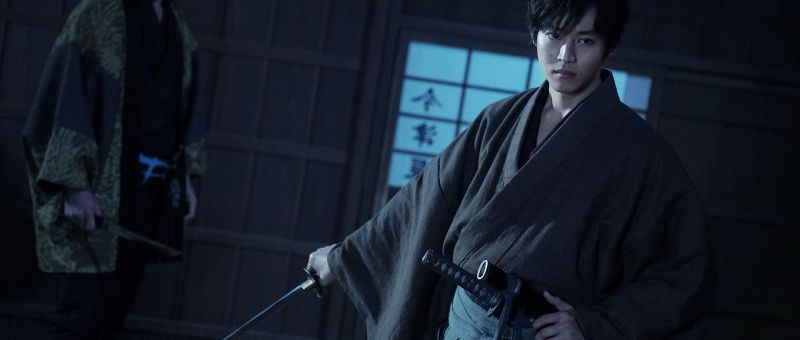
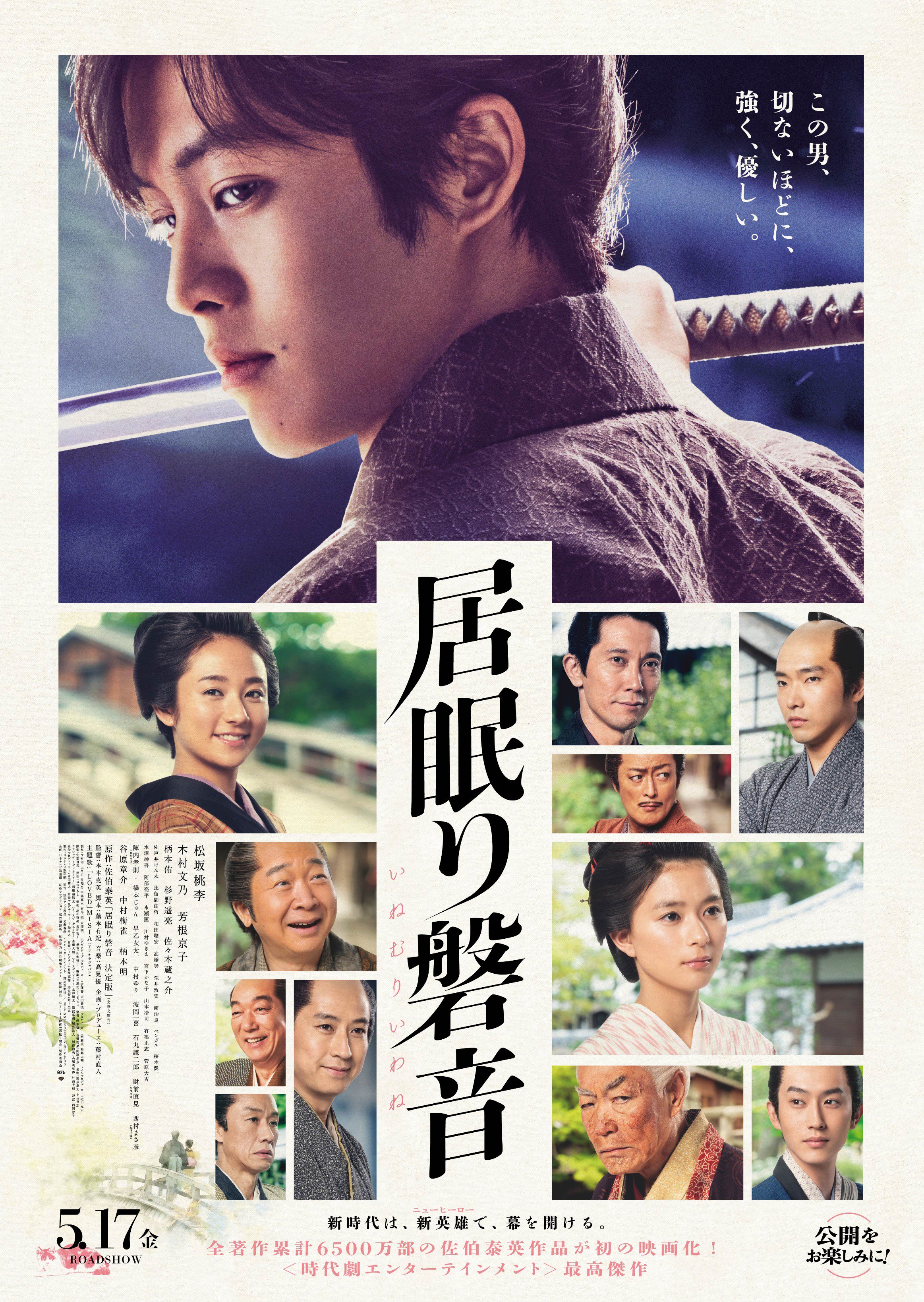
The contradictions of the samurai code conspire against one noble-hearted young man in Katsuhide Motoki’s adaptation of the long running series of historical novels by Saeki Yasuhide, Iwane: Sword of Serenity (居眠り磐音, Inemuri Iwane). Yet this truly serene samurai is a stoical sort, learning to bear his pain with fortitude while standing up for justice in an increasingly corrupt Edo where money rules all while an ascendent merchant class continues to challenge the fiercely hierarchical social order. 

Beginning in 1772 which turned out to be a disastrous year, the tale opens as hero Iwane (Tori Matsuzaka) prepares to return home after completing his three year rotation in Edo in the company of childhood friends Kinpei (Tasuku Emoto) and Shinnosuke (Yosuke Sugino). Shinnosuke is in fact married to Kinpei’s sister Mai, while Iwane will himself be married to Kinpei’s other sister Nao immediately on his return so close are they. As Iwane’s father tells him, there are great hopes for these young men that they can “turn our outdated clan around”, but events will conspire against them. Spoiling the happy homecoming, Shinnosuke is accosted by a drunken uncle who convinces him Mai has been unfaithful in his absence with the consequence that he kills her immediately on his return home. Unable to understand this turn of events, Kinpei confronts his friend but eventually kills him, while Iwane is then forced to kill Kinpei after he goes on murderous rampage in revenge for the wrong done to his sister. 

In trying to mediate the case, the argument is put forward that Shinnosuke acted rashly and should have brought his suspicion to the authorities rather than opting for summary execution. The lord however disagrees, condoning Shinnosuke’s actions under the rationale that to do so would have been considered “weak minded” while as Shinnosuke himself had claimed he acted in accordance with the samurai code in which female adultery is illegal and punishable by death. By contrast, he finds Kinpei’s rashness offensive, insisting that he also should have recognised the legitimacy of his sister’s murder and simply left quietly with her body. Having learned the truth in which his childhood friends became victims of clan intrigue, romantic jealousy, and tragic misunderstandings in this Othello-like plot, Shinnosuke and childhood sweetheart Nao are also consumed by the rashness of samurai law each exiled from their clan and cast adrift in Edo-era society. 

Edo-era society is however also itself corrupt. Some months later, Iwane has returned to Edo as a lowly ronin lodging with a kindly old man, Kinbei, who helps him find a job firstly gutting eel then as a bodyguard at a money exchange which has been receiving anonymous threats they assume are from rival broker Awaya who has hatched a nefarious plan to manipulate the currency market to stop the current Shogun introducing a new unit which can be used in both Edo and Kyoto which would understandably cut into his already corrupt business model. Luckily, Imazuya is an honourable man who backs the new currency plan and wants to do the right thing which makes him a perfect fit for Iwane’s innate sense of justice. “You don’t know the way of the merchant” Awaya snaps at him, suggesting both that the samurai are already on their way down as the merchants rise and that his unwillingness to play dirty will be his downfall. Nevertheless, Iwane is the type to adapt quickly, instantly coming up with a way to play Awaya at his own game and kick his destructive amoral capitalism to the curb. 

Meanwhile, he continues to pine for Nao while drawing closer to Kinbei’s earnest daughter Okon (Fumino Kimura). As we discover Nao is also a victim of an intensely patriarchal social order but through the tragedy that befalls them also finds strength and agency making a life changing decision that allows her to become independent while looking after her family if in the knowledge that the childhood romance she shared with Iwane is a thing of the past. Iwane too agrees that he is trapped in a living hell of guilt and grief, yet choosing to go on living anyway as calm and cheerful as he’d ever been while standing up to Edo-era corruption though uncomfortably enough this time against the destabilising influence of the rising merchant class and therefore in contrast to most jidaigeki reinforcing the legitimacy of the samurai order which has paradoxically also ruined his life with its rigid and implacable social codes. In any case, Motoki’s classic chanbara melodrama has a serenity of its own as the cheerfully laidback hero resolves to live his life by a code of his own free of samurai constraint. 


Trailer (no subtitles)
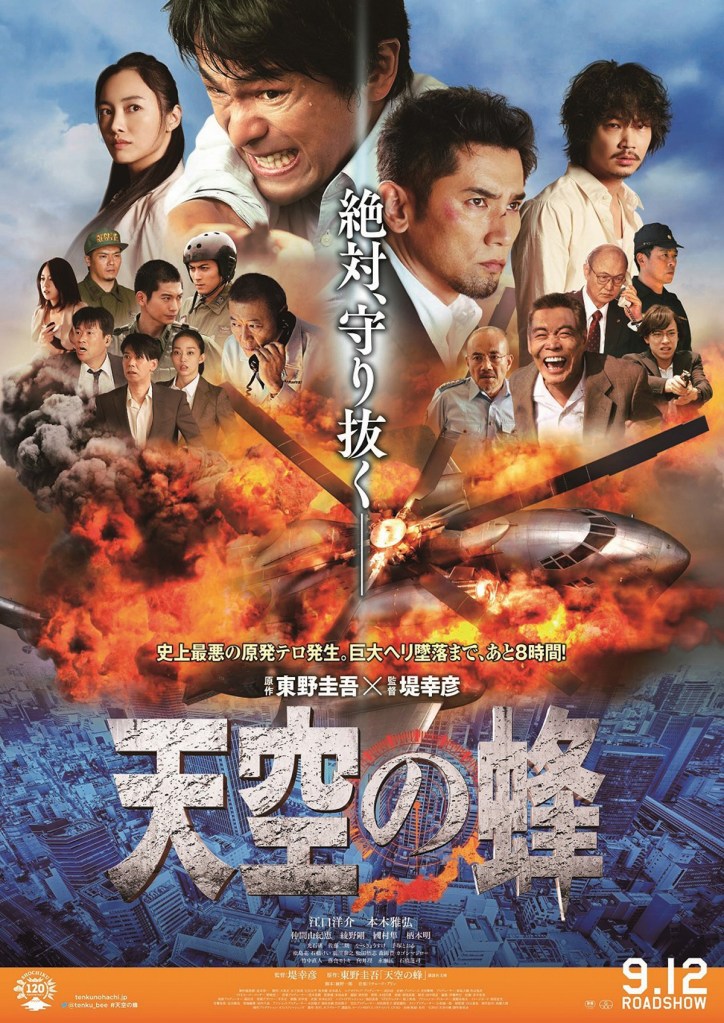
The Big Bee (天空の蜂, Yukihiko Tsutsumi, 2015)

Blockbuster cinema wades into the anti-nuclear debate in a characteristically ambivalent take from prolific author Keigo Higashino adapted from his 1995 novel. Brought to the screen by blockbuster master Yukihiko Tsutsumi, The Big Bee (天空の蜂, Tenku no Hachi) is less wedded to its anti-nuclear message than it might at first seem, eventually sliding into a more comfortable tale of failed fathers redeemed with a potentially ambiguous coda that perhaps undercuts much of what has gone before . 

The main action takes place on 8th August, 1995 which falls between the 50th anniversaries of the atomic bomb attacks on Hiroshima and Nagasaki and is also a few months after the devastating earthquake in Kobe. Engineer Yuhara (Yosuke Eguchi) is about to unveil the “Big Bee”, Japan’s largest ever helicopter built with state of the art technology. He’s brought along his wife and son, but it’s clear there is discord in the family and neither of them are very impressed that the security guard didn’t even seem to know who he was so perhaps he’s not such a big shot after all. While his wife Atsuko (Kei Ishibashi) takes their son Takahiko (Shota Taguchi) and another boy to get a drink from the vending machine, Yuhara talks things over with a colleague and reveals that his workaholic lifestyle has destroyed his family life. He’s about to be divorced and doesn’t seem particularly cut up about it. Asked what’s going to happen to Takahiko, Yuhara cooly explains that it’s best he stays with his mum because he isn’t capable of being a good father to him. Unfortunately, Takahiko overhears him say that he’s essentially planning to abandon him and runs off to explore on his own, eventually sneaking aboard the helicopter which is then hijacked by a mysterious villain via remote control who flies it over a nuclear power plant and gives the Japanese government the eight hours before the fuel runs out to agree to shut down all the nuclear power plants in Japan. 

Yuhara’s failure as a father is immediately brought home to him when his son manages to throw the other boy, who climbed in with him but got injured, to safety, but doesn’t trust his dad enough to jump himself after hearing him say he was going to abandon him to his mother. Yuhara, meanwhile, was able to jump and grab the ramp of the helicopter but not to climb up and reach his son. He has to accept that his failure as a father and in consequence as a man is complete and total. His quest to save Takahiko is also a quest to redeem himself in the eyes of his society and avoid being branded as a man who sacrificed his family for a career and was finally unable to protect them.

Yet, at the present time, he’s also trying to save a nation while in the place of a father. To his mind, he built the Big Bee as a rescue craft, but its usage is most obviously military. He and his former colleague Mishima (Masahiro Motoki) see themselves as neutral engineers interested in technology but not particularly in its application. The government is reluctant to shut the plants down not only because cutting the power is extremely inconvenient and damaging to the economy, but because they do not wish to reopen the nuclear debate and risk the general populace realising that nuclear power is not entirely “safe”. Of course, this has extreme resonance in light of the Fukushima disaster, the government wilfully putting lives at risk in order to safeguard its own ends in refusing to issue an evacuation order for a potential disaster area covering all of the nation’s major cities right across the centre of the Japanese mainland.

This cavalier approach to human life extends to those working in the plants. We’re quickly introduced to a middle-aged woman whose son died of leukaemia she believes caused by lax safety procedures while the prime suspect is a friend of his (Go Ayano) who may also be suffering from a terminal illness caused by exposure to radiation after working as a cleaner at the power station. He vows revenge on a society which has rendered him “disposable”, thrown away like used tissue and left to fend for himself only because he was born into socio-economic circumstances which left him with no other choice than to take a “dangerous” job for employers that failed to protect him in much the same way Yuhara has failed to protect his son. 

The farmers in the town where the plant has become the major source of employment complain that no one wanted it but everyone needed the money. One leans into the mild message that perhaps we take our electric lives for granted, plugging in our toothbrushes without really thinking of the costs incurred in how we generate our power. Hotels dim their lights and switch off elevators while guests complain of the heat in the absence of aircon, but didn’t we manage OK before the power grid? Perhaps so, but our lives have changed. It might be as well to think again if those changes are really as good for us as we think they are, but you can’t turn back the clock. 

Not even the villain really wants the clock turning back, just better accountability and proper governance that puts the lives of citizens ahead of economic gain. Then again, a lot of this is personal, an act of self harm rebranded as revenge taken in atonement for the failures of a father. In this respect Yuhara may redeem himself, but there’s a note of discomfort in the jump to 2011 and the Fukushima disaster which doesn’t so much shout “I told you so” as over rely on the heroic efforts of the Self Defence Force as they battle a disaster which the powers that be from the government to the power company have failed to prevent. Yuhara wonders if the country is worth dying for and is comforted only in a trick he taught his son to calm his anxiety in the wake of the Kobe earthquake, tapping out “I am here” in morse code as an affirmation of survival which might also serve to say the work goes on even while “fathers” continue to fail in their responsibilities. 


Hong Kong release trailer (English subtitles)