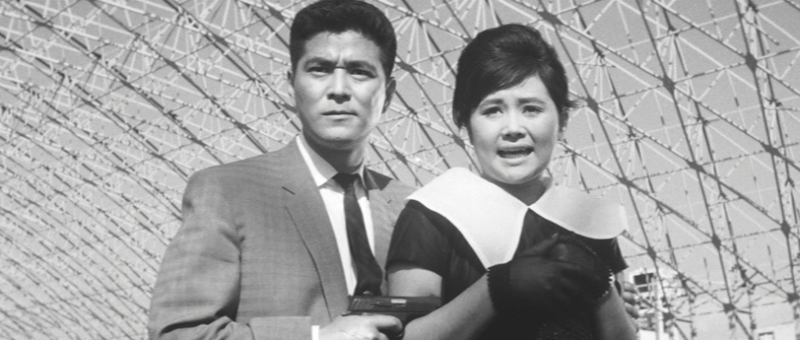
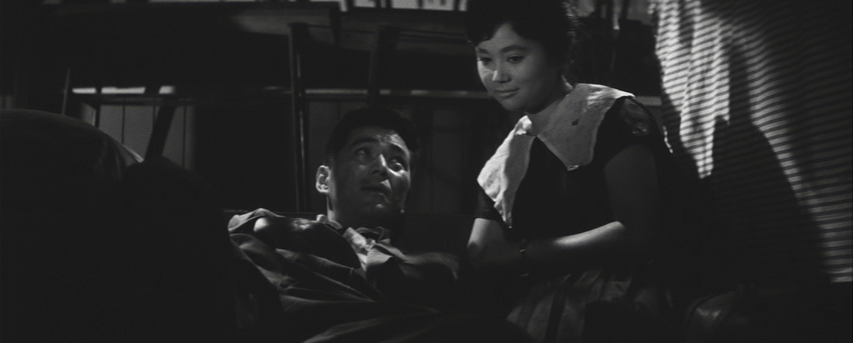
Procurer of Hell (地獄の饗宴, Kihachi Okamoto, 1961)

By 1961, the Japanese economy had largely recovered and the nation was emerging into an era of rising prosperity, but there were also those who were left behind or could progress into the new Japan. Shot with Okamaoto’s trademark irony, Procurer of Hell (地獄の饗宴, Jigoku no Kyoen) is a darkly comic tale of one such man who could have quit while he was ahead and started a new life if only he hadn’t been so greedy or perhaps so hung up on revenge. 

In a sign of the newly international society, Tobe (Tatsuya Mihashi) runs a shady business that claims to provide “English lessons” with blonde women are that are in reality appointments with sex workers. He also peddles pornographic images and dabbles in blackmail. When he finds a roll of film at the station, he gets it developed and discovers it contains photographs of his sergeant during the war, Itami (Jun Tazaki), who raped the Chinese woman he wanted to marry back in Manchuria. Tobe was unable to help her after getting his hand impaled on a tree branch from which he could not free himself. The scar he still bears on his hand is a mark of his corruption and a reminder of the moment which seems to have soured him on humanity and turned him into a cynical and amoral man. He decides to use the photographs to torment and blackmail Itami to get the money to help a widowed single mother he’s interested in secure a better future for herself by taking over a coffee shop from the owner who plans to retire.

As such, he does it for “good” reasons and Kazuko (Junko Ikeuchi) and her son Saburo represent for him a better future in the new Japan in which he would own a photo studio and live a law-abiding life. Saeko (Reiko Dan), Itami’s secretary with whom he was also having an extra-marital affair, is in other ways his opposite number and the representative of the dark side to which Tobe is drawn. Like him, she tries to play the situation to her advantage by playing the innocent before finally throwing her lot in with Tobe and suggesting he help her double-cross Itami so they can run off with the money he embezzled from his company before faking his own death in a convenient train crash. That Tobe extracts sexual favours from Saeko in return for giving her the photos and negatives interferes with the supposed nobility of his quest and apparently pure-hearted love for Kazuko and her little boy, while Saeko gradually shifts from exploited victim to calculating conspirator manipulating Tobe just as he believes himself to be manipulating her.

In any case, it remains true that he could have just settled for the money he needed for the cafe and walked away from this overly complicated situation involving Itami’s legal wife and associates who have actually embezzled the money and want the pictures back because they need Itami to be dead for their plan to work, but he doesn’t. He becomes fixated on getting his fair share of the ill-gotten gains much more than helping Kazuko or getting his revenge against Itami, which wasn’t really much of a revenge anyway considering what Itami had actually done during the war. But on the other hand, Itami seems to have become a rather powerless figure having married into his wife’s family to work in their business while she plots to have him confined to a psychiatric hospital to keep him out of her way. Saeko too is manipulating him. She has no real feelings for Itami and only wants the money, masterminding this whole scheme to get her hands on it with no intention of fleeing abroad with him. Similarly, she plays the victim with Tobe, telling him that Itami paid for her brother’s school fees and that she wants the photos back to avoid her brother or Mrs Itami finding out it about it and feeling hurt.

But while they’re fixating on the 150 million yen embezzled from the business, there are crowds of angry people turning up at the building society Itami runs complaining that their savings have disappeared and wanting to know if they’re going to get the houses they’ve been promised. Tobe walks through the May Day protests calling for better working conditions and higher wages, pointing to the ways this society is still veering off course in deliberately leaving some-people behind by rooting the new economic prosperity in exploitation. Tobe’s assistant wants to join the protest, but Tobe tells him they don’t really belong with the workers because of their nature of their business. The blackmail scam is his revenge not only on Itami but on everything that’s happened to him since the war and this ridiculous post-war society that he nevertheless hopes to join through these immoral means. The song of the canary he buys for Saburo begins to haunt him as a symbol of the wholesome life he might lead, but that life cannot really be won that way. He and Saeko are really two of a kind, she apparently brought low by her unexpectedly genuine feelings for him as even the police, picking him up for something else, leave them bleeding in the street surrounded only by emptiness and futility mere feet from the hospital in their own relentless pursuit of the “real” criminals.
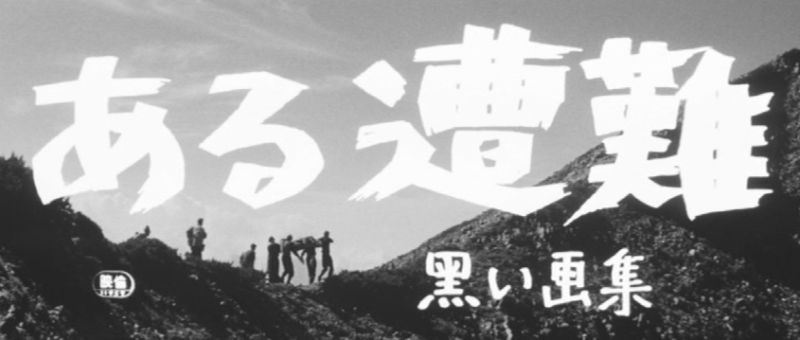


Death on the Mountain (黒い画集 ある遭難, Toshio Sugie, 1961)

Death on the Mountain DVD coverThere can be few films with as accurate a title as Death on the Mountain (黒い画集 ある遭難, Kuroi Gashu: Aru Sonan) , but Toshio Sugie’s 1961 psychological melodrama certainly makes good on its promise. The Japanese title of the film is prefaced by “The Black Album” which is a title given to a series of novellas penned by one of Japan’s most prominent mystery writers, Seicho Matsumoto, whose work was frequently adapted for the screen including eight collaborations with director Yoshitaro Nomura of such well known mysteries as Zero Focus and Castle of Sand. Death on the Mountain was, like the others in the Black Album series, serialised in Shukan Asahi, in this case between 5th October and 14th December 1958 under the title “Sonan”. “Sonan” literally means “distress” or “disaster”, but it has another telling association – “Sonanshi”, meaning “accidental death” such as might occur while mountain climbing, sailing, or engaged in some other dangerous yet normalised activity. The death at the centre of Death on the Mountain is accidental in once sense, but very much not in another.

The film begins with a body being winched from a lower platform back up to a snowy ridge. Iwase (Kiyoshi Kodama), an experienced mountain climber, has perished in a freak accident. Packed inside his backpack, Iwase’s body is burned at the foot of his beloved mountains while his mother looks on sadly, his sister Masako (Kyoko Kagawa) angrily wondering how her brother, a true mountain man, could have died in such a bizarre way while a much less experienced climber, Urahashi (Takashi Wada), survived. The secret may lie with the leader of the expedition, Eda (Hisaya Ito), who has been looking sheepish ever since the incident but otherwise comports himself in a cool, detached manner.

Like many of Matsumoto’s mysteries, Death on the Mountain turns on a secret but Sugie’s adaptation never seriously considers that Eda is not in someway at fault or questions that Urahashi’s recollection of events, published in a popular mountaineering journal, is anything other than accurate. The facts, as laid out firstly by Urahashi’s article, state that Iwase had not been himself on the day of the climb. Eda had treated them all to first class sleeper cabins but Iwase spent the night drinking, chain-smoking and brooding, meaning he was tired before they even arrived at the mountain. He didn’t sleep at the inn either because of someone whispering all night long and needed to take frequent rests during the early part of the climb. Resting is, however, dangerous – as is excessive thirst, and Iwase spent a lot of time guzzling water and sitting down all of which made him even more exhausted. Coupled with a turn in the weather which left him cold and wet, Iwase’s exhaustion got the better of him and he finally lost his mind. At least, that’s the way Urahashi described it, and Eda seems not to dispute his version of events even if the failures – not bringing a map for both mountains they intended to climb but only one, pressing on despite the weather, and mistaking the trail back to the standard path, all rest squarely with him.

Japanese mysteries by and large are much more concerned with the how rather than the why, though in Death on the Mountain the how is a much greyer area than one might assume. As Masako’s cousin, an experienced mountaineer himself, points out, Iwase’s death was caused by a series of unfortunate circumstances but that doesn’t necessarily preclude that there was ill will or that someone didn’t help the “unfortunate circumstances” along in the hope that they would lead to the “accidental death” of the title. There was, therefore, not quite a murder but definitely a lot of ill will and gentle coaxing towards an act of guilty self destruction. As for the why, well that turns out to be far less interesting and suitably petty. Morally speaking, the act of “murder” becomes moot, though the “murderer” finally meets justice head on, only for the tale to end on a note of ambiguity as Masako, whose investigations have resulted only in further deaths, blames herself for daring to disturb the peace. If she’d only have let the “murder” of her brother lie, no one else would have died. Is Masako now an accidental “murderess” or a frustrated seeker of justice? Whatever the answer, all her efforts have been in vein.

Death on the Mountain was previously adapted as a TV drama shortly after the novel’s release, broadcast between 31st August and 7th September 1959, though presumably with lesser production values than Sugie’s admittedly minimal yet authentically detailed exploration of modern mountaineering. Shooting on location and making much of crunching snow, swirling fog, and pelting rain, Sugie runs high on atmosphere but fails to capitalise on the noirish sense of malevolence that lies at the centre of Matsumoto’s mystery, that evil can come dressed as kindness and the line between murder and accident is much thinner than might otherwise be presumed. Matsumoto seems to want to ask a few questions about causality and personal responsibility, the degree to which a man’s death is his own failing, how much the fault of “unfortunate circumstance”, and how much ill intentions from the world around him. Sugie, however, is content to let the suspense peter out with the solution offered in true detective style through a suppositional monologue delivered in front of the presumed murderer but for the audience’s benefit. Nevertheless, even if the mystery falls flat the mountain air rings true and Sugie has, at least, captured something of nature’s awesome power and terrifying beauty.